Legislative Intelligence: Reconstituting Legislative Power in Pakistan




Text view shows the paper as plain, searchable text. Tables, figures and page layout are shown in Pages view and in the PDF.
K S C . J U S N R E M I N T E L L I G E N C E S E R I E S · P O L I C Y P A P E R · I S S U E I · 2 0 2 6 Legislative Intelligence
Reconstituting Legislative Power in Pakistan
Author: Khurram Chughtai.
An independent KSC.JUSNREM think-tank publication. Its proposals do not require prior institutional adoption to be published; any later official implementation follows the legal procedures applicable to that institution.
First published November 2026. Sources examined through 31 October 2026, with later checks dated in the notes.
Cite as: Khurram Chughtai, Legislative Intelligence: Reconstituting Legislative Power in Pakistan (KSC.JUSNREM Policy Paper, Issue I, 2026)
Companion paper in the series: Khurram Chughtai, Sovereign Intelligence for Pakistan: Constitutional capability, knowledge and accountable public action (KSC.JUSNREM Policy Paper, Issue I, 2026).
ksc-jusnrem.io · jusnrem.digital
LEGISLATIVE INTELLIGENCE Contents
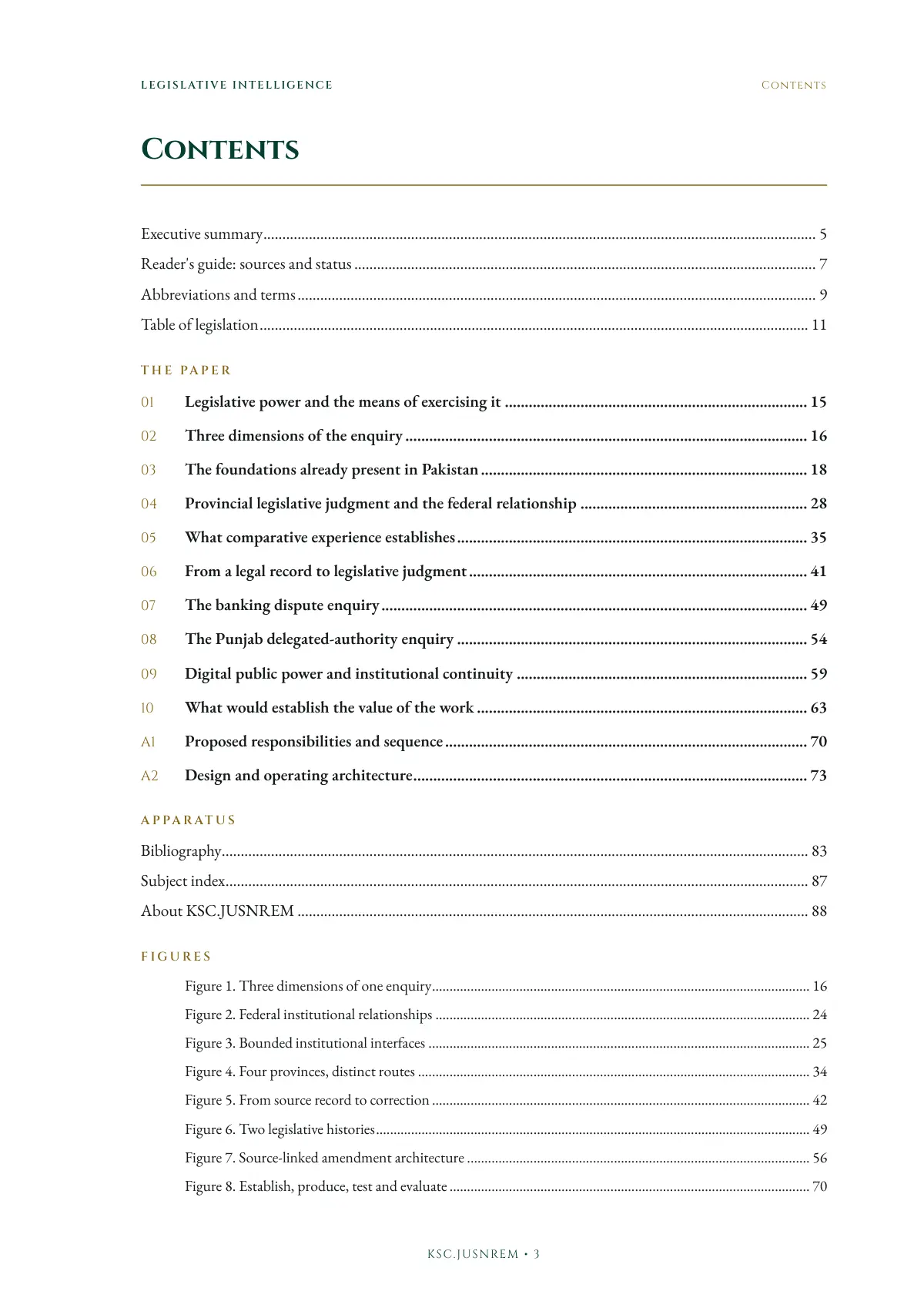
Contents
Executive summary .................................................................................................................................................. 5
Reader's guide: sources and status .......................................................................................................................... 7
Abbreviations and terms ......................................................................................................................................... 9
Table of legislation ................................................................................................................................................. 11
T H E PA P E R
01 Legislative power and the means of exercising it ............................................................................ 15
02 Three dimensions of the enquiry ..................................................................................................... 16
03 The foundations already present in Pakistan .................................................................................. 18
04 Provincial legislative judgment and the federal relationship ......................................................... 28
05 What comparative experience establishes ........................................................................................ 35
06 From a legal record to legislative judgment ..................................................................................... 41
07 The banking dispute enquiry ........................................................................................................... 49
08 The Punjab delegated-authority enquiry ........................................................................................ 54
09 Digital public power and institutional continuity ......................................................................... 59
10 What would establish the value of the work ................................................................................... 63
A1 Proposed responsibilities and sequence ........................................................................................... 70
A2 Design and operating architecture ................................................................................................... 73
A P PA R AT U S
Bibliography ........................................................................................................................................................... 83
Subject index .......................................................................................................................................................... 87
About KSC.JUSNREM ....................................................................................................................................... 88
F I G U R E S
Figure 1. Three dimensions of one enquiry ............................................................................................................ 16
Figure 2. Federal institutional relationships ........................................................................................................... 24
Figure 3. Bounded institutional interfaces ............................................................................................................. 25
Figure 4. Four provinces, distinct routes ................................................................................................................ 34
Figure 5. From source record to correction ............................................................................................................ 42
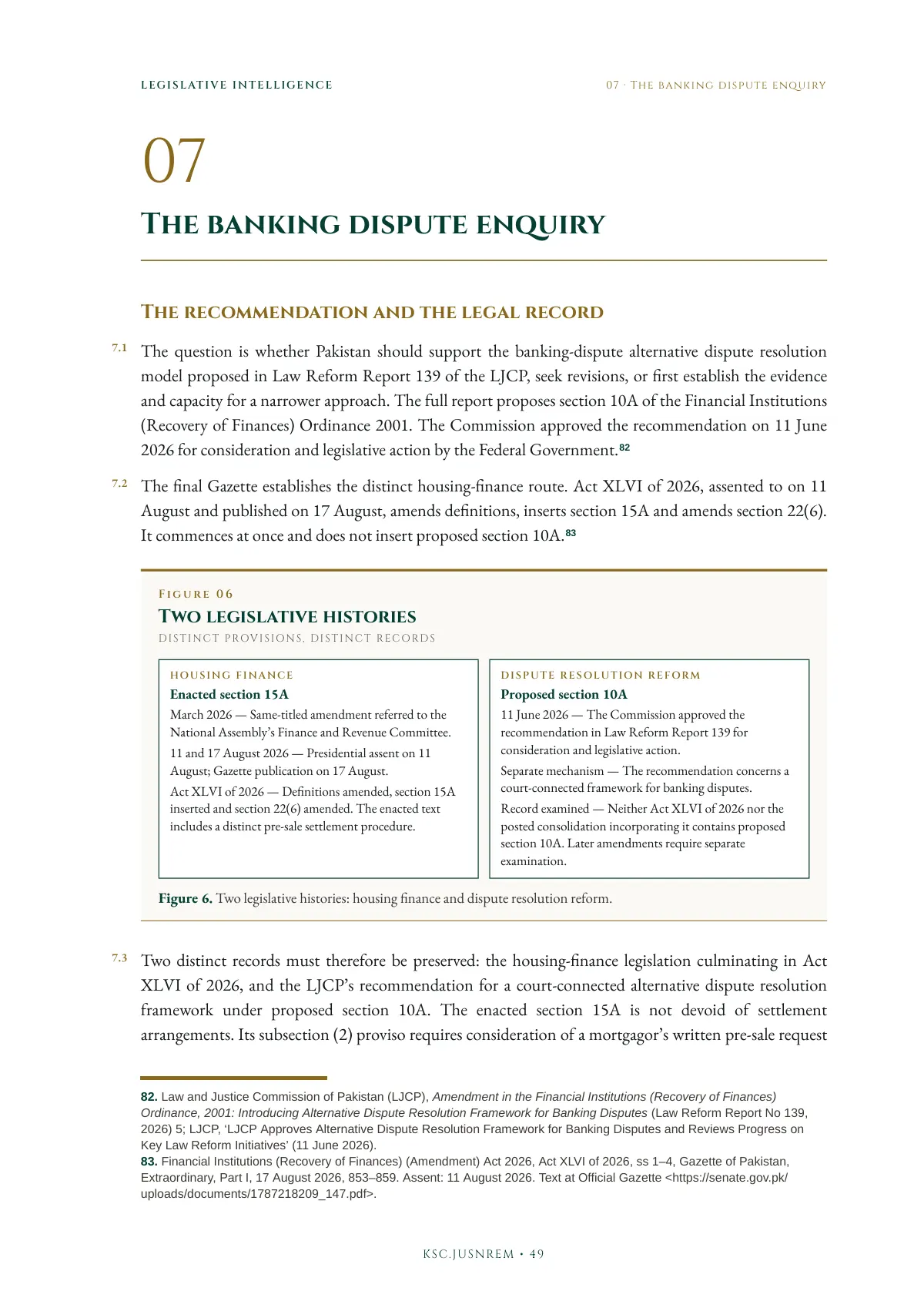
Figure 6. Two legislative histories ............................................................................................................................ 49
Figure 7. Source-linked amendment architecture .................................................................................................. 56
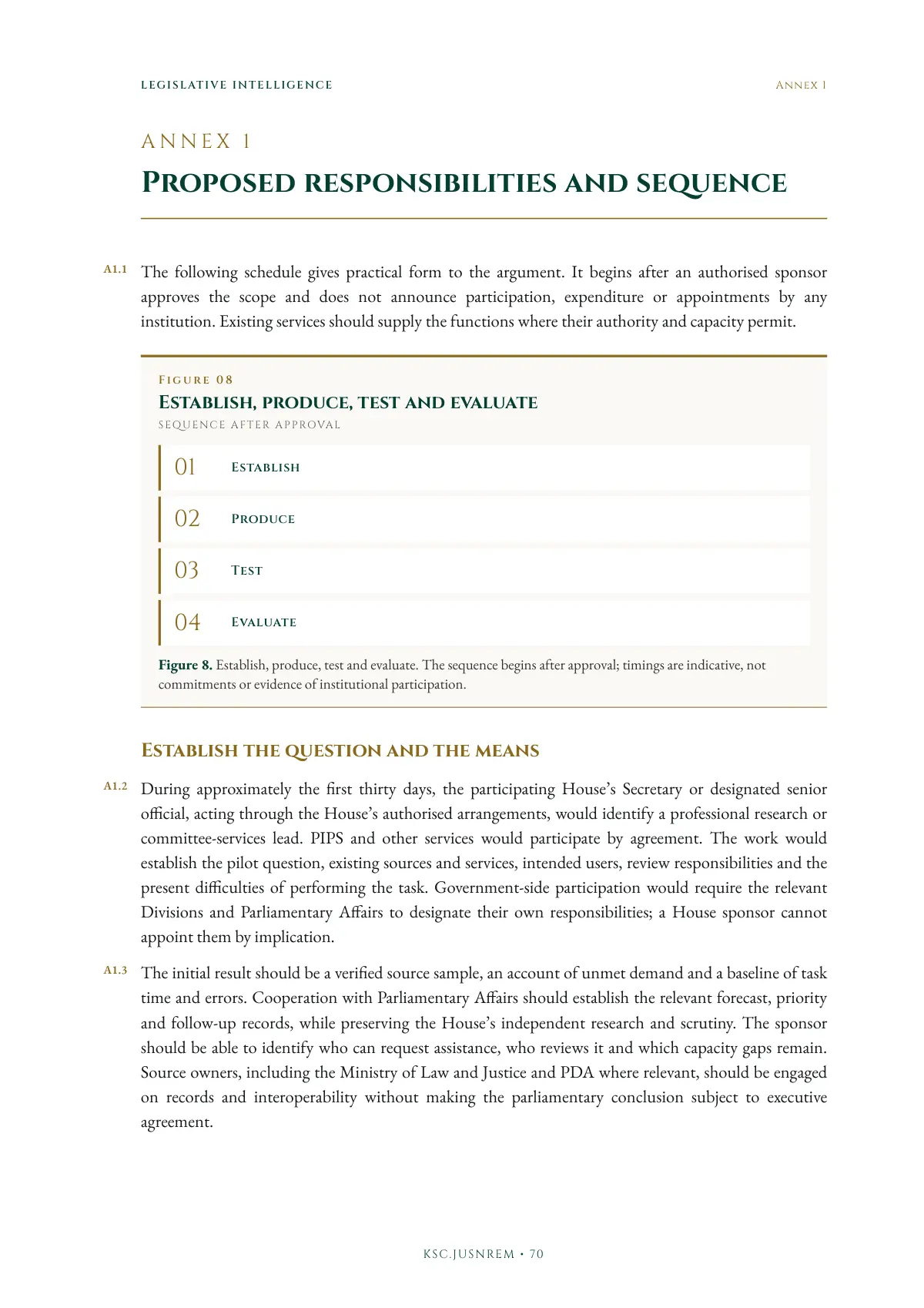
Figure 8. Establish, produce, test and evaluate ....................................................................................................... 70
LEGISLATIVE INTELLIGENCE Contents
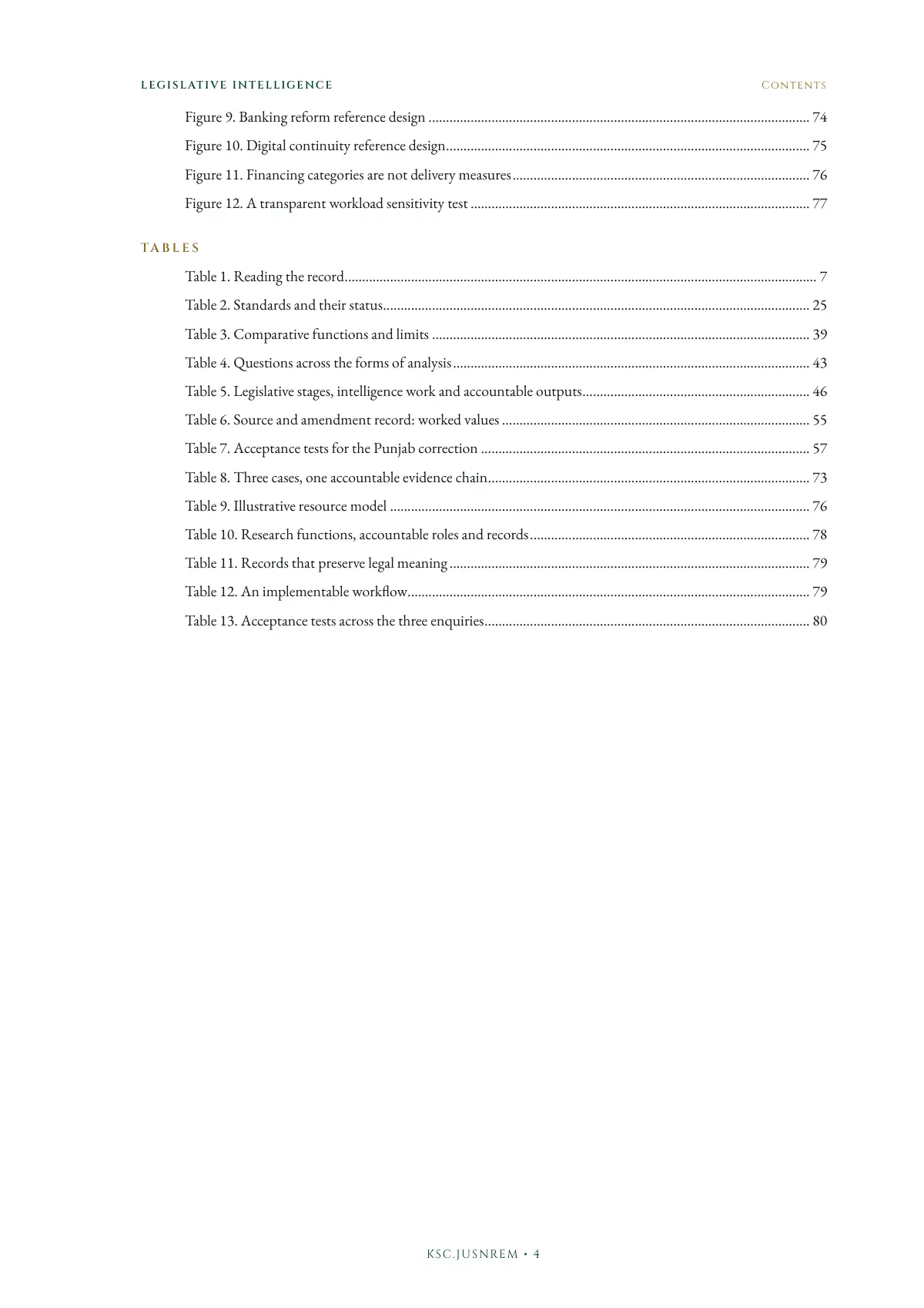
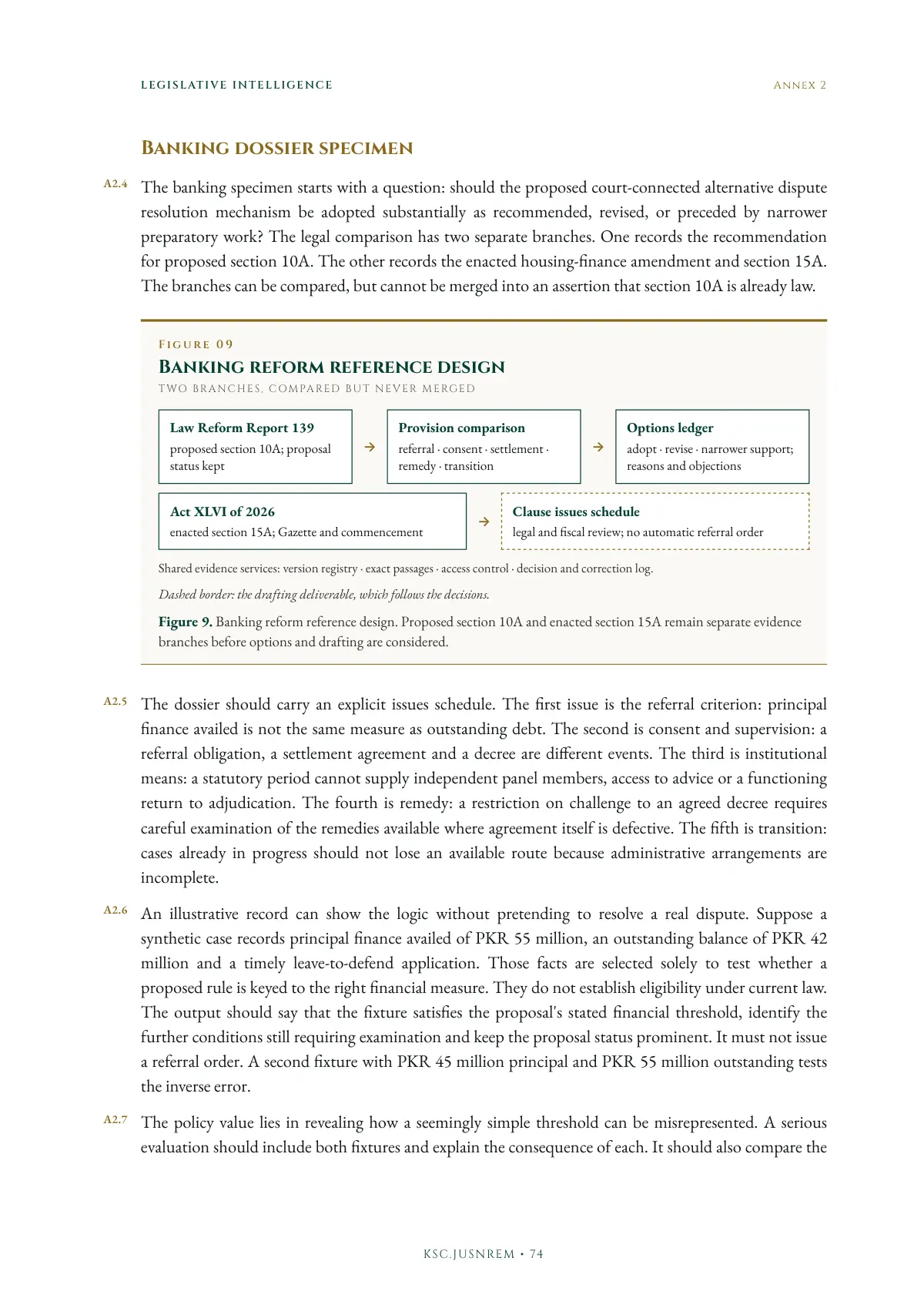
Figure 9. Banking reform reference design ............................................................................................................. 74
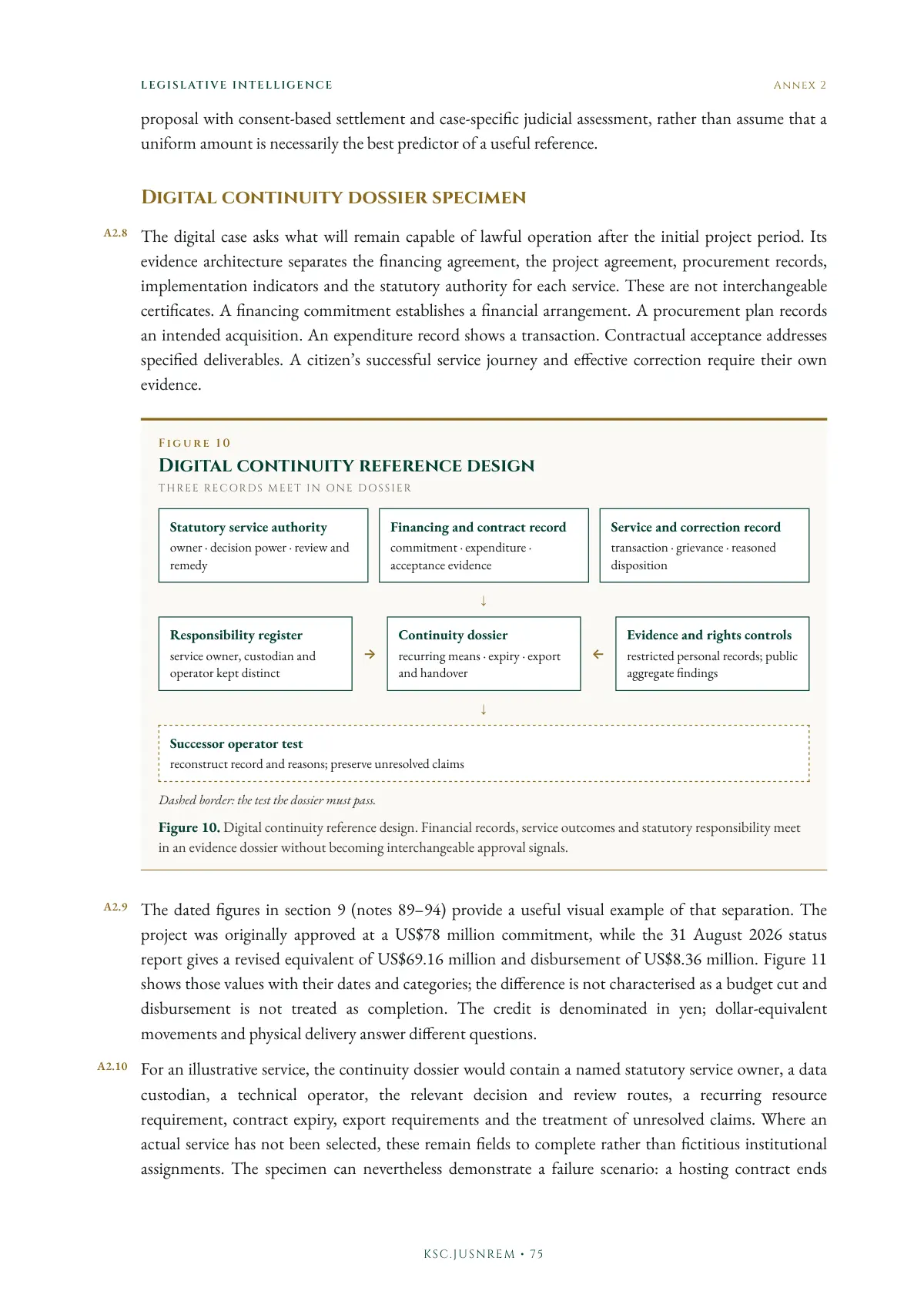
Figure 10. Digital continuity reference design ........................................................................................................ 75
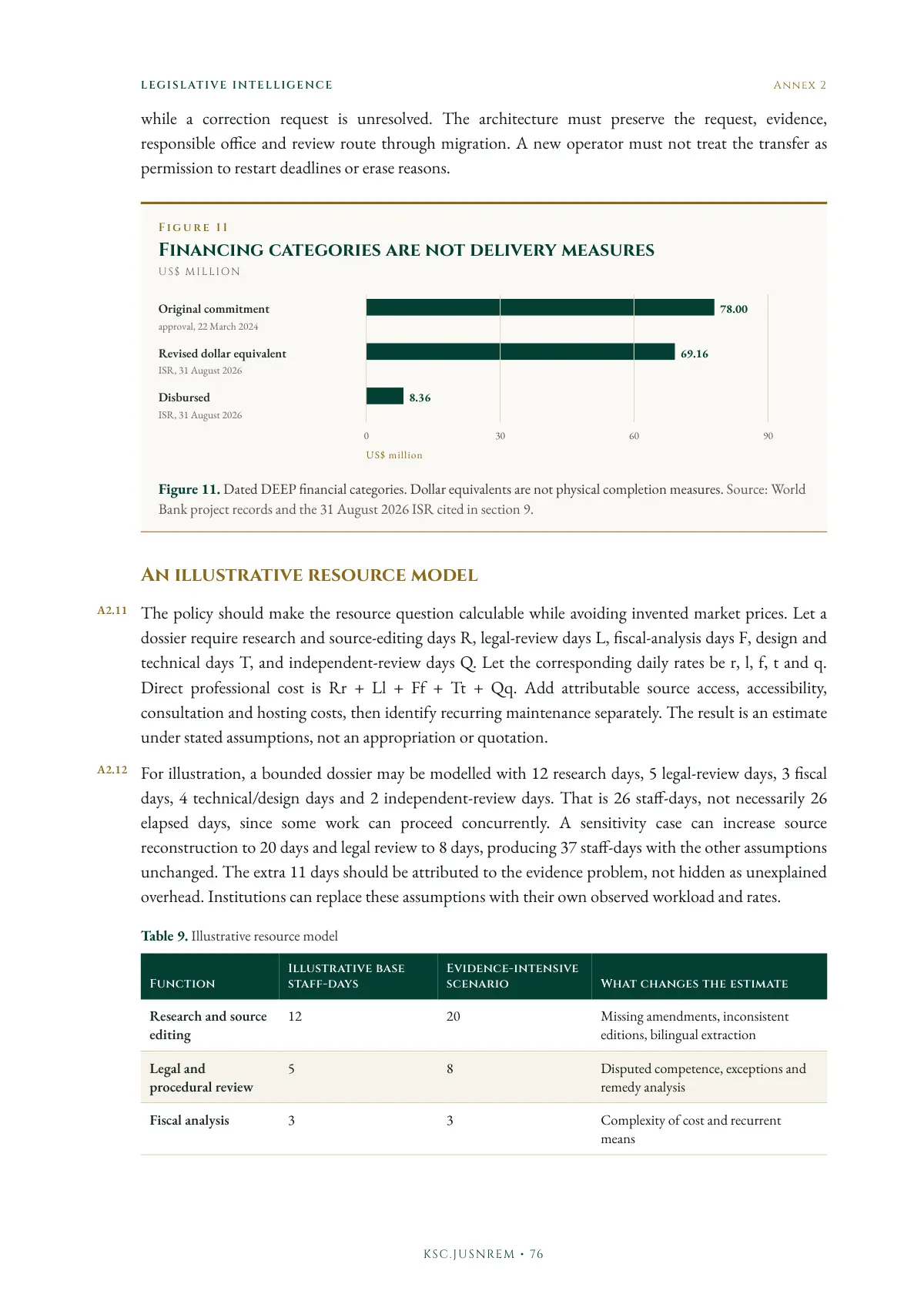
Figure 11. Financing categories are not delivery measures ..................................................................................... 76
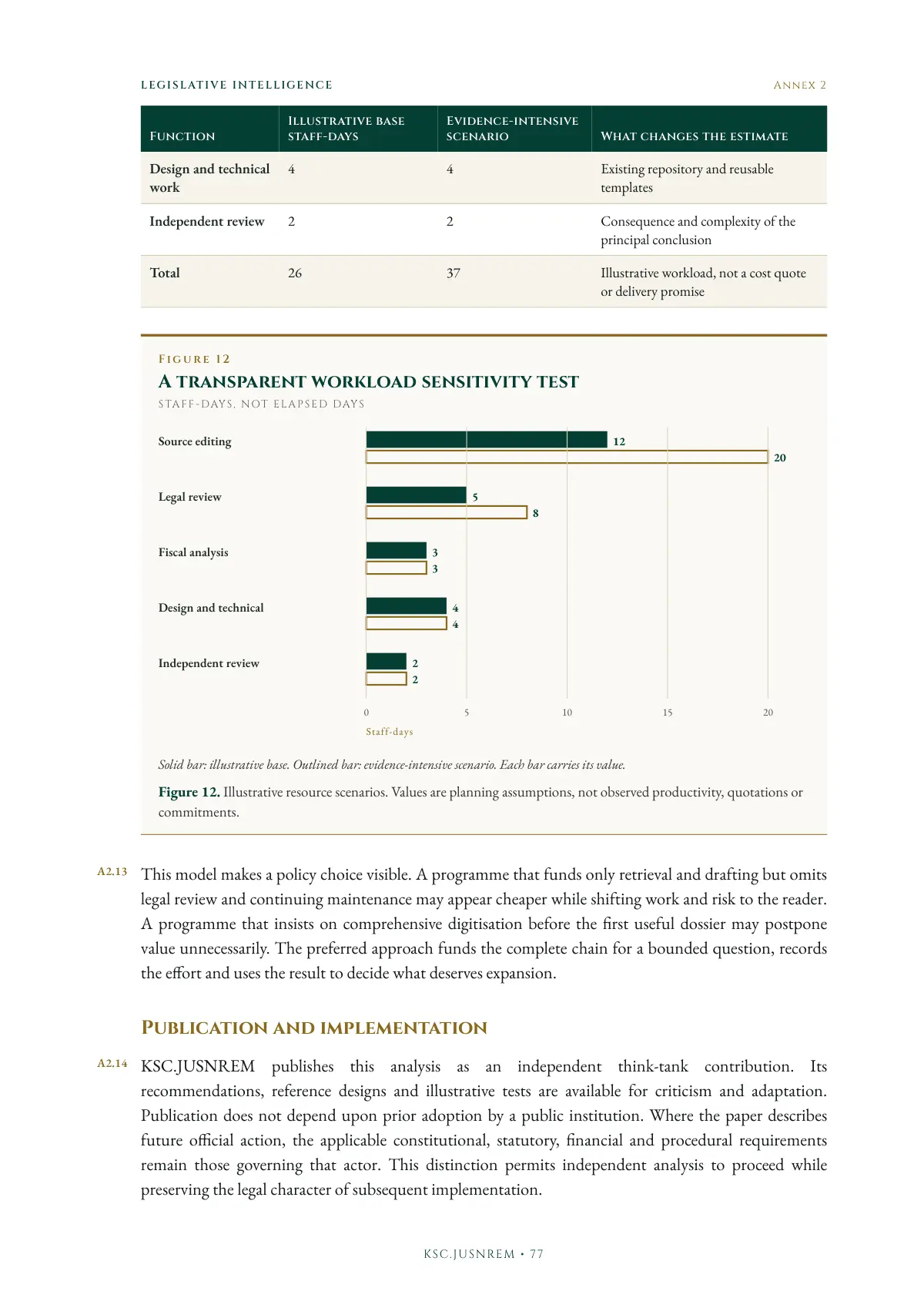
Figure 12. A transparent workload sensitivity test ................................................................................................. 77
TA B L E S
Table 1. Reading the record ....................................................................................................................................... 7
Table 2. Standards and their status .......................................................................................................................... 25
Table 3. Comparative functions and limits ............................................................................................................ 39
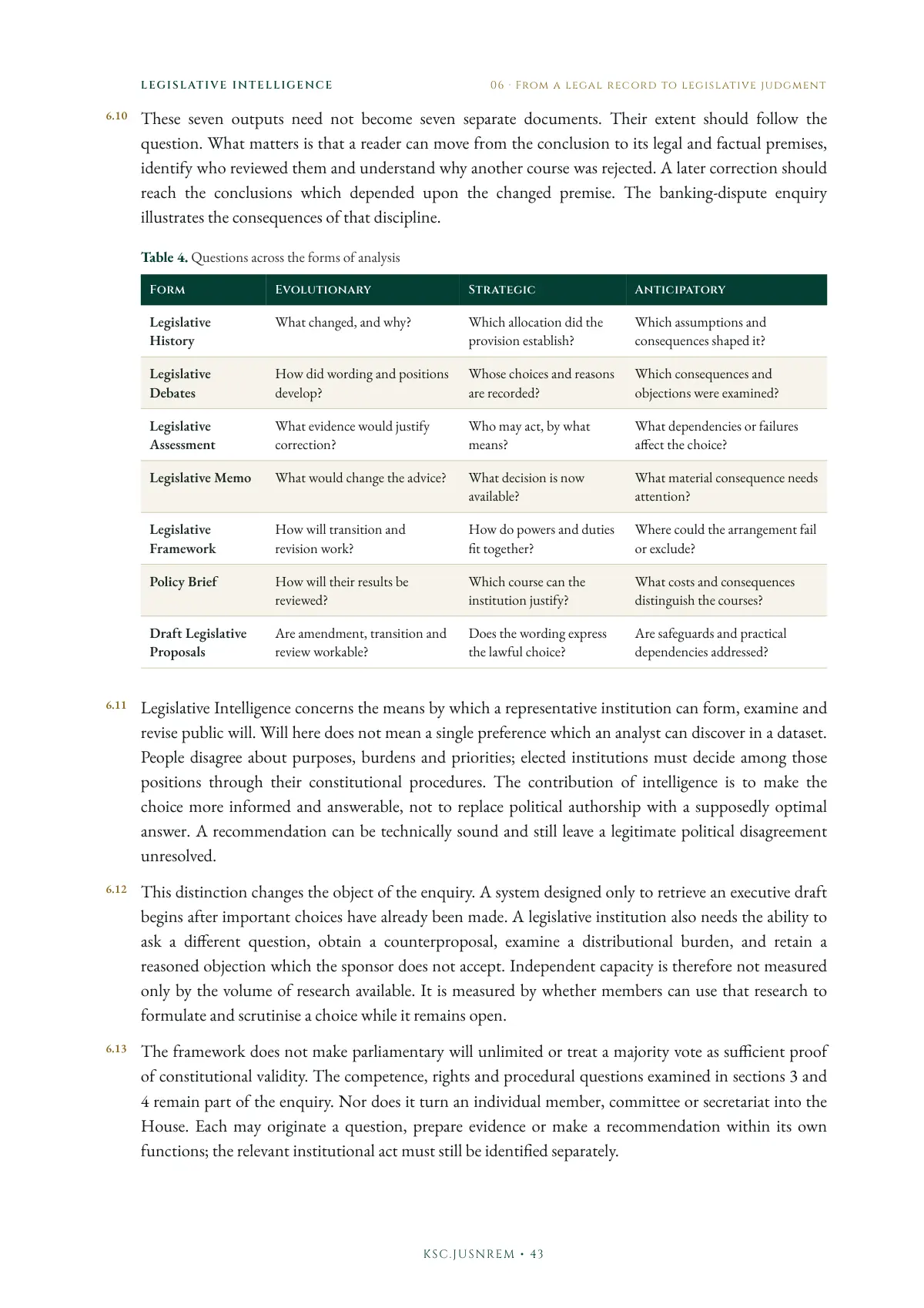
Table 4. Questions across the forms of analysis ...................................................................................................... 43
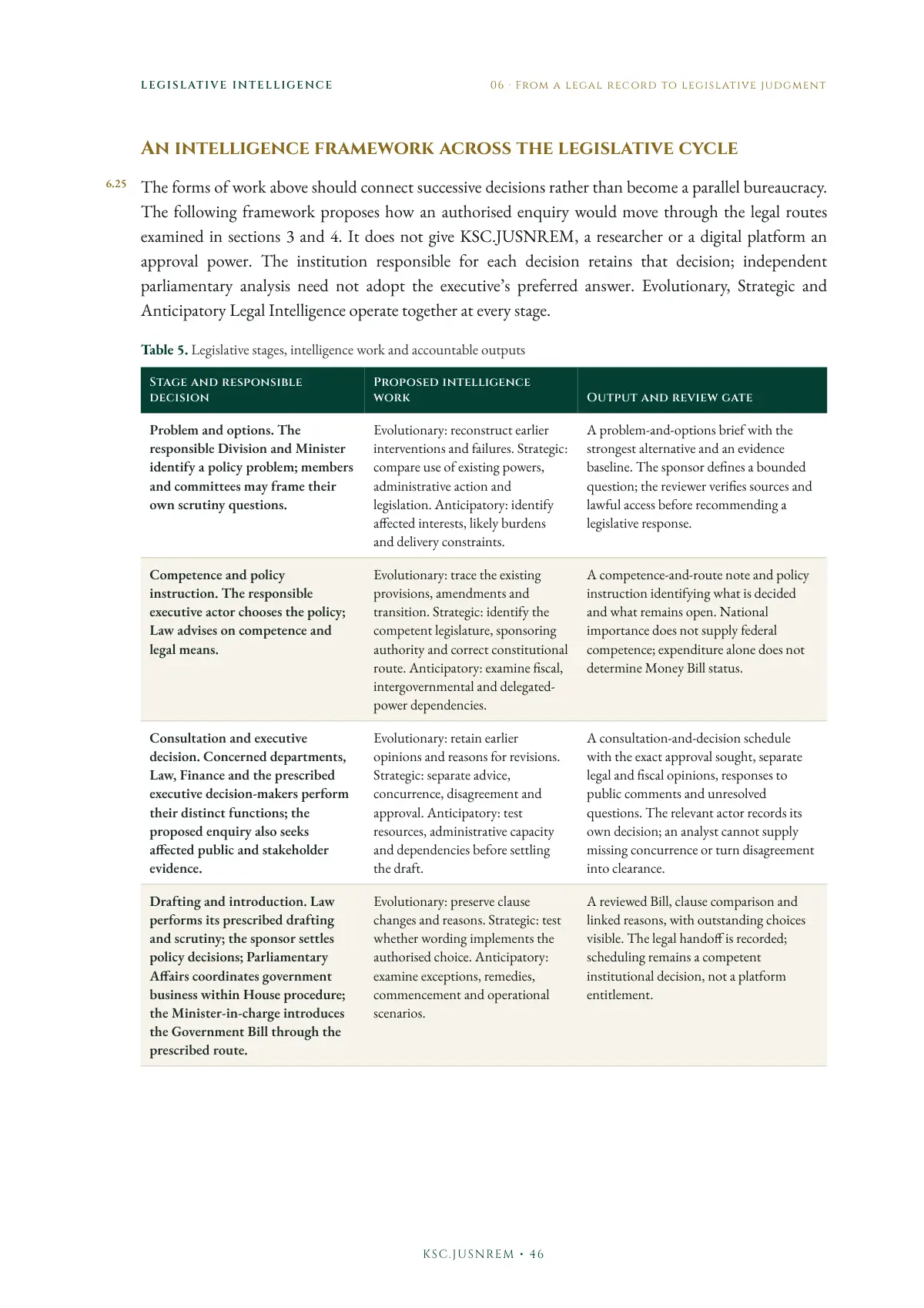
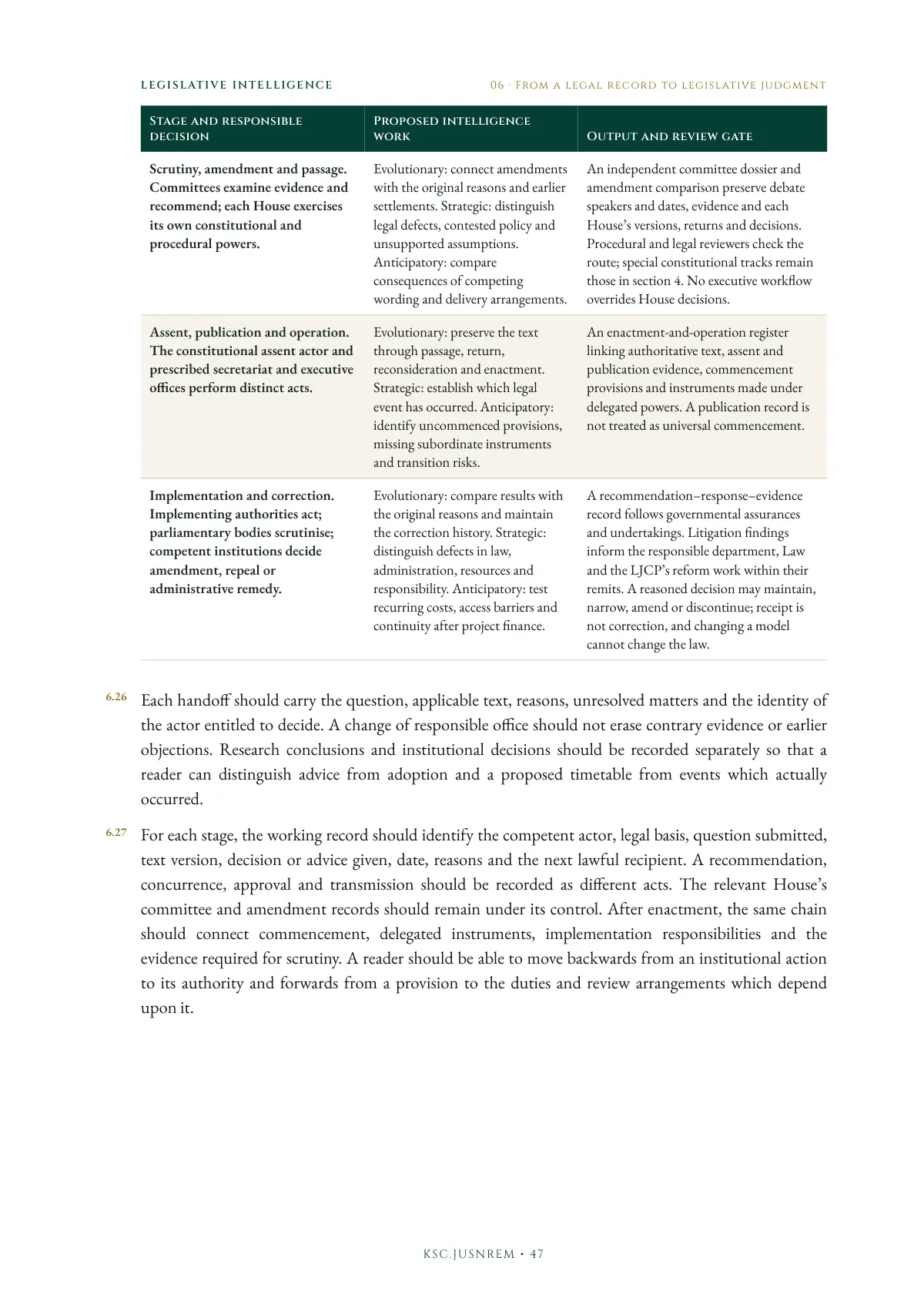
Table 5. Legislative stages, intelligence work and accountable outputs ................................................................. 46
Table 6. Source and amendment record: worked values ........................................................................................ 55
Table 7. Acceptance tests for the Punjab correction .............................................................................................. 57
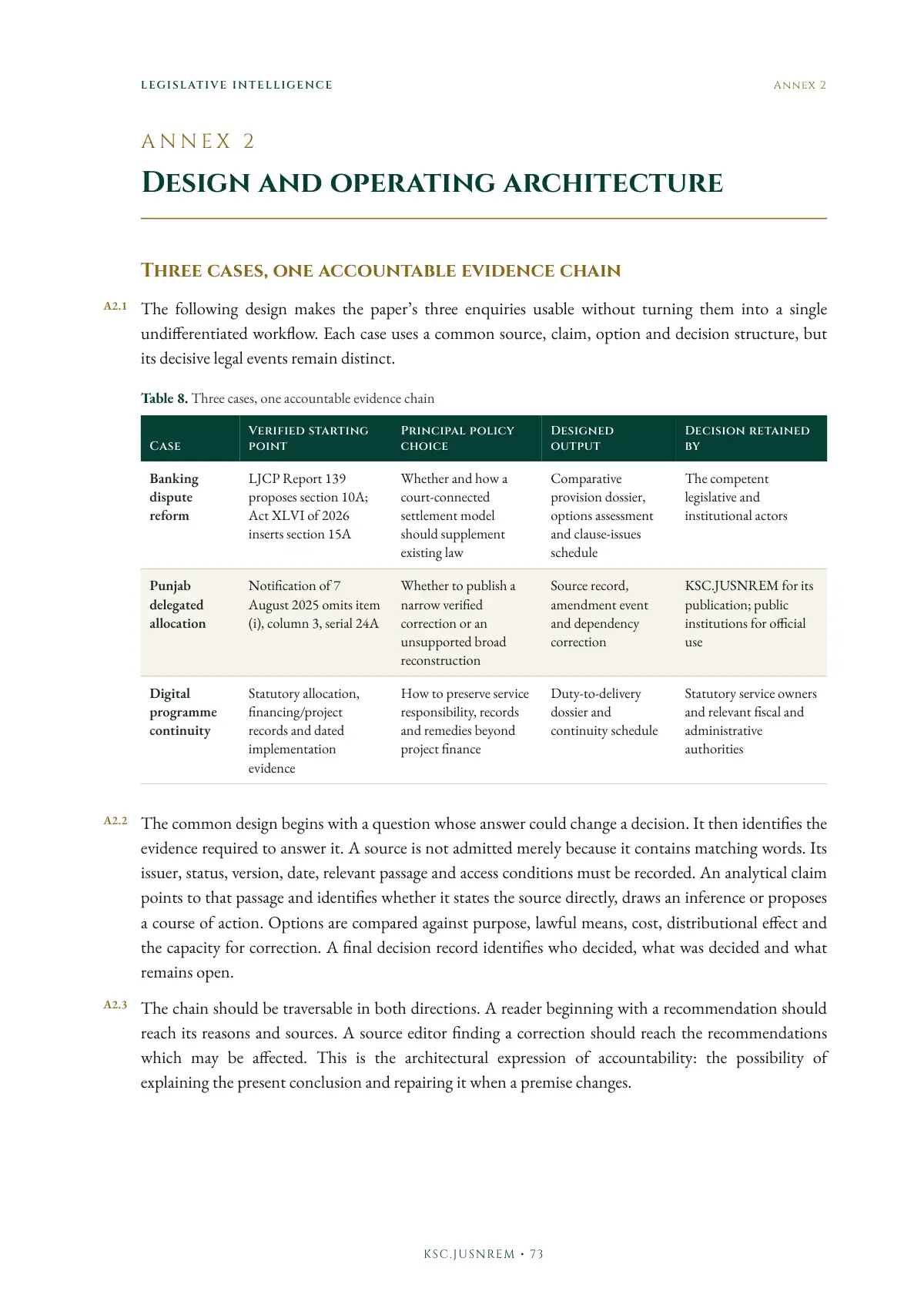
Table 8. Three cases, one accountable evidence chain ............................................................................................ 73
Table 9. Illustrative resource model ........................................................................................................................ 76
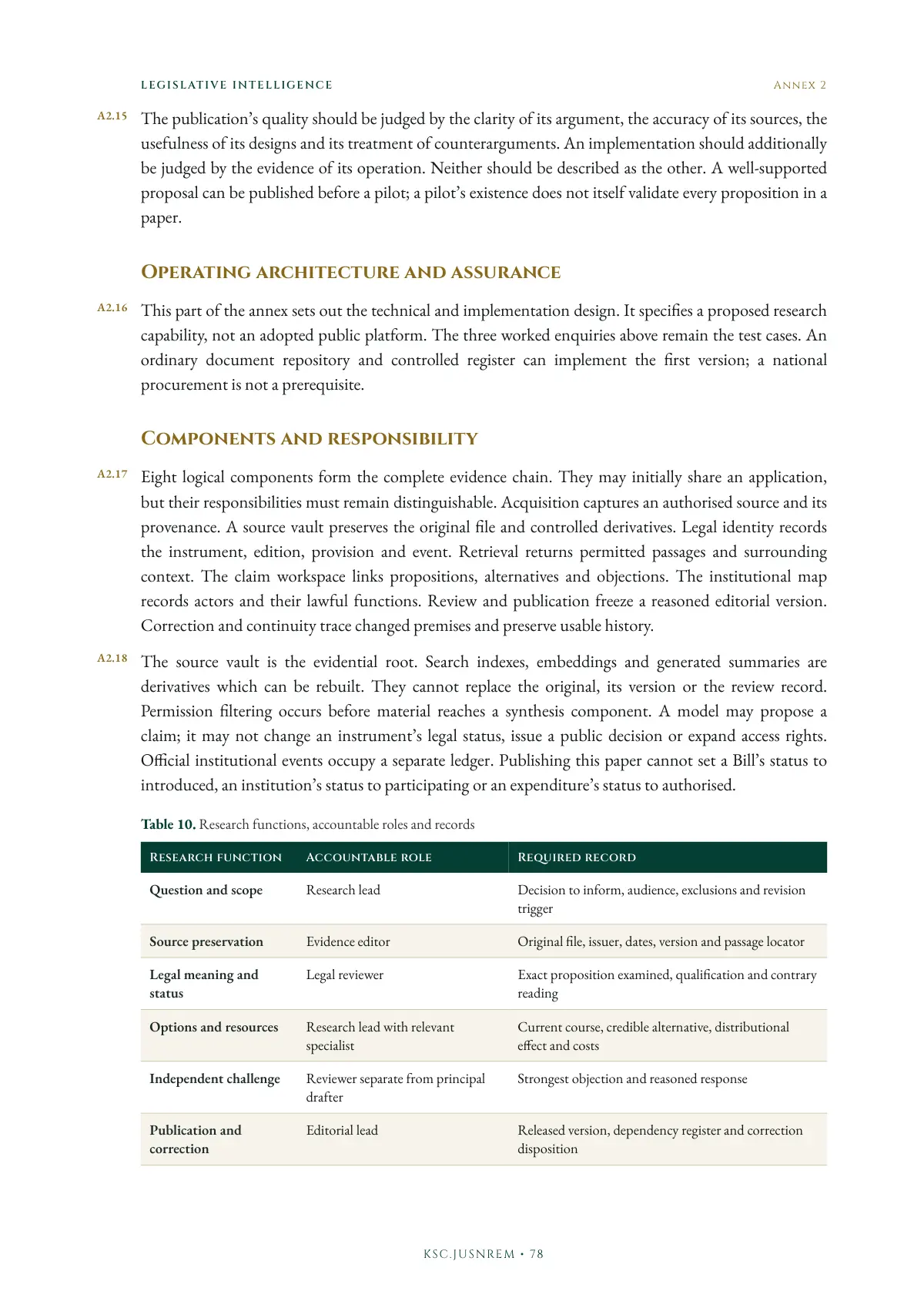
Table 10. Research functions, accountable roles and records ................................................................................ 78
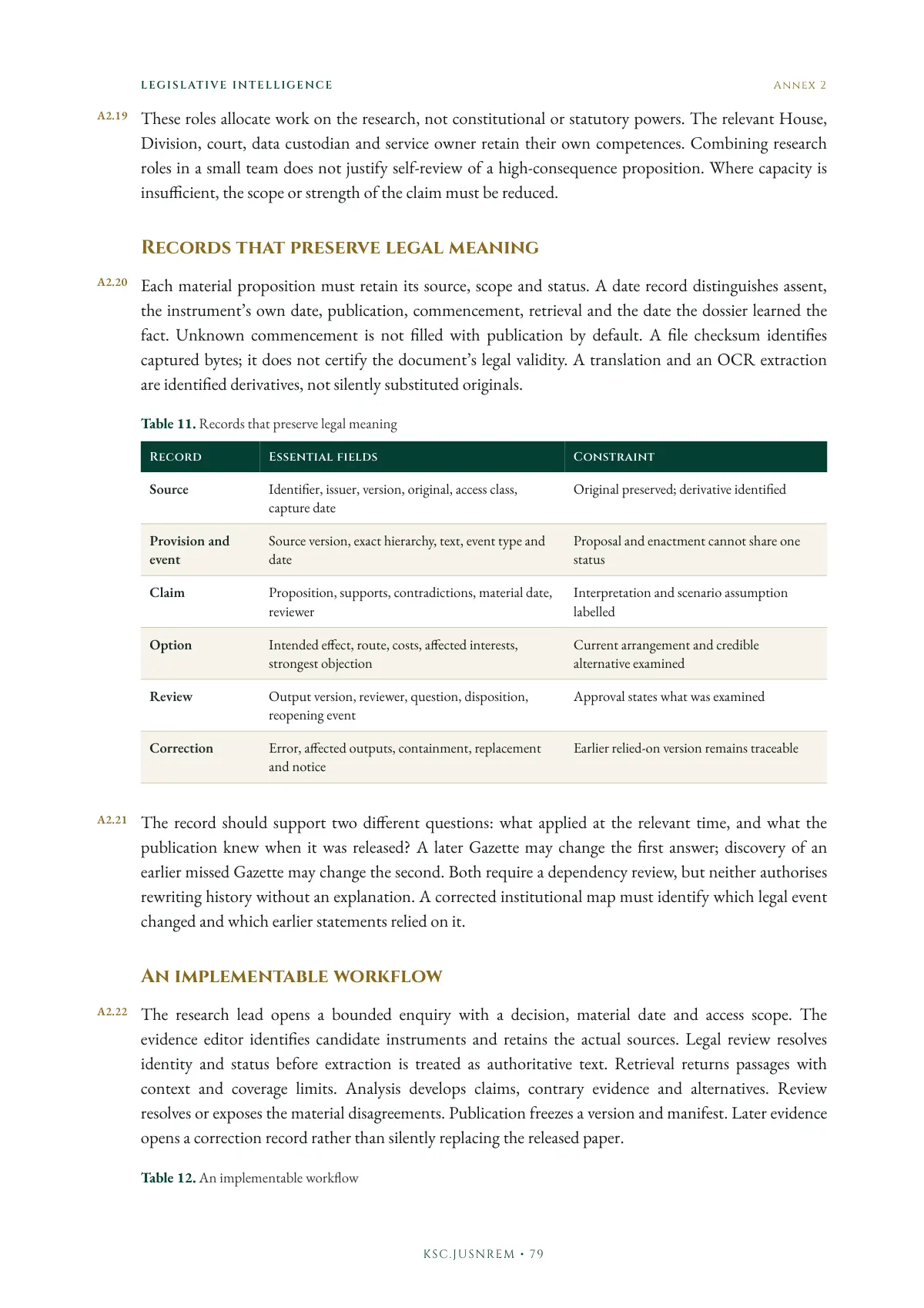
Table 11. Records that preserve legal meaning ....................................................................................................... 79
Table 12. An implementable workflow ................................................................................................................... 79
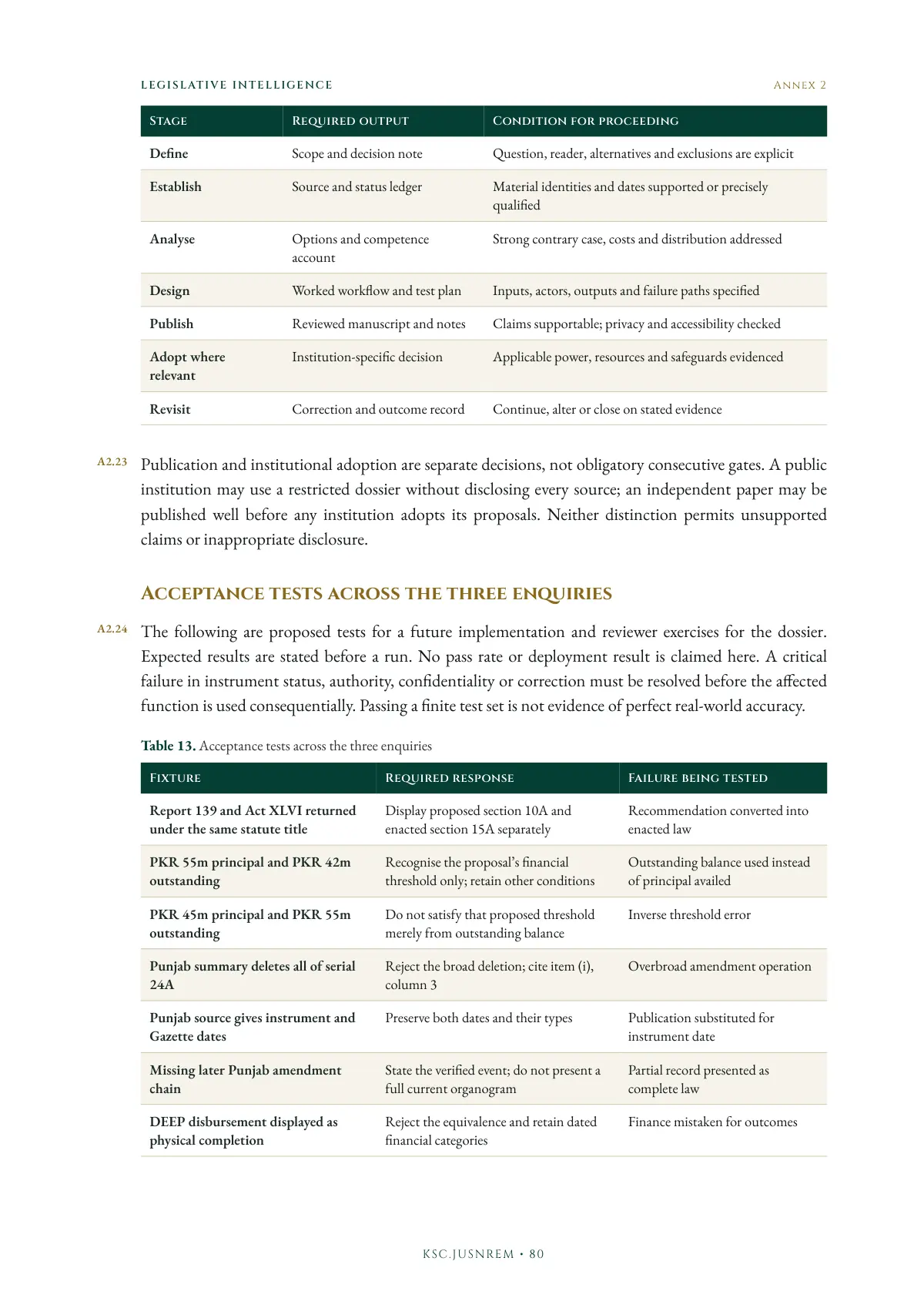
Table 13. Acceptance tests across the three enquiries ............................................................................................. 80
LEGISLATIVE INTELLIGENCE Executive summary
Executive summary
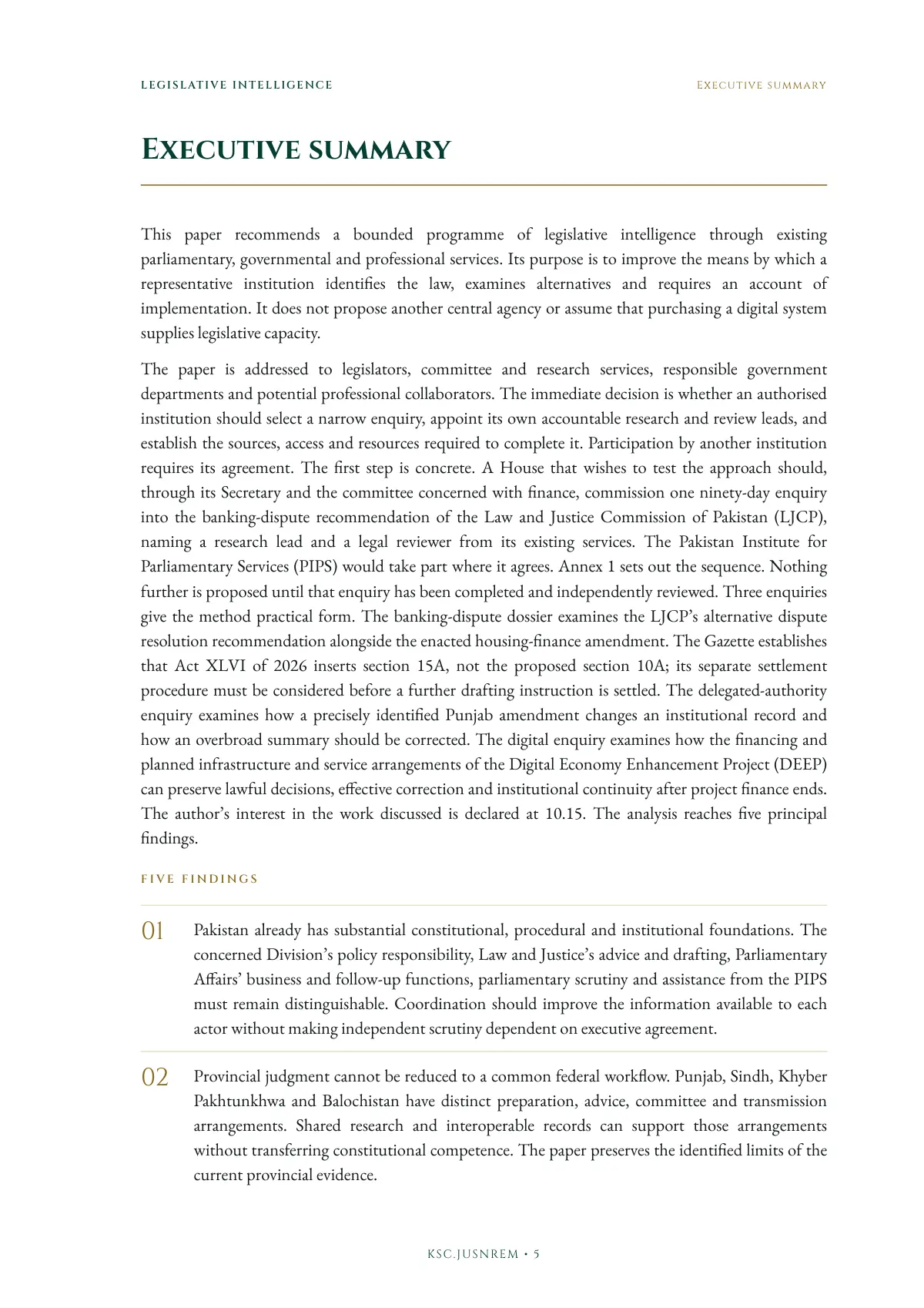
This paper recommends a bounded programme of legislative intelligence through existing parliamentary, governmental and professional services. Its purpose is to improve the means by which a representative institution identifies the law, examines alternatives and requires an account of implementation. It does not propose another central agency or assume that purchasing a digital system supplies legislative capacity.
The paper is addressed to legislators, committee and research services, responsible government departments and potential professional collaborators. The immediate decision is whether an authorised institution should select a narrow enquiry, appoint its own accountable research and review leads, and establish the sources, access and resources required to complete it. Participation by another institution requires its agreement. The first step is concrete. A House that wishes to test the approach should, through its Secretary and the committee concerned with finance, commission one ninety-day enquiry into the banking-dispute recommendation of the Law and Justice Commission of Pakistan (LJCP), naming a research lead and a legal reviewer from its existing services. The Pakistan Institute for Parliamentary Services (PIPS) would take part where it agrees. Annex 1 sets out the sequence. Nothing further is proposed until that enquiry has been completed and independently reviewed. Three enquiries give the method practical form. The banking-dispute dossier examines the LJCP’s alternative dispute resolution recommendation alongside the enacted housing-finance amendment. The Gazette establishes that Act XLVI of 2026 inserts section 15A, not the proposed section 10A; its separate settlement procedure must be considered before a further drafting instruction is settled. The delegated-authority enquiry examines how a precisely identified Punjab amendment changes an institutional record and how an overbroad summary should be corrected. The digital enquiry examines how the financing and planned infrastructure and service arrangements of the Digital Economy Enhancement Project (DEEP) can preserve lawful decisions, effective correction and institutional continuity after project finance ends. The author’s interest in the work discussed is declared at 10.15. The analysis reaches five principal findings.
F I V E F I N D I N G S
01
Pakistan already has substantial constitutional, procedural and institutional foundations. The concerned Division’s policy responsibility, Law and Justice’s advice and drafting, Parliamentary Affairs’ business and follow-up functions, parliamentary scrutiny and assistance from the PIPS must remain distinguishable. Coordination should improve the information available to each actor without making independent scrutiny dependent on executive agreement.
02
Provincial judgment cannot be reduced to a common federal workflow. Punjab, Sindh, Khyber Pakhtunkhwa and Balochistan have distinct preparation, advice, committee and transmission arrangements. Shared research and interoperable records can support those arrangements without transferring constitutional competence. The paper preserves the identified limits of the current provincial evidence.
LEGISLATIVE INTELLIGENCE Executive summary
03
The stages of digital work matter. Digitisation, structured legislation, institutional mapping and executable rules require different evidence. Comparative registers show how provision-level reading, version history and enabling-law relationships can make that evidence usable. A decision model additionally requires a defined purpose, legal review and a boundary around discretion. The Pakistan Akoma Ntoso (AKN) profile remains a draft with named dependencies distinct from the newer international standard. The maturity and scope of each Digital Nation Pakistan publication must be established separately; a technical format cannot determine authority for a substantive decision.
04
DEEP’s financing, procurement, financial opinions and implementation reports answer different questions. They provide a concrete basis for scrutinising responsibilities, safeguards and continuity, not a general assurance of completed delivery. The proposed continuity dossier would identify the service owner, data custodian, operator, recurrent means and responsibility for unresolved claims and remedies. Book Four of Reconstituting Public Power (RPP) and the global volume of Code, Law and Capital supply the institutional argument; project evidence tests its application.
05
Evolutionary, Strategic and Anticipatory Legal Intelligence are co-central. The work must examine the evidence and authority for correction, purpose and lawful means, and foreseeable consequences and dependencies together. Faster retrieval alone is not the measure of success.
The first gate is a verified source sample, a baseline of present work and an identified reviewer responsible for the conclusion. Continuation depends on demonstrated use and sustainable review and maintenance. A material source or legal-status defect, inadequate protection of confidential information or absence of accountable review should hold back the affected work. A better-grounded decision includes a reasoned decision to narrow or discontinue the enquiry. This is an independent KSC.JUSNREM think-tank publication. It develops analysis, policy recommendations and reference designs for public examination. Its proposals do not require prior institutional adoption to be published; any later official implementation follows the legal procedures applicable to that institution.
LEGISLATIVE INTELLIGENCE Reader's guide: sources and status
Reader's guide: sources and status
The paper distinguishes existing law and institutional practice from its analytical and operational proposals. The notes identify cited records, editions and material limits; the notes also carry the links for online sources. These distinctions allow the reader to examine what each source establishes and what remains to be decided.
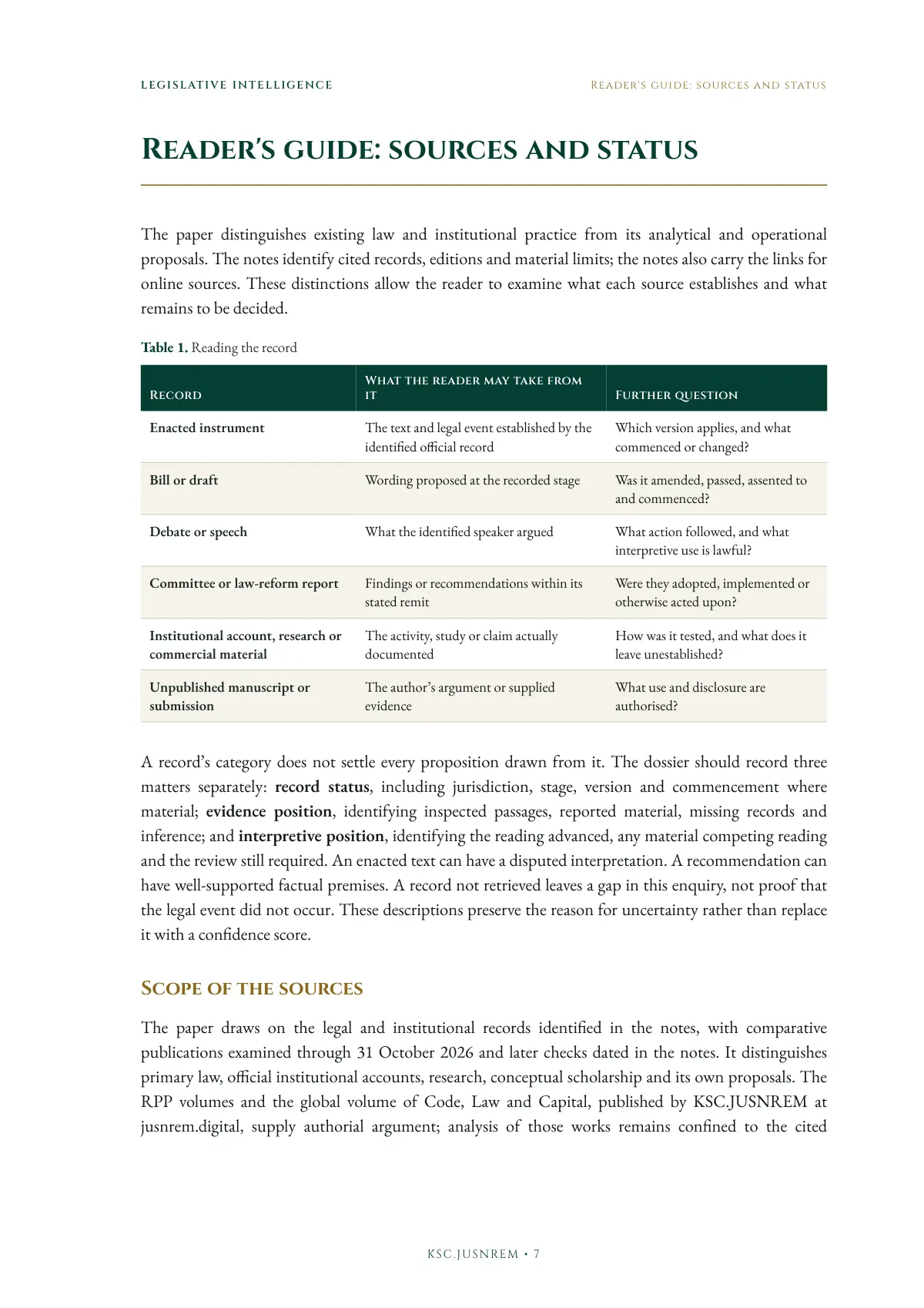
Table 1. Reading the record
Record
What the reader may take from it Further question
Enacted instrument The text and legal event established by the identified official record
Which version applies, and what commenced or changed?
Bill or draft Wording proposed at the recorded stage Was it amended, passed, assented to and commenced?
Debate or speech What the identified speaker argued What action followed, and what interpretive use is lawful?
Committee or law-reform report Findings or recommendations within its stated remit
Were they adopted, implemented or otherwise acted upon?
Institutional account, research or commercial material
The activity, study or claim actually documented
How was it tested, and what does it leave unestablished?
Unpublished manuscript or submission
What use and disclosure are authorised?
The author’s argument or supplied evidence
A record’s category does not settle every proposition drawn from it. The dossier should record three matters separately: record status, including jurisdiction, stage, version and commencement where material; evidence position, identifying inspected passages, reported material, missing records and inference; and interpretive position, identifying the reading advanced, any material competing reading and the review still required. An enacted text can have a disputed interpretation. A recommendation can have well-supported factual premises. A record not retrieved leaves a gap in this enquiry, not proof that the legal event did not occur. These descriptions preserve the reason for uncertainty rather than replace it with a confidence score.
Scope of the sources
The paper draws on the legal and institutional records identified in the notes, with comparative publications examined through 31 October 2026 and later checks dated in the notes. It distinguishes primary law, official institutional accounts, research, conceptual scholarship and its own proposals. The RPP volumes and the global volume of Code, Law and Capital, published by KSC.JUSNREM at jusnrem.digital, supply authorial argument; analysis of those works remains confined to the cited
LEGISLATIVE INTELLIGENCE Reader's guide: sources and status
passages.1 The DEEP findings preserve the gaps in acceptance evidence, management letters, provincial agreements and operational safeguards. The final Gazette of Act XLVI of 2026 has been examined and distinguished from the banking-dispute recommendation. That examination does not certify an exhaustive later amendment history. Footnotes supply authorities and pinpoints; they also record editions and material limits.
1. Khurram Chughtai, Reconstituting Public Power (RPP), Book Four: The Digital and Intelligent Constitutional Order (KSC.JUSNREM 2026) <https://jusnrem.digital> ch 54, topics 901 and 906; Khurram Chughtai, Code, Law and Capital: The Global Digital-Assets Order (KSC.JUSNREM 2026) <https://jusnrem.digital> ch 18.3, 378–379. The analysis of these works is confined to the cited passages.
LEGISLATIVE INTELLIGENCE Abbreviations and terms
Abbreviations and terms
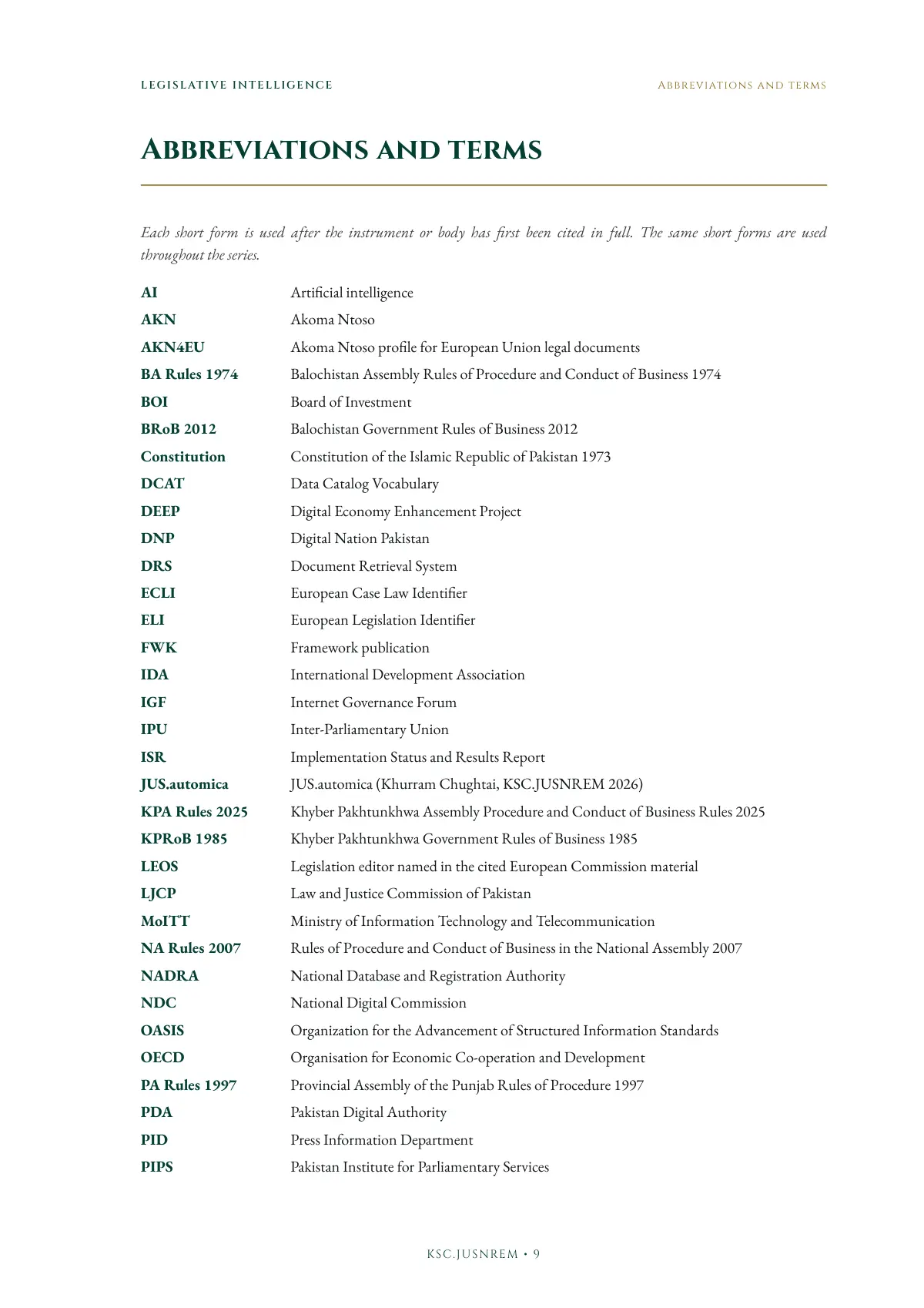
Each short form is used after the instrument or body has first been cited in full. The same short forms are used throughout the series.
AI Artificial intelligence
AKN Akoma Ntoso
AKN4EU Akoma Ntoso profile for European Union legal documents
BA Rules 1974 Balochistan Assembly Rules of Procedure and Conduct of Business 1974
BOI Board of Investment
BRoB 2012 Balochistan Government Rules of Business 2012
Constitution Constitution of the Islamic Republic of Pakistan 1973
DCAT Data Catalog Vocabulary
DEEP Digital Economy Enhancement Project
DNP Digital Nation Pakistan
DRS Document Retrieval System
ECLI European Case Law Identifier
ELI European Legislation Identifier
FWK Framework publication
IDA International Development Association
IGF Internet Governance Forum
IPU Inter-Parliamentary Union
ISR Implementation Status and Results Report
JUS.automica JUS.automica (Khurram Chughtai, KSC.JUSNREM 2026)
KPA Rules 2025 Khyber Pakhtunkhwa Assembly Procedure and Conduct of Business Rules 2025
KPRoB 1985 Khyber Pakhtunkhwa Government Rules of Business 1985
LEOS Legislation editor named in the cited European Commission material
LJCP Law and Justice Commission of Pakistan
MoITT Ministry of Information Technology and Telecommunication
NA Rules 2007 Rules of Procedure and Conduct of Business in the National Assembly 2007
NADRA National Database and Registration Authority
NDC National Digital Commission
OASIS Organization for the Advancement of Structured Information Standards
OECD Organisation for Economic Co-operation and Development
PA Rules 1997 Provincial Assembly of the Punjab Rules of Procedure 1997
PDA Pakistan Digital Authority
PID Press Information Department
PIPS Pakistan Institute for Parliamentary Services
LEGISLATIVE INTELLIGENCE Abbreviations and terms
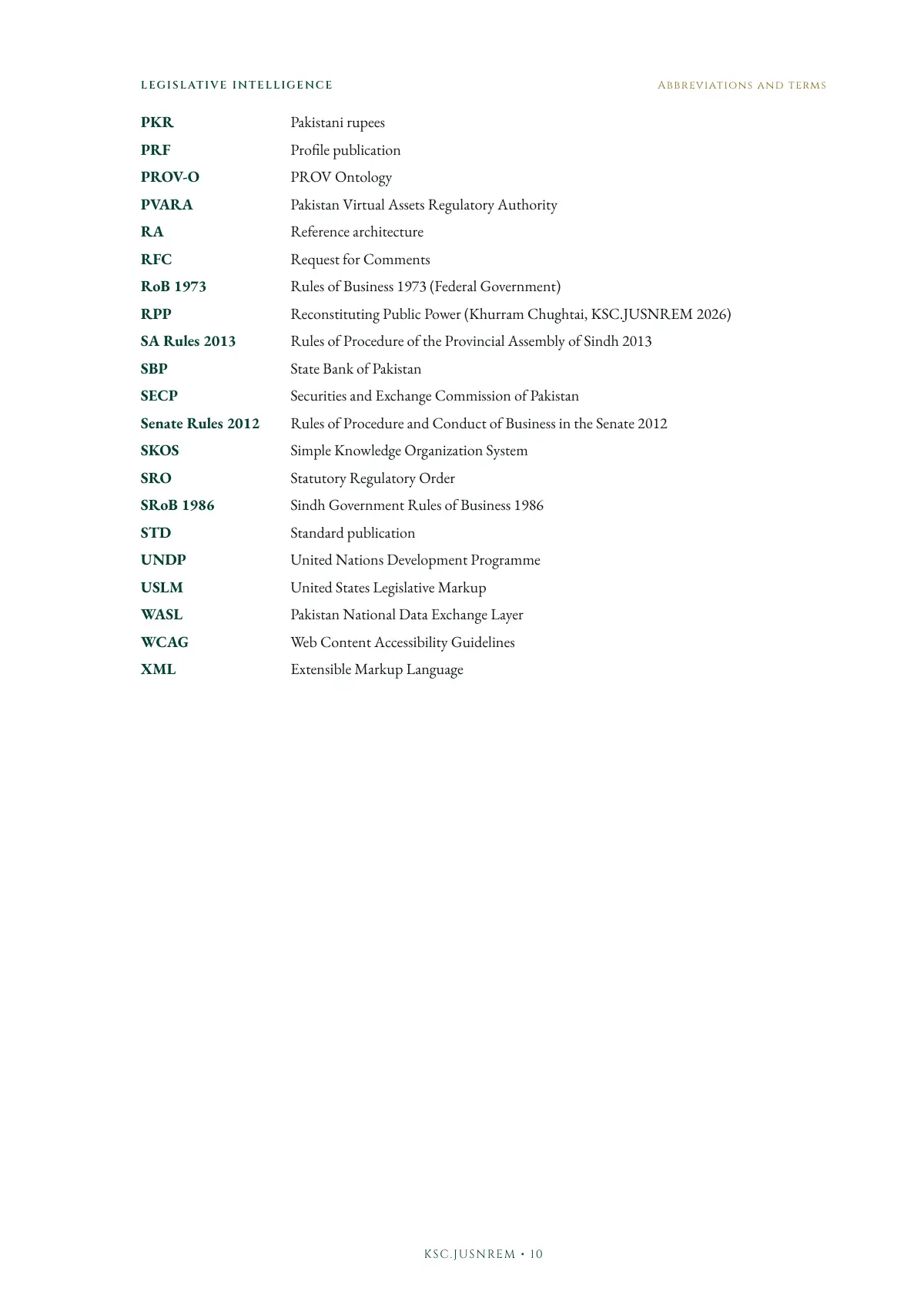
PKR Pakistani rupees
PRF Profile publication
PROV-O PROV Ontology
PVARA Pakistan Virtual Assets Regulatory Authority
RA Reference architecture
RFC Request for Comments
RoB 1973 Rules of Business 1973 (Federal Government)
RPP Reconstituting Public Power (Khurram Chughtai, KSC.JUSNREM 2026)
SA Rules 2013 Rules of Procedure of the Provincial Assembly of Sindh 2013
SBP State Bank of Pakistan
SECP Securities and Exchange Commission of Pakistan
Senate Rules 2012 Rules of Procedure and Conduct of Business in the Senate 2012
SKOS Simple Knowledge Organization System
SRO Statutory Regulatory Order
SRoB 1986 Sindh Government Rules of Business 1986
STD Standard publication
UNDP United Nations Development Programme
USLM United States Legislative Markup
WASL Pakistan National Data Exchange Layer
WCAG Web Content Accessibility Guidelines
XML Extensible Markup Language
LEGISLATIVE INTELLIGENCE Table of legislation
Table of legislation
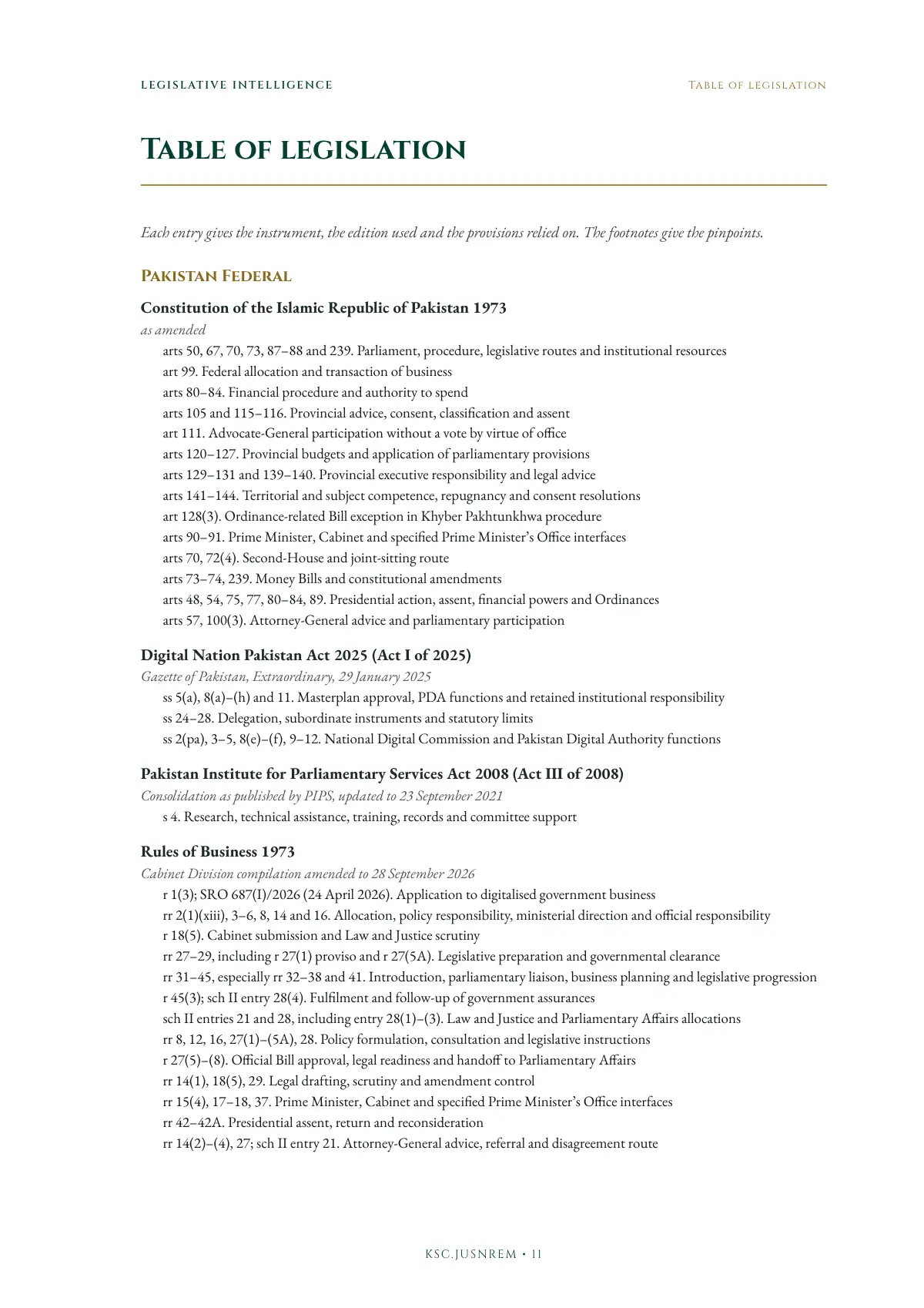
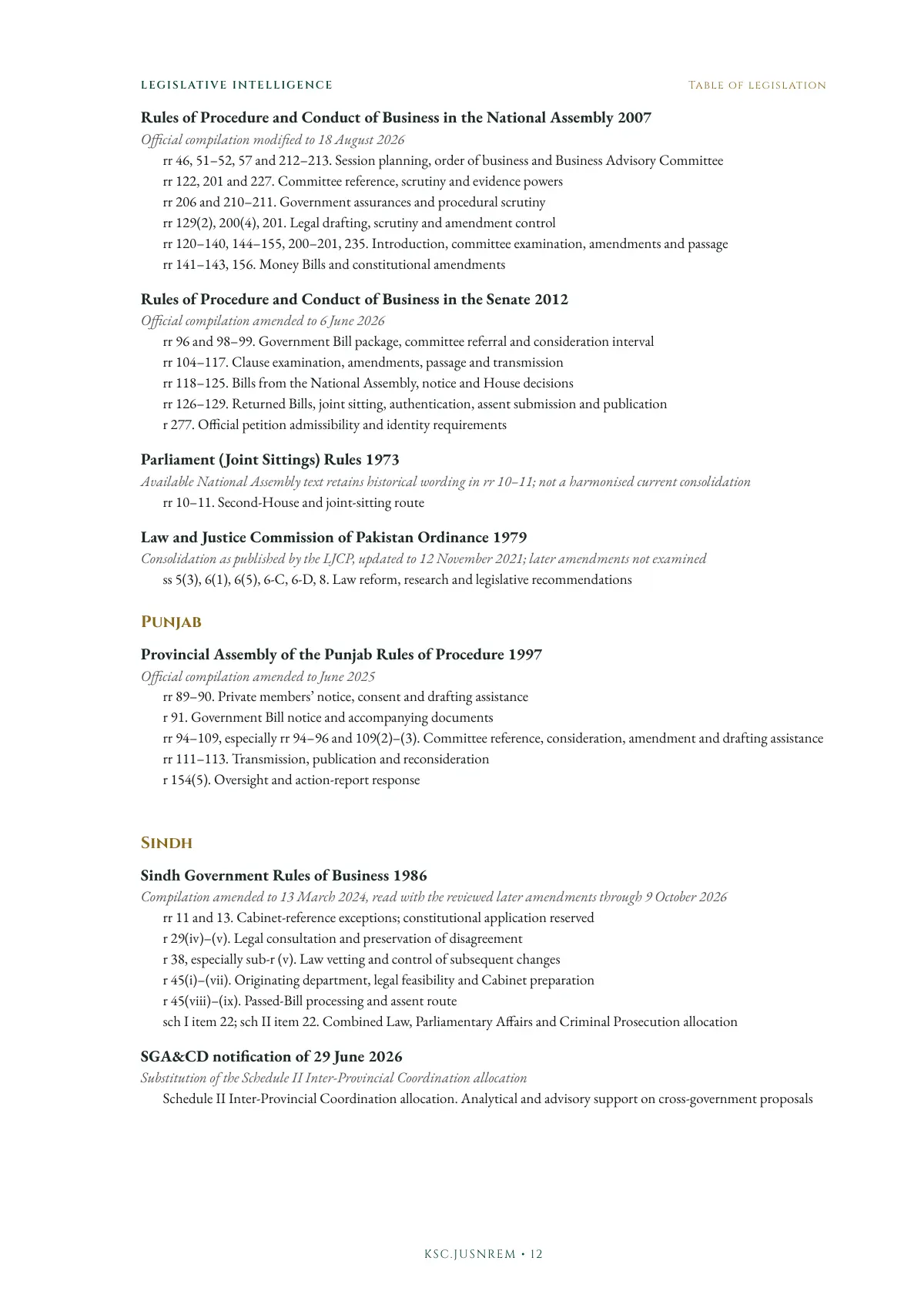
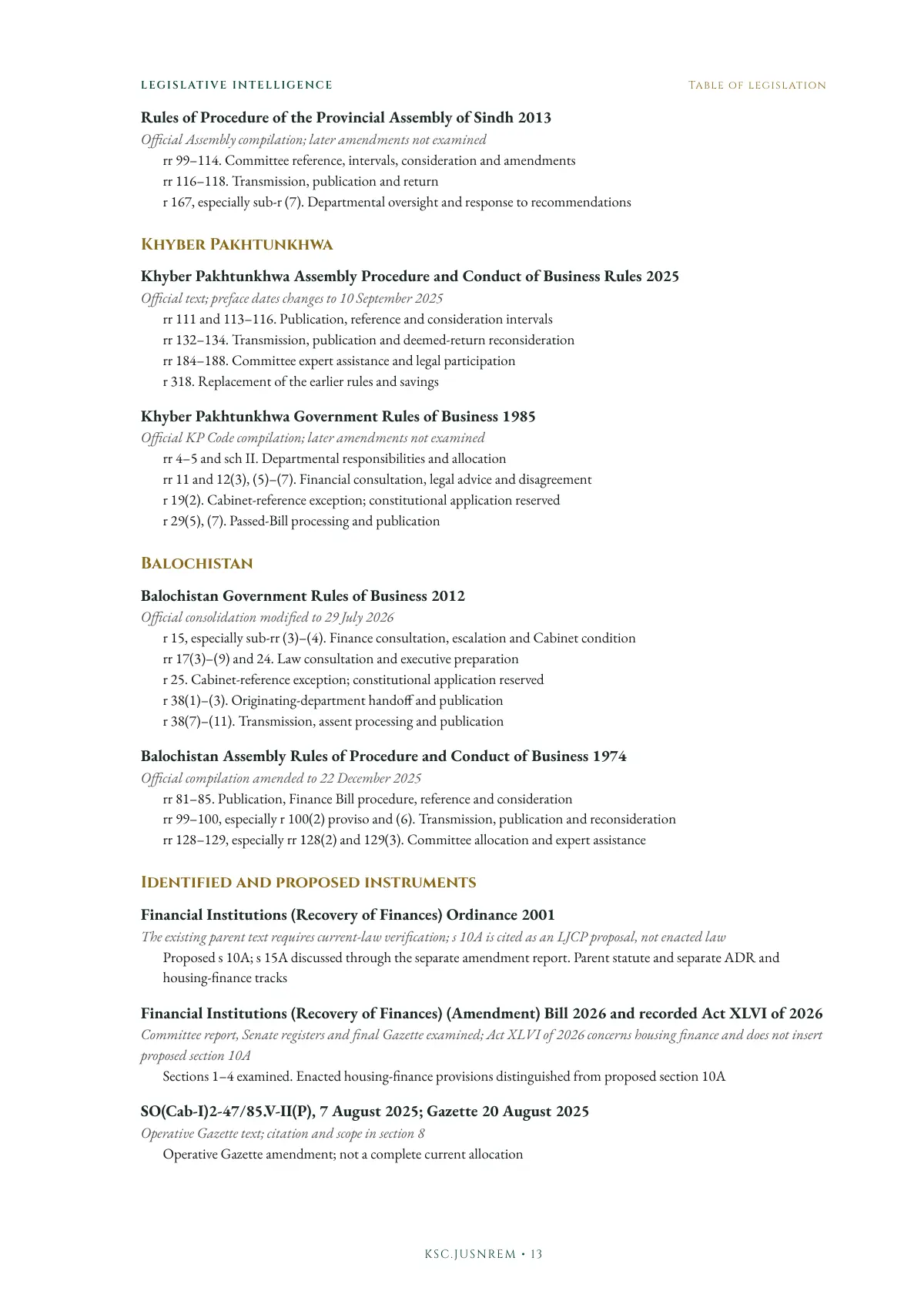
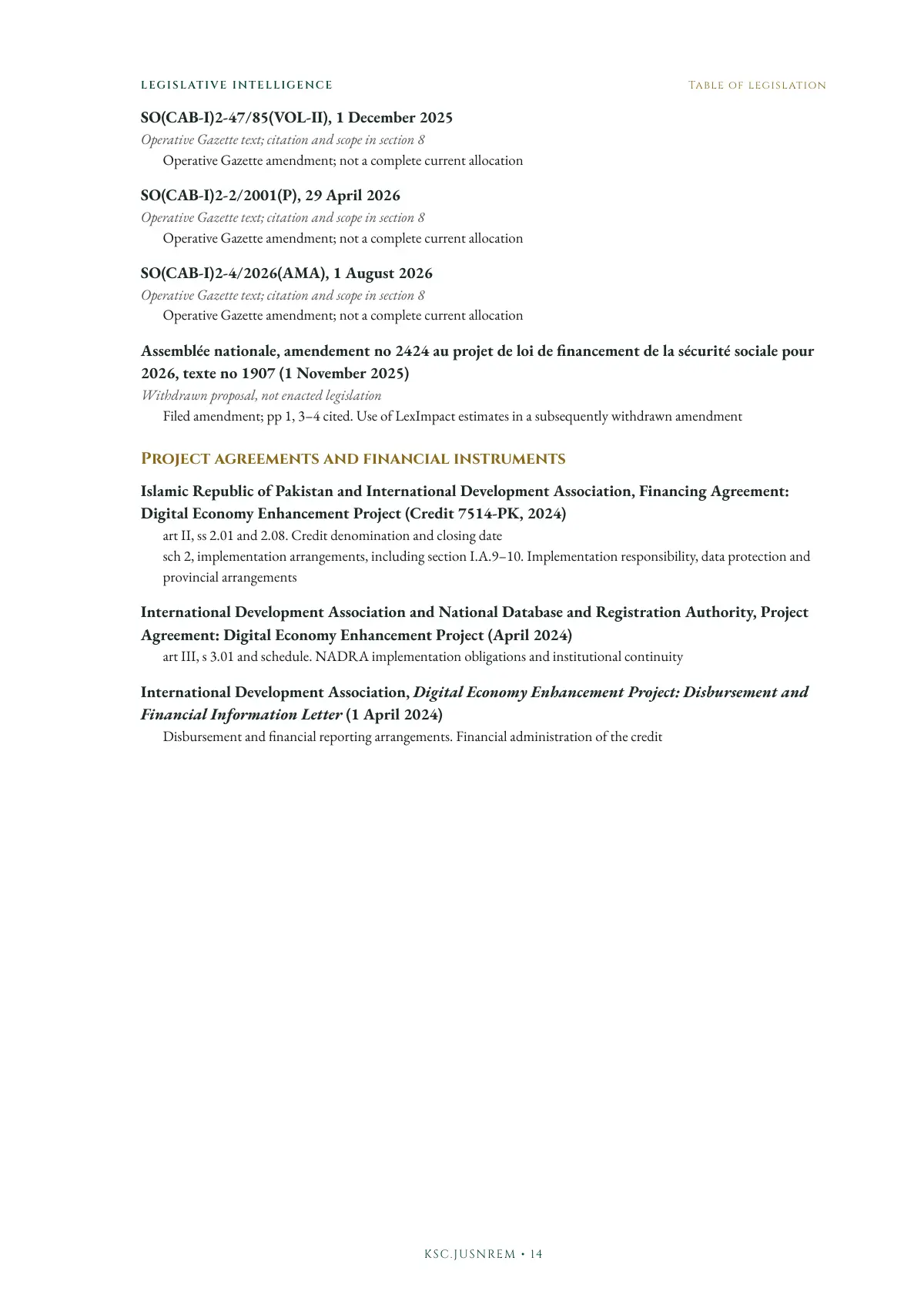
Each entry gives the instrument, the edition used and the provisions relied on. The footnotes give the pinpoints.
Pakistan Federal
Constitution of the Islamic Republic of Pakistan 1973 as amended
arts 50, 67, 70, 73, 87–88 and 239. Parliament, procedure, legislative routes and institutional resources art 99. Federal allocation and transaction of business arts 80–84. Financial procedure and authority to spend arts 105 and 115–116. Provincial advice, consent, classification and assent art 111. Advocate-General participation without a vote by virtue of office arts 120–127. Provincial budgets and application of parliamentary provisions arts 129–131 and 139–140. Provincial executive responsibility and legal advice arts 141–144. Territorial and subject competence, repugnancy and consent resolutions art 128(3). Ordinance-related Bill exception in Khyber Pakhtunkhwa procedure arts 90–91. Prime Minister, Cabinet and specified Prime Minister’s Office interfaces arts 70, 72(4). Second-House and joint-sitting route arts 73–74, 239. Money Bills and constitutional amendments arts 48, 54, 75, 77, 80–84, 89. Presidential action, assent, financial powers and Ordinances arts 57, 100(3). Attorney-General advice and parliamentary participation
Digital Nation Pakistan Act 2025 (Act I of 2025) Gazette of Pakistan, Extraordinary, 29 January 2025
ss 5(a), 8(a)–(h) and 11. Masterplan approval, PDA functions and retained institutional responsibility ss 24–28. Delegation, subordinate instruments and statutory limits ss 2(pa), 3–5, 8(e)–(f), 9–12. National Digital Commission and Pakistan Digital Authority functions
Pakistan Institute for Parliamentary Services Act 2008 (Act III of 2008) Consolidation as published by PIPS, updated to 23 September 2021
s 4. Research, technical assistance, training, records and committee support
Rules of Business 1973 Cabinet Division compilation amended to 28 September 2026
r 1(3); SRO 687(I)/2026 (24 April 2026). Application to digitalised government business rr 2(1)(xiii), 3–6, 8, 14 and 16. Allocation, policy responsibility, ministerial direction and official responsibility r 18(5). Cabinet submission and Law and Justice scrutiny rr 27–29, including r 27(1) proviso and r 27(5A). Legislative preparation and governmental clearance rr 31–45, especially rr 32–38 and 41. Introduction, parliamentary liaison, business planning and legislative progression r 45(3); sch II entry 28(4). Fulfilment and follow-up of government assurances sch II entries 21 and 28, including entry 28(1)–(3). Law and Justice and Parliamentary Affairs allocations rr 8, 12, 16, 27(1)–(5A), 28. Policy formulation, consultation and legislative instructions r 27(5)–(8). Official Bill approval, legal readiness and handoff to Parliamentary Affairs rr 14(1), 18(5), 29. Legal drafting, scrutiny and amendment control rr 15(4), 17–18, 37. Prime Minister, Cabinet and specified Prime Minister’s Office interfaces rr 42–42A. Presidential assent, return and reconsideration rr 14(2)–(4), 27; sch II entry 21. Attorney-General advice, referral and disagreement route
LEGISLATIVE INTELLIGENCE Table of legislation
Rules of Procedure and Conduct of Business in the National Assembly 2007 Official compilation modified to 18 August 2026
rr 46, 51–52, 57 and 212–213. Session planning, order of business and Business Advisory Committee rr 122, 201 and 227. Committee reference, scrutiny and evidence powers rr 206 and 210–211. Government assurances and procedural scrutiny rr 129(2), 200(4), 201. Legal drafting, scrutiny and amendment control rr 120–140, 144–155, 200–201, 235. Introduction, committee examination, amendments and passage rr 141–143, 156. Money Bills and constitutional amendments
Rules of Procedure and Conduct of Business in the Senate 2012 Official compilation amended to 6 June 2026
rr 96 and 98–99. Government Bill package, committee referral and consideration interval rr 104–117. Clause examination, amendments, passage and transmission rr 118–125. Bills from the National Assembly, notice and House decisions rr 126–129. Returned Bills, joint sitting, authentication, assent submission and publication r 277. Official petition admissibility and identity requirements
Parliament (Joint Sittings) Rules 1973 Available National Assembly text retains historical wording in rr 10–11; not a harmonised current consolidation
rr 10–11. Second-House and joint-sitting route
Law and Justice Commission of Pakistan Ordinance 1979 Consolidation as published by the LJCP, updated to 12 November 2021; later amendments not examined
ss 5(3), 6(1), 6(5), 6-C, 6-D, 8. Law reform, research and legislative recommendations
Punjab
Provincial Assembly of the Punjab Rules of Procedure 1997 Official compilation amended to June 2025
rr 89–90. Private members’ notice, consent and drafting assistance r 91. Government Bill notice and accompanying documents rr 94–109, especially rr 94–96 and 109(2)–(3). Committee reference, consideration, amendment and drafting assistance rr 111–113. Transmission, publication and reconsideration r 154(5). Oversight and action-report response
Sindh
Sindh Government Rules of Business 1986 Compilation amended to 13 March 2024, read with the reviewed later amendments through 9 October 2026
rr 11 and 13. Cabinet-reference exceptions; constitutional application reserved r 29(iv)–(v). Legal consultation and preservation of disagreement r 38, especially sub-r (v). Law vetting and control of subsequent changes r 45(i)–(vii). Originating department, legal feasibility and Cabinet preparation r 45(viii)–(ix). Passed-Bill processing and assent route sch I item 22; sch II item 22. Combined Law, Parliamentary Affairs and Criminal Prosecution allocation
SGA&CD notification of 29 June 2026 Substitution of the Schedule II Inter-Provincial Coordination allocation
Schedule II Inter-Provincial Coordination allocation. Analytical and advisory support on cross-government proposals
LEGISLATIVE INTELLIGENCE Table of legislation
Rules of Procedure of the Provincial Assembly of Sindh 2013 Official Assembly compilation; later amendments not examined
rr 99–114. Committee reference, intervals, consideration and amendments rr 116–118. Transmission, publication and return r 167, especially sub-r (7). Departmental oversight and response to recommendations
Khyber Pakhtunkhwa
Khyber Pakhtunkhwa Assembly Procedure and Conduct of Business Rules 2025 Official text; preface dates changes to 10 September 2025
rr 111 and 113–116. Publication, reference and consideration intervals rr 132–134. Transmission, publication and deemed-return reconsideration rr 184–188. Committee expert assistance and legal participation r 318. Replacement of the earlier rules and savings
Khyber Pakhtunkhwa Government Rules of Business 1985 Official KP Code compilation; later amendments not examined
rr 4–5 and sch II. Departmental responsibilities and allocation rr 11 and 12(3), (5)–(7). Financial consultation, legal advice and disagreement r 19(2). Cabinet-reference exception; constitutional application reserved r 29(5), (7). Passed-Bill processing and publication
Balochistan
Balochistan Government Rules of Business 2012 Official consolidation modified to 29 July 2026
r 15, especially sub-rr (3)–(4). Finance consultation, escalation and Cabinet condition rr 17(3)–(9) and 24. Law consultation and executive preparation r 25. Cabinet-reference exception; constitutional application reserved r 38(1)–(3). Originating-department handoff and publication r 38(7)–(11). Transmission, assent processing and publication
Balochistan Assembly Rules of Procedure and Conduct of Business 1974 Official compilation amended to 22 December 2025
rr 81–85. Publication, Finance Bill procedure, reference and consideration rr 99–100, especially r 100(2) proviso and (6). Transmission, publication and reconsideration rr 128–129, especially rr 128(2) and 129(3). Committee allocation and expert assistance
Identified and proposed instruments
Financial Institutions (Recovery of Finances) Ordinance 2001 The existing parent text requires current-law verification; s 10A is cited as an LJCP proposal, not enacted law
Proposed s 10A; s 15A discussed through the separate amendment report. Parent statute and separate ADR and housing-finance tracks
Financial Institutions (Recovery of Finances) (Amendment) Bill 2026 and recorded Act XLVI of 2026 Committee report, Senate registers and final Gazette examined; Act XLVI of 2026 concerns housing finance and does not insert proposed section 10A
Sections 1–4 examined. Enacted housing-finance provisions distinguished from proposed section 10A
SO(Cab-I)2-47/85.V-II(P), 7 August 2025; Gazette 20 August 2025 Operative Gazette text; citation and scope in section 8
Operative Gazette amendment; not a complete current allocation
LEGISLATIVE INTELLIGENCE Table of legislation
SO(CAB-I)2-47/85(VOL-II), 1 December 2025 Operative Gazette text; citation and scope in section 8
Operative Gazette amendment; not a complete current allocation
SO(CAB-I)2-2/2001(P), 29 April 2026 Operative Gazette text; citation and scope in section 8
Operative Gazette amendment; not a complete current allocation
SO(CAB-I)2-4/2026(AMA), 1 August 2026 Operative Gazette text; citation and scope in section 8
Operative Gazette amendment; not a complete current allocation
Assemblée nationale, amendement no 2424 au projet de loi de financement de la sécurité sociale pour 2026, texte no 1907 (1 November 2025) Withdrawn proposal, not enacted legislation
Filed amendment; pp 1, 3–4 cited. Use of LexImpact estimates in a subsequently withdrawn amendment
Project agreements and financial instruments
Islamic Republic of Pakistan and International Development Association, Financing Agreement: Digital Economy Enhancement Project (Credit 7514-PK, 2024)
art II, ss 2.01 and 2.08. Credit denomination and closing date sch 2, implementation arrangements, including section I.A.9–10. Implementation responsibility, data protection and provincial arrangements
International Development Association and National Database and Registration Authority, Project Agreement: Digital Economy Enhancement Project (April 2024)
art III, s 3.01 and schedule. NADRA implementation obligations and institutional continuity
International Development Association, Digital Economy Enhancement Project: Disbursement and Financial Information Letter (1 April 2024)
Disbursement and financial reporting arrangements. Financial administration of the credit
LEGISLATIVE INTELLIGENCE 01 · Legislative power and the means of exercising it
01
Legislative power and the means of exercising it
1.1 Parliament may possess the power to make law and remain dependent upon the executive for the information by which a Bill can be examined. A committee may be entitled to obtain evidence and receive it too late to affect the decision. A member may have a route for introducing an amendment and lack the drafting assistance needed to give it legal form. The authority exists in each case. The means of exercising it are incomplete.
1.2 This is the problem from which legislative intelligence must begin. A legislature requires more than a supply of documents. It needs to know which text governs, what a proposal would change, whose authority would increase, what resources its implementation would require, and how those affected could question the result. Information becomes a source of legislative capacity when members can use it to examine and alter a proposal, rather than merely receive an explanation of a decision already settled elsewhere.
1.3 The distinction is developed in RPP. Its second Book, The Constitutional Settlement and the Allocation of Power, examines the relationship between authority and dependence, and asks whether elected institutions possess the means of authorship, scrutiny, financial control and accountability.2 An unlawful substitution of the decision-maker calls for enforcement of the lawful allocation. A disabling dependence upon another institution may require capacity, procedure or resources to be changed. Another law is not the answer to every failure; nor does compliance with existing law place an arrangement beyond reconsideration.3
1.4
Legislative intelligence should make these differences examinable. It should connect the relevant legal text to the institution entitled to act, the reasons for and against a proposal, its practical means and the consequences of its operation. The resulting analysis must be available while a choice remains open. Advice delivered after passage may explain what happened; it cannot supply the opportunity for scrutiny which was missing before it.
1.5
KSC.JUSNREM’s contribution is an independent enquiry into how that capacity can be built. The banking-dispute dossier developed below tests the approach against an actual reform recommendation. It asks what should be decided, by whom, upon which evidence and with what provision for what follows. Its conclusions are offered for examination by the institutions concerned, whose advice, procedure and decisions remain their own.
2. Khurram Chughtai, RPP, Book Two: The Constitutional Settlement and the Allocation of Power (KSC.JUSNREM 2026) <http s://jusnrem.digital> ch 22, topics 561–563 and 595–596. 3. Chughtai, Book Two (n 2) ch 22, topics 563, 588 and 594.
LEGISLATIVE INTELLIGENCE 02 · Three dimensions of the enquiry
02
Three dimensions of the enquiry
2.1 Evolutionary, Strategic and Anticipatory Legal Intelligence are co-central dimensions of the approach. Each addresses a question which the others cannot settle alone. A proposal may work under its initial conditions and possess no adequate means of correction when those conditions change. It may pursue a defensible purpose and fail because the institution cannot carry it out. It may be capable of immediate operation and impose consequences which were never examined.
F i g u r e 0 1 Three dimensions of one enquiry
CO-CENTRAL DIMENSIONS
EVOLUTIONARY Legal Intelligence
STRATEGIC Legal Intelligence
ANTICIPATORY Legal Intelligence
Development and adaptation
Purpose and authority
Consequences
Feedback and correction
Capability and choice
Dependencies and uncertainty
One integrated assessment · all three operate across time.
Figure 1. Evolutionary, Strategic and Anticipatory Legal Intelligence are co-central dimensions of one enquiry, operating together across time.
2.2
Evolutionary Legal Intelligence examines development and correction. The history of a provision may explain the problem it was intended to answer and the arrangements it displaced. The proposed measure must also provide for its own future: the evidence by which implementation will be judged, the authority capable of correcting a failure, and the treatment of powers or concessions whose justification has expired.
2.3
Strategic Legal Intelligence examines the relationship between purpose, authority, capacity and choice. Who can act, by which instrument, with whose cooperation and through which resources? The enquiry should establish whether legislation is needed at all. Where an existing power is sufficient, the material question may concern its exercise; where the power is defective, better administration alone will leave the defect in place.
2.4
Anticipatory Legal Intelligence examines the consequences and dependencies of the available choices. A proposal rests upon assumptions about institutions, resources, conduct and the circumstances in which it will operate. Those assumptions can be tested against delayed appropriations, unavailable staff, litigation, technological change or unequal ability to bear a burden. The purpose is to identify which choices remain defensible under uncertainty and which require a safeguard, a different design or further evidence.
LEGISLATIVE INTELLIGENCE 02 · Three dimensions of the enquiry
2.5 All three operate across time. Their connection should appear in one reasoned assessment of the capacity for revision, purpose, lawful means and consequences. These descriptions state the method used in this paper; its particular procedures are proposals applying that method to the concerns of Book Two, Chapter 22, with authority, capacity, responsibility and scrutiny.4
2.6 The assessment should leave the reader able to identify the preferred course, the strongest reasonable alternative and the evidence which would change the conclusion. An enquiry that identifies no consequential question beyond the documents already available has not yet shown how it enlarges legislative judgment.
A L S O I N T H E S E R I E S Sovereign Intelligence · Issue I · 2026
A framework for constitutionally competent institutions in Pakistan to obtain, assess and use knowledge for lawful public purposes, and to govern the expertise, records and computational systems on which they depend. Its four pillars are constitutional authority and accountability, controllable infrastructure, federated and inclusive capability, and legal memory.
ksc-jusnrem.io
4. Chughtai, Book Two (n 2) ch 22, topics 561–596. The operational arrangements in this paper are proposals applying its stated organising framework.
LEGISLATIVE INTELLIGENCE 03 · The foundations already present in Pakistan
03
The foundations already present in Pakistan
3.1 The Constitution provides a starting point from which practical reform can proceed. Parliament’s composition, the Houses’ authority over procedure, separate secretariats and control of expenditure within authorised appropriations are established legal arrangements. Ordinary Bills, Money Bills and constitutional amendments follow different routes. Provincial competence and procedure require their own examination. Articles 50, 67, 70, 73, 87–88, 127, 142 and 239 locate these questions within the constitutional order.5
3.2 The route affects who can participate in the decision. Expenditure consequences do not automatically make a proposal a Money Bill, and national importance does not establish exclusive federal competence. A legislative enquiry must therefore identify the jurisdiction, lawful decision-maker and appropriate instrument before recommending a change. An attractive policy objective cannot supply an authority which the Constitution allocates elsewhere.
3.3 Federal legislative preparation extends beyond the drafting of a Bill. The Rules of Business distribute policy responsibility to the concerned Division and its Minister-in-charge, legal advice and drafting to the Law and Justice Division, and parliamentary liaison and the priority of official business to Parliamentary Affairs. Rule 18(5) requires draft Bills, Ordinances and Orders to reach Cabinet after Law and Justice scrutiny, and changes to be made in consultation with that Division. The Secretary is the official head of the Division; the Minister directs its business and bears the relevant political responsibility. Those offices should remain distinguishable. A reference to “the Ministry” cannot settle whether a particular duty belongs to the Minister, Secretary or another institution.6
3.4
Parliamentary Affairs operates before, during and after consideration by the Houses. Divisions furnish their proposed business before a session. The Secretary, Parliamentary Affairs, prepares the provisional forecast and proposals for allocation of days through the appropriate Leader of the House, or the Prime Minister for a joint sitting, and prepares official-day business in the prescribed consultation. The final arrangement remains subject to the Speaker or Chairman. In the National Assembly, the Ministry supplies the annual session calendar and the Minister for Parliamentary Affairs intimates the order of government business to the Assembly Secretary. These are substantial responsibilities for preparation and priority. They coexist with private members’ precedence, the Speaker’s procedural authority and the Business Advisory Committee’s role in recommending time.7
5. Constitution of the Islamic Republic of Pakistan 1973 (the Constitution), arts 50, 67, 70, 73, 87–88, 127, 142 and 239. 6. Constitution, art 99; Rules of Business 1973 (RoB 1973), rr 2(1)(xiii), 3–6, 8, 14, 16, 18(5), 27–29 and 31–45, sch II entries 21 and 28, including r 27(1) proviso and r 27(5A). 7. RoB 1973, rr 32–38 and sch II entry 28(1)–(3); Rules of Procedure and Conduct of Business in the National Assembly 2007 (NA Rules 2007), rr 46, 51–52, 57 and 212–213.
LEGISLATIVE INTELLIGENCE 03 · The foundations already present in Pakistan
3.5 The same allocation continues after a statement is made in the House. The concerned Division must fulfil undertakings given in answers to questions; Parliamentary Affairs follows up governmental assurances, promises and undertakings; the National Assembly’s Government Assurances Committee scrutinises implementation and timeliness. The Minister for Parliamentary Affairs is an ex officio member of that committee and of the Committee on Rules of Procedure and Privileges. Membership connects the executive to scrutiny without making its account the committee’s conclusion.8
3.6 A legislative-intelligence programme which omits these functions would leave an important institutional relationship unexamined. A proposal can be legally prepared and still lack a place among government priorities. A question can receive a ministerial answer without the undertaking being fulfilled. Parliamentary Affairs is therefore an essential participant in a governmental programme linking preparation, business and follow-up. The parliamentary service must, at the same time, retain the means to examine the government’s account independently. Coordination and scrutiny require connected records, with responsibility for each preserved.
3.7 Digitisation does not create another allocation. Rule 1(3), substituted in April 2026, applies the Rules of Business, with the necessary modifications, to business conducted through automated or digitalised applications, platforms or systems.9 Consultation, approval and the prescribed parliamentary route remain questions of lawful authority when the record becomes digital. A change in the medium should make the responsible act more traceable, rather than conceal the institution which must perform it.
3.8 The National Assembly’s own rules supply the means of legislative scrutiny. Rule 122 governs committee referral and its exceptions. Rule 201 provides for examination and recommendations, including constitutional scrutiny and specified ministerial response duties; rule 227 provides evidence-gathering powers and safeguards for disputed disclosure.10 The executive’s desired motion remains subject to the applicable House procedure. Whether a committee obtains the information it needs, early enough and in usable form, is a question about the exercise and adequacy of its powers. Describing those powers as absent would misidentify the reform required.
3.9
The PIPS supplies another existing route. Its statutory functions include research, technical assistance, training, legislative records and committee support.11 RPP accordingly proposes strengthening and connecting existing services before adding another institution. Timely analysis, impartial access and protection of professional advice are the tests of the relationship, whatever organisational form supplies them.12
From policy choice to an authorised Bill
3.10
A federal Government Bill should be followed through a complete sequence, not treated as a document which moves from a ministry to Parliament once Law has drafted it. The responsible Division determines the proposed content and consults affected Divisions, including Finance where necessary. Cabinet normally approves the issues before Law and Justice is asked to draft. Law then translates the
8. RoB 1973, r 45(3) and sch II entry 28(4); NA Rules 2007, rr 206 and 210–211. 9. RoB 1973, r 1(3), as substituted by SRO 687(I)/2026 (24 April 2026). Text at Rules of Business 1973, Cabinet Division compilation <https://cabinet.gov.pk/Detail/ZGUzMWFiODAtMzczYS00ZDE2LThjZWYtNjM1NjJlNjAyMGIz>. 10. NA Rules 2007, rr 122, 201 and 227; RoB 1973, rr 31 and 41. 11. Pakistan Institute for Parliamentary Services Act 2008 (Act III of 2008), s 4. 12. Chughtai, Book Two (n 2) ch 22, topics 579–582.
LEGISLATIVE INTELLIGENCE 03 · The foundations already present in Pakistan
instructions into provisions and advises on legislative competence and introduction requirements. The Division subsequently obtains approval of the draft and outstanding issues, the prescribed Prime Ministerial approval and any required consent or sanction. The initial exception for verbal or formal amendments does not waive every later requirement; Cabinet may expressly dispense with draft resubmission under rule 27(5A). Private members’ proposals remain distinct: executive assessment under rule 28 addresses their implications and the Government’s response; it is not government authorship or a freestanding power to bar introduction.13
3.11 These are different decisions. An intelligence record should preserve the problem, options, approved policy, drafting instructions, legal objections and approved text separately. It should reveal a change in policy disguised as a drafting alteration, and a drafting consequence which requires the policy to be reconsidered. The Minister’s signed statement of objects and reasons accompanies the final text returned to Law. Under rule 27(8), Law checks introduction requirements and transfers the package to Parliamentary Affairs. That transfer changes responsibility for arranging introduction; it does not extinguish Law’s advisory function.14
3.12 Law can enter before formal drafting through advice on legal questions and interpretation. Its scrutiny precedes Cabinet submission of draft Bills, Ordinances and Orders, and subsequent changes require consultation under rule 18(5). After introduction, National Assembly rules permit the Law Secretary or a nominee of at least Joint Secretary rank to attend the relevant committee. Constitutionally required amendment-consent questions are routed through Parliamentary Affairs and Law; executive amendment work also engages rule 29. These provisions do not give Law a veto over House amendments or replace the committee’s own constitutional examination.15
3.13 The proposed record should therefore show each return for legal advice, the question asked, the version considered and the disposition of the answer. After enactment, statutory instruments and interpretation can require renewed consultation. A legislative cycle ends neither with transfer to Parliamentary Affairs nor with an Act’s publication: implementation, delegated instruments, disputes and evidence of results can expose defects requiring another properly authorised enquiry.
Prime Minister, Cabinet and the Prime Minister’s Office
3.14
The Prime Minister’s constitutional executive position, Cabinet’s collective role and the administrative support of the Prime Minister’s Office must not be merged. Articles 90 and 91 locate executive authority and Cabinet responsibility; the Rules of Business prescribe Cabinet submission and decision methods. Cabinet committee decisions require ratification unless Cabinet has authorised otherwise. The Prime Minister’s Office receives specified records and information, including records of orally obtained orders and parliamentary arrangements. Receipt by that Office is not itself a substitute for the competent Prime Ministerial, Cabinet or parliamentary act.16
3.15
A proposed coordination service should identify whose decision is outstanding and under which provision. It may track consultation, unresolved differences, approved changes and implementation
13. RoB 1973, rr 8, 12, 16, 27(1)–(5A) and 28. 14. RoB 1973, r 27(5)–(8). 15. RoB 1973, rr 14(1), 18(5) and 29; NA Rules 2007, rr 129(2), 200(4) and 201. 16. Constitution, arts 90–91; RoB 1973, rr 15(4), 17–18 and 37. The specified Prime Minister’s Office interfaces do not constitute an exhaustive description of its administrative functions.
LEGISLATIVE INTELLIGENCE 03 · The foundations already present in Pakistan
commitments, but should not label every communication from the Prime Minister’s Office “Cabinet approval”. Separate recording protects both responsibility and candour: the Secretary’s assessment, Minister’s recommendation, legal advice and ultimate executive decision need not be identical. Parliamentary access remains governed by its own lawful arrangements, not by an executive system’s permission settings.
Two Houses, distinct legislative routes and presidential action
3.16 Introduction, publication, committee examination, consideration, amendment and passage are separate parliamentary acts. National Assembly rules provide the default committee route and its exceptions, evidence-based scrutiny and the subsequent consideration and passage stages. They also regulate Bills arriving from the Senate and National Assembly Bills returned with Senate amendments. An executive timetable cannot erase those stages. A proposed scrutiny service should supply clause comparisons, evidence and reasons for amendments under the receiving House’s control, rather than present a government-approved text as the only permissible option.17
3.17 The Senate’s own route requires a distinct record. Rule 96 requires the Minister’s notice, Bill, signed statement of objects and reasons and Money Bill certificate; an amending Bill must include a comparison with the existing provisions. Rule 98 ordinarily refers an introduced Bill to the standing committee, subject to the Senate’s dispensation and public-opinion procedures. Rule 99’s consideration interval is normally two clear days after supplying copies, with specified exceptions and an urgency route. Bills received from the National Assembly instead engage rules 118–125: circulation, notice, consideration and possible committee reference by motion. Rule 120 ordinarily measures two working days from receipt of notice, unless the Chairman directs otherwise. These are different triggers, not an interchangeable waiting period.
3.18 The proposed dossier should preserve the comparison required for amendment, the actual referral or dispensation, committee changes and each House’s text and message. Senate rules 104–117 address clause consideration, amendments, passage and transmission; rules 126–129 govern returned Bills, joint-sitting referral, authentication, assent submission and publication. The relevant Senate or National Assembly record must establish what happened. An executive transmission entry or a generic “passed” status cannot establish agreement on identical wording, a valid request for a joint sitting, assent or commencement.18
3.19
For an ordinary Bill, either House may originate within the constitutional route. Agreement on the text leads to presentation for assent. If the other House rejects it, does not pass it within 90 days of its being laid there, or the originating House does not pass the amended text, the originating House may request a joint sitting. The request is a House decision, not an automatic action on day 90. The current constitutional majority is that of members present and voting. Inconsistent historical wording in subordinate joint-sitting rules must not be converted into an automated voting threshold.19
17. NA Rules 2007, rr 120–140, 144–155, 200–201 and 235. 18. Rules of Procedure and Conduct of Business in the Senate 2012 (Senate Rules 2012), rr 96, 98–99 and 104–129. 19. Constitution, arts 70 and 72(4); Parliament (Joint Sittings) Rules 1973, rr 10–11. The available joint-sitting rules retain wording that predates the present article 70(3); the Constitution controls.
LEGISLATIVE INTELLIGENCE 03 · The foundations already present in Pakistan
3.20 A Money Bill originates only in the National Assembly. The Senate receives a copy simultaneously and may recommend within 14 days; the Assembly considers those recommendations but may pass the Bill without incorporating them. Classification and certification belong to the Speaker under article 73. Article 74’s consent requirements must be assessed separately, including where a financial measure is not a Money Bill. A constitutional amendment instead requires two-thirds of total membership in each House, with that threshold again in the originating House for an amended text. Altering provincial limits additionally requires the affected Provincial Assembly’s approval by two-thirds of its total membership. Ordinary deadlock machinery cannot substitute for these requirements.20
3.21 The President’s summoning function and assent function also require separate records. Article 75 provides ten days at first presentation and permits return of a non-Money Bill with a message. Reconsideration and repassage at a joint sitting lead to a further ten-day period, after which the specified deemed-assent consequence applies. That second-stage provision must not be treated as first-presentation deemed assent. The constitutional advice framework also remains applicable. Assent, Gazette publication and commencement are different events; commencement must be established from the particular enactment and any required instrument. Budget authorisation and the exceptional ordinance route likewise need their own constitutional analysis, not absorption into an ordinary Bill checklist.21
Attorney-General: advice, performance and institutional learning
3.22 The Attorney-General advises on legal matters referred or assigned by the Federal Government and has the constitutional right of audience. This office is not the ordinary drafting service for every Bill. Divisions normally consult it through Law and Justice, subject to the express arbitration-settlement exception. Disagreement is escalated through the Law Minister to the Prime Minister, who may refer the matter to Cabinet. That process determines the executive’s course; it does not make executive preference binding constitutional interpretation or create an Attorney-General’s veto. Article 57 permits parliamentary participation, including in a committee of which the Attorney-General is named a member, without a vote by virtue of that article; this is not automatic membership of every committee.22
3.23
Present performance must be distinguished from this mandate. The office’s institutional account describes advice, litigation and referred legislative work, but is not an evaluated record of coverage, timeliness or quality. A Senate committee account of September 2026 records pending steps concerning law officers’ remuneration and requests implementation reporting. It evidences an administrative issue under scrutiny, not completion of reform or deficient legal advice. These materials do not establish that legislative review is uniformly effective, uniformly inadequate or exclusively reactive.23
20. Constitution, arts 73–74 and 239; NA Rules 2007, rr 141–143 and 156. 21. Constitution, arts 48, 54, 75, 77, 80–84 and 89; RoB 1973, rr 42–42A. 22. Constitution, arts 57 and 100(3); RoB 1973, rr 14(2)–(4) and 27, sch II entry 21. Parliamentary participation does not displace the limits stated in article 57. 23. Attorney-General for Pakistan, ‘Functions’ (Attorney-General for Pakistan) accessed 30 October 2026; Senate of Pakistan, ‘Senate Committee Reviews Functioning of Special Courts and Tribunals, Juvenile Justice Amendments’ (7 September 2026), discussion of law officers’ remuneration and implementation reporting. The institutional description is not controlling constitutional text or an evaluated performance record.
LEGISLATIVE INTELLIGENCE 03 · The foundations already present in Pakistan
3.24 The proposed improvement is a risk-based referral and response record, not compulsory Attorney- General clearance of every proposal. A referral should identify competence, rights, procedural prerequisites, relevant litigation, alternative formulations and urgency. Law and the responsible Division should record their response, including unresolved objections and the competent decision-maker’s reasons. Counsel-verified litigation feedback should distinguish a party’s argument, interim order, final holding, appeal and compliance obligation before suggesting reform.
3.25 Evaluation requires authorised access to actual referrals, completion dates, complexity, staffing, unresolved objections and follow-through. Useful measures include advice received before irreversible commitments, missed deadlines, recurring avoidable procedural defects and timely implementation of judgments. Raw win rates can reward unsuitable litigation and discourage unwelcome but correct advice. Public reporting should use lawful aggregation or redaction. Software may retrieve authorities and flag deadlines; it must not issue the Attorney-General’s opinion, waive privilege, concede a case or authorise settlement. These are proposed safeguards, not a claim that a comprehensive present system has been demonstrated.
Law reform and digital-programme interfaces
3.26 The LJCP provides a continuing reform interface. Its Ordinance requires systematic review and recommendations on modernisation, anomalies, obsolete provisions, simplification, codification and related reform; governments may refer matters within its functions. Research, committees and reporting support that work. Recommendations do not enact themselves or establish a universal clearance requirement for Bills.24 A proposed reform register should connect diagnosed defects to options, recommendations, governmental responses and subsequent results. The sponsoring Division would remain responsible for its proposal; Parliament would retain its independent examination. Repeated litigation may identify a reform question without deciding its answer.
3.27
The digital programme requires a separate, connected record. The National Digital Commission (NDC), chaired by the Prime Minister, approves the Masterplan and implementation plans. The Pakistan Digital Authority (PDA) reviews relevant digital projects, advises the Information Technology and Telecommunications Division on alignment and collaborates with legislative and regulatory bodies. The statutory Oversight Committee reviews PDA’s performance and reporting; it does not scrutinise every Bill. Applicable consultation, approval and monitoring provisions concern their specified objects.25
3.28
A legislative-intelligence service could seek programme support within those powers. It should record the applicable plan, direction and approval rather than infer authorisation from an institutional announcement. Programme approval cannot replace legislative authority, Cabinet procedure or parliamentary judgment. Proposed technical cooperation should preserve institutional custody, lawful access and correction. This is a connected institutional design, not a new central approval hierarchy.
24. Law and Justice Commission of Pakistan Ordinance 1979, ss 5(3), 6(1), 6(5), 6-C, 6-D and 8. 25. Digital Nation Pakistan Act 2025 (Act I of 2025), Gazette of Pakistan, Extraordinary, 29 January 2025 (DNP Act 2025), ss 2(pa), 3–5, 8(e)–(f), 9–12. The approval and consultation duties concern the objects specified in those provisions, not a universal legislative-clearance process.
LEGISLATIVE INTELLIGENCE 03 · The foundations already present in Pakistan
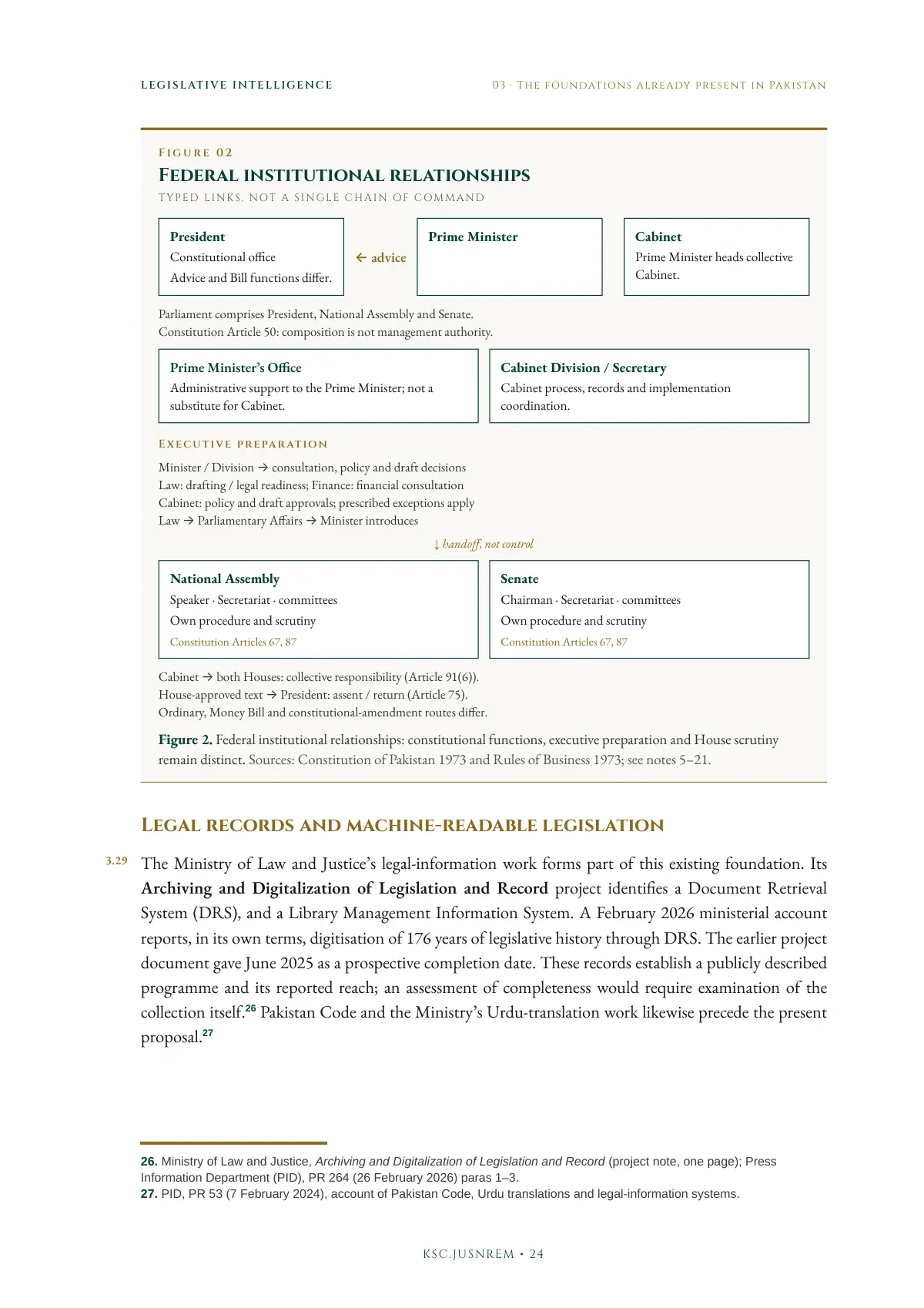
F i g u r e 0 2 Federal institutional relationships
TYPED LINKS, NOT A SINGLE CHAIN OF COMMAND
President
Prime Minister Cabinet
Constitutional office
← advice
Prime Minister heads collective Cabinet.
Advice and Bill functions differ.
Parliament comprises President, National Assembly and Senate. Constitution Article 50: composition is not management authority.
Prime Minister’s Office
Cabinet Division / Secretary
Administrative support to the Prime Minister; not a substitute for Cabinet.
Cabinet process, records and implementation coordination.
Executive prepar ation
Minister / Division → consultation, policy and draft decisions Law: drafting / legal readiness; Finance: financial consultation Cabinet: policy and draft approvals; prescribed exceptions apply Law → Parliamentary Affairs → Minister introduces
↓ handoff, not control
National Assembly
Senate
Speaker · Secretariat · committees
Chairman · Secretariat · committees
Own procedure and scrutiny
Own procedure and scrutiny
Constitution Articles 67, 87
Constitution Articles 67, 87
Cabinet → both Houses: collective responsibility (Article 91(6)). House-approved text → President: assent / return (Article 75). Ordinary, Money Bill and constitutional-amendment routes differ.
Figure 2. Federal institutional relationships: constitutional functions, executive preparation and House scrutiny remain distinct. Sources: Constitution of Pakistan 1973 and Rules of Business 1973; see notes 5–21.
Legal records and machine-readable legislation
3.29
The Ministry of Law and Justice’s legal-information work forms part of this existing foundation. Its Archiving and Digitalization of Legislation and Record project identifies a Document Retrieval System (DRS), and a Library Management Information System. A February 2026 ministerial account reports, in its own terms, digitisation of 176 years of legislative history through DRS. The earlier project document gave June 2025 as a prospective completion date. These records establish a publicly described programme and its reported reach; an assessment of completeness would require examination of the collection itself.26 Pakistan Code and the Ministry’s Urdu-translation work likewise precede the present proposal.27
26. Ministry of Law and Justice, Archiving and Digitalization of Legislation and Record (project note, one page); Press Information Department (PID), PR 264 (26 February 2026) paras 1–3. 27. PID, PR 53 (7 February 2024), account of Pakistan Code, Urdu translations and legal-information systems.
LEGISLATIVE INTELLIGENCE 03 · The foundations already present in Pakistan
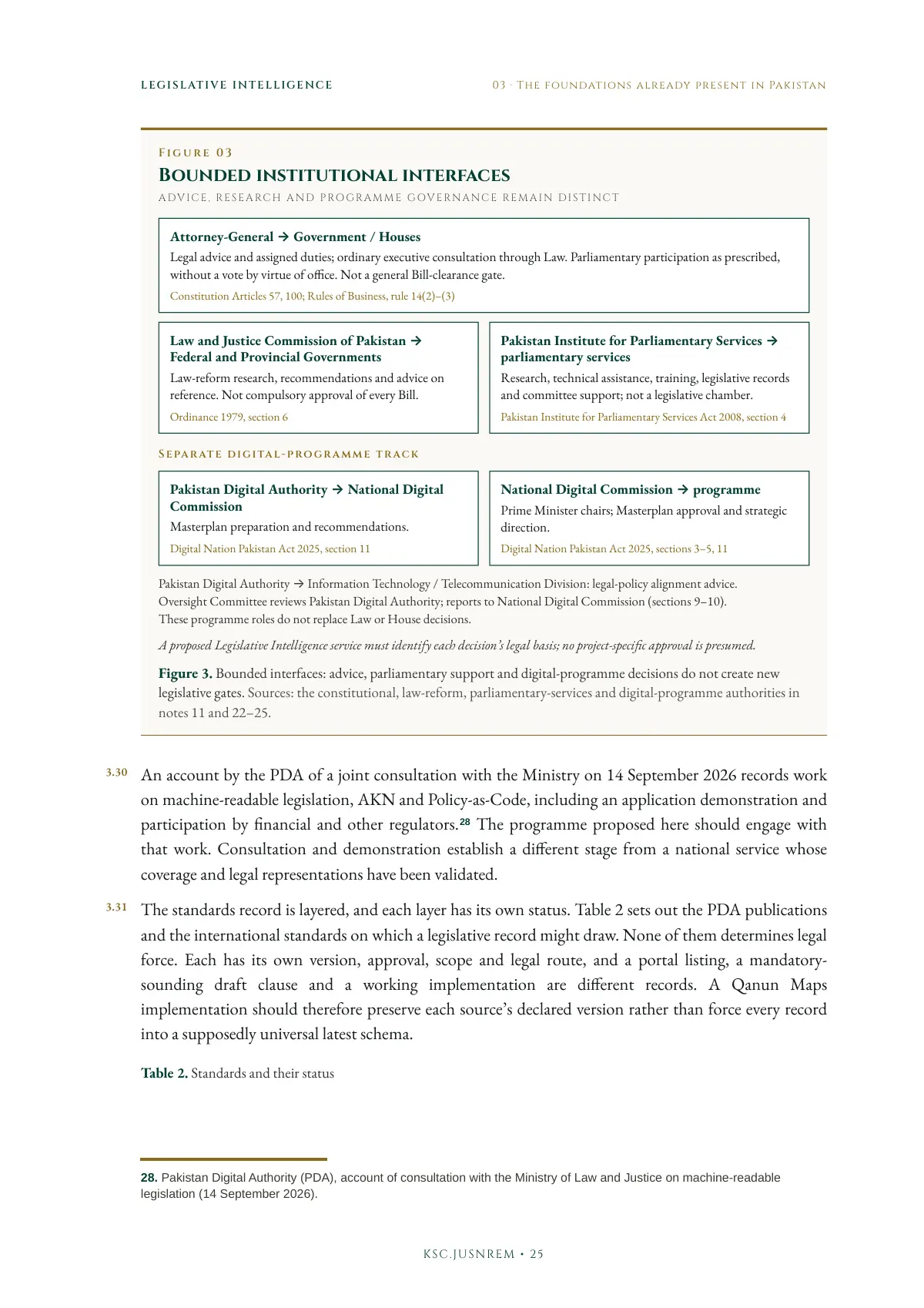
F i g u r e 0 3 Bounded institutional interfaces
ADVICE, RESEARCH AND PROGRAMME GOVERNANCE REMAIN DISTINCT
Attorney-General → Government / Houses
Legal advice and assigned duties; ordinary executive consultation through Law. Parliamentary participation as prescribed, without a vote by virtue of office. Not a general Bill-clearance gate.
Constitution Articles 57, 100; Rules of Business, rule 14(2)–(3)
Law and Justice Commission of Pakistan → Federal and Provincial Governments
Pakistan Institute for Parliamentary Services → parliamentary services
Law-reform research, recommendations and advice on reference. Not compulsory approval of every Bill.
Research, technical assistance, training, legislative records and committee support; not a legislative chamber.
Ordinance 1979, section 6
Pakistan Institute for Parliamentary Services Act 2008, section 4
Separ ate digital-progr amme tr ack
National Digital Commission → programme
Pakistan Digital Authority → National Digital Commission
Masterplan preparation and recommendations.
Prime Minister chairs; Masterplan approval and strategic direction.
Digital Nation Pakistan Act 2025, section 11
Digital Nation Pakistan Act 2025, sections 3–5, 11
Pakistan Digital Authority → Information Technology / Telecommunication Division: legal-policy alignment advice. Oversight Committee reviews Pakistan Digital Authority; reports to National Digital Commission (sections 9–10). These programme roles do not replace Law or House decisions.
A proposed Legislative Intelligence service must identify each decision’s legal basis; no project-specific approval is presumed.
Figure 3. Bounded interfaces: advice, parliamentary support and digital-programme decisions do not create new legislative gates. Sources: the constitutional, law-reform, parliamentary-services and digital-programme authorities in notes 11 and 22–25.
3.30
An account by the PDA of a joint consultation with the Ministry on 14 September 2026 records work on machine-readable legislation, AKN and Policy-as-Code, including an application demonstration and participation by financial and other regulators.28 The programme proposed here should engage with that work. Consultation and demonstration establish a different stage from a national service whose coverage and legal representations have been validated.
3.31
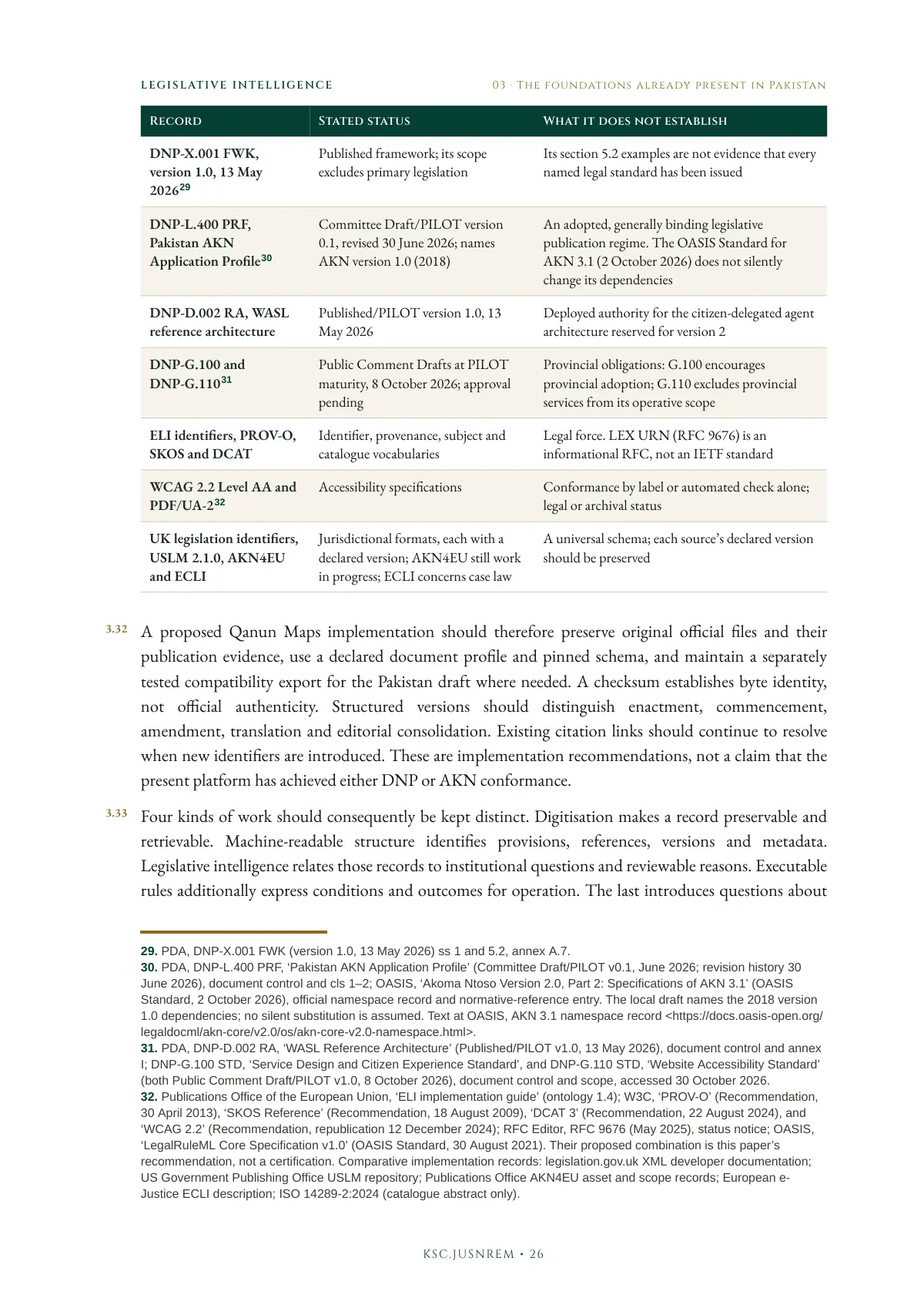
The standards record is layered, and each layer has its own status. Table 2 sets out the PDA publications and the international standards on which a legislative record might draw. None of them determines legal force. Each has its own version, approval, scope and legal route, and a portal listing, a mandatory-sounding draft clause and a working implementation are different records. A Qanun Maps implementation should therefore preserve each source’s declared version rather than force every record into a supposedly universal latest schema.
Table 2. Standards and their status
28. Pakistan Digital Authority (PDA), account of consultation with the Ministry of Law and Justice on machine-readable legislation (14 September 2026).
LEGISLATIVE INTELLIGENCE 03 · The foundations already present in Pakistan
Record Stated status What it does not establish
Published framework; its scope excludes primary legislation
Its section 5.2 examples are not evidence that every named legal standard has been issued
DNP-X.001 FWK, version 1.0, 13 May 202629
DNP-L.400 PRF, Pakistan AKN Application Profile30
Committee Draft/PILOT version 0.1, revised 30 June 2026; names AKN version 1.0 (2018)
An adopted, generally binding legislative publication regime. The OASIS Standard for AKN 3.1 (2 October 2026) does not silently change its dependencies
DNP-D.002 RA, WASL reference architecture
Published/PILOT version 1.0, 13 May 2026
Deployed authority for the citizen-delegated agent architecture reserved for version 2
DNP-G.100 and DNP-G.11031
Public Comment Drafts at PILOT maturity, 8 October 2026; approval pending
Provincial obligations: G.100 encourages provincial adoption; G.110 excludes provincial services from its operative scope
ELI identifiers, PROV-O, SKOS and DCAT
Identifier, provenance, subject and catalogue vocabularies
Legal force. LEX URN (RFC 9676) is an informational RFC, not an IETF standard
WCAG 2.2 Level AA and PDF/UA-232
Accessibility specifications Conformance by label or automated check alone; legal or archival status
A universal schema; each source’s declared version should be preserved
UK legislation identifiers, USLM 2.1.0, AKN4EU and ECLI
Jurisdictional formats, each with a declared version; AKN4EU still work in progress; ECLI concerns case law
3.32 A proposed Qanun Maps implementation should therefore preserve original official files and their publication evidence, use a declared document profile and pinned schema, and maintain a separately tested compatibility export for the Pakistan draft where needed. A checksum establishes byte identity, not official authenticity. Structured versions should distinguish enactment, commencement, amendment, translation and editorial consolidation. Existing citation links should continue to resolve when new identifiers are introduced. These are implementation recommendations, not a claim that the present platform has achieved either DNP or AKN conformance.
3.33
Four kinds of work should consequently be kept distinct. Digitisation makes a record preservable and retrievable. Machine-readable structure identifies provisions, references, versions and metadata. Legislative intelligence relates those records to institutional questions and reviewable reasons. Executable rules additionally express conditions and outcomes for operation. The last introduces questions about
29. PDA, DNP-X.001 FWK (version 1.0, 13 May 2026) ss 1 and 5.2, annex A.7. 30. PDA, DNP-L.400 PRF, ‘Pakistan AKN Application Profile’ (Committee Draft/PILOT v0.1, June 2026; revision history 30 June 2026), document control and cls 1–2; OASIS, ‘Akoma Ntoso Version 2.0, Part 2: Specifications of AKN 3.1’ (OASIS Standard, 2 October 2026), official namespace record and normative-reference entry. The local draft names the 2018 version 1.0 dependencies; no silent substitution is assumed. Text at OASIS, AKN 3.1 namespace record <https://docs.oasis-open.org/ legaldocml/akn-core/v2.0/os/akn-core-v2.0-namespace.html>. 31. PDA, DNP-D.002 RA, ‘WASL Reference Architecture’ (Published/PILOT v1.0, 13 May 2026), document control and annex I; DNP-G.100 STD, ‘Service Design and Citizen Experience Standard’, and DNP-G.110 STD, ‘Website Accessibility Standard’ (both Public Comment Draft/PILOT v1.0, 8 October 2026), document control and scope, accessed 30 October 2026. 32. Publications Office of the European Union, ‘ELI implementation guide’ (ontology 1.4); W3C, ‘PROV-O’ (Recommendation, 30 April 2013), ‘SKOS Reference’ (Recommendation, 18 August 2009), ‘DCAT 3’ (Recommendation, 22 August 2024), and ‘WCAG 2.2’ (Recommendation, republication 12 December 2024); RFC Editor, RFC 9676 (May 2025), status notice; OASIS, ‘LegalRuleML Core Specification v1.0’ (OASIS Standard, 30 August 2021). Their proposed combination is this paper’s recommendation, not a certification. Comparative implementation records: legislation.gov.uk XML developer documentation; US Government Publishing Office USLM repository; Publications Office AKN4EU asset and scope records; European e- Justice ECLI description; ISO 14289-2:2024 (catalogue abstract only).
LEGISLATIVE INTELLIGENCE 03 · The foundations already present in Pakistan
interpretation, exceptions, temporal application and authority which a successful scan or a well-formed document cannot answer.
Three connected records for practical use
3.34 These distinctions should govern the proposed service at the level of an individual provision. The first record is the legislation itself: the instrument, its parts, sections, subsections and schedules, with the source version and subsequent legal events. A section remains identifiable when its wording changes. A page number or a position in extracted text can locate evidence, but cannot replace the provision’s legal identity. An editorially reconstructed heading should be distinguishable from wording found in the instrument.
3.35 The second record concerns authority and responsibility. A rule should point to its enabling provision, the lawful maker, the subject and territorial scope, required consultation or approval, publication and commencement. An institutional connection should identify its basis in the Constitution, an enactment or the relevant allocation of business. Responsibility may change without the underlying Act being repealed. The map must therefore retain the dates and instruments supporting both the legal rule and the institutional allocation.
3.36 The third record is a reviewed decision model for a defined use. It should identify the applicable provision and version, facts required, conditions, exceptions, consequences and matters reserved for judgment. Missing evidence, conflicting sources and a legally discretionary decision require different responses; none should be converted silently into an automatic refusal or permission. A model may expose a drafting defect or support an authorised process. It cannot confer jurisdiction, determine a contested interpretation by its own operation or replace the legally responsible decision-maker.
3.37 The initial institutional enquiry should establish who maintains each source, how amendments and corrections are incorporated, which periods and languages are covered, and how parliamentary services can use the records. Cooperation on these matters would be more useful than duplicating collections or treating existing work as though it began with this paper.
3.38
A participating House would commission its own work through its authorised arrangements. PIPS and the relevant research and drafting services are possible collaborators; the nature of their contribution would require agreement. Compatible standards could also support federal and provincial work without transferring competence between them. This accords with the preference stated in Book Two, Chapter 22, for coordinated instruments rather than an omnibus federal law which obscures separate constitutional allocations.33
F R O M T H E A U T H O R Reconstituting Public Power
Constitutional, territorial, administrative and fiscal restructuring in Pakistan, in five books. Book Two examines the constitutional settlement and the allocation of power; Book Four examines the digital and intelligent constitutional order.
jusnrem.digital
33. Chughtai, Book Two (n 2) ch 22, topics 589–594.
LEGISLATIVE INTELLIGENCE 04 · Provincial legislative judgment and the federal…
04
Provincial legislative judgment and the federal relationship
4.1 Provincial legislative intelligence must begin with the province’s authority to decide. Article 142 reserves unlisted subjects to the Provincial Assemblies, subject to the shared competence over criminal law, criminal procedure and evidence. Where a provincial Act is repugnant to an Act which Parliament was competent to enact, Article 143 gives the parliamentary Act precedence and makes the provincial Act void to the extent of that repugnancy. Cooperation therefore requires an account of the subject and instrument before a common solution is proposed. Article 144 offers a consent-resolution route for parliamentary legislation on an unlisted matter; it does not impose federal clearance upon provincial legislation. Provincial executive arrangements, in turn, rest upon Article 139 and the province’s own rules for allocating and transacting business.34
4.2 A connected service should make these allocations usable. Evolutionary Legal Intelligence would trace amendments, experience and the authority to correct the arrangement; Strategic Legal Intelligence would establish the lawful actors and available choices; Anticipatory Legal Intelligence would examine dependence upon another government’s resources, records or administration. These dimensions belong together in preparation, scrutiny and implementation. A shared source format or analytical service could support them without placing provincial conclusions under federal supervision. Neither the NDC nor PDA should be treated in this proposal as a substitute for provincial competence or the Assembly’s judgment.
4.3
Two constitutional distinctions govern every provincial route. Article 115 requires Provincial Government introduction or consent for Money Bills and for the specified Bills or amendments involving expenditure from the Provincial Consolidated Fund or withdrawal from the Public Account. The Speaker decides Money Bill classification and supplies the constitutional certificate; government consent does not perform that function. Article 116 separately governs assent: ten days for assent or the return of a non-Money Bill, followed, after reconsideration and repassage by a majority present and voting, by ten days for assent and then deemed assent. Those periods differ from Article 105’s reconsideration of executive advice. Article 116 does not expressly make silence on first presentation assent.35 An intelligence record should distinguish these acts rather than report one undifferentiated approval.
34. Constitution, arts 139 and 141–144. Article 144 additionally permits the relevant Provincial Assembly to amend or repeal the resulting Act as applicable to that province. 35. Constitution, arts 105, 115–116. Article 115(2)–(3) supplies the Money Bill definition and exclusions; clauses (4)–(5) assign classification and certification to the Speaker. Provincial budgets separately follow arts 120–126.
LEGISLATIVE INTELLIGENCE 04 · Provincial legislative judgment and the federal…
Punjab and the capacity of the Assembly to examine and follow through
4.4 For Punjab, the defensible starting point is the Assembly and constitutional route. The June 2025 Assembly rules establish procedures which can support a substantial enquiry without reconstructing the current executive allocation. Four executive amendment texts from August 2025 to August 2026 are available in operative Gazette form. Their exact citations and the narrow August 2025 omission are set out in section 8. Those four texts improve the allocation record, but do not by themselves establish a complete current Punjab Law departmental organogram or the entire subsequent amendment chain. The constitutional responsibilities of the Provincial Government, Cabinet, Chief Minister and Advocate-General remain distinguishable from the unresolved administrative detail.36
4.5 The Assembly’s route makes preparation consequential. Rule 91 requires the Minister’s written notice, Bill, signed statement of objects and reasons and certificate concerning its Money Bill character. Under rules 94–95, ordinary Bills go to the appropriate standing committee unless the House dispenses with reference; the Finance Bill exception is not a declaration that every Money Bill follows that exception. Following the committee process, the ordinary minimum between supply of copies and the consideration motion is two clear days, with an exception for consideration without a committee report. Rules 96–109 provide the subsequent consideration, amendment and passage procedures, including a drafting-committee route for formal or consequential amendments.37
4.6 The proposed assistance should enlarge what members can examine within that route. A research account would connect the reasons for the Bill with the affected provisions, constitutional competence, fiscal assumptions and matters left to delegated legislation. The same account should test whether the institutions named in the clauses could carry out their duties and identify earlier arrangements whose experience bears on the proposed change. A committee report could then distinguish a drafting defect from a disputed policy choice or an unsupported implementation assumption. The House would retain the decision whether and how to amend.
4.7
Private members require usable assistance too. Rules 89–90 provide their notice and consent procedures and assistance against merely technical rejection. The constitutional Advocate-General advises on referred legal matters and may participate in the Assembly and qualifying committees without acquiring a vote by virtue of that office; this does not establish routine approval of every Bill.38 Legal research should help formulate questions requiring that professional judgment, without representing an automated answer as the opinion given.
4.8
Follow-through has an existing procedural basis. Rule 154(5) provides committee examination of departmental expenditure, administration, delegated legislation and policy, with an action report within forty-five days, subject to its provisos. This is an oversight response period, not a general deadline for
36. Provincial Assembly of the Punjab Rules of Procedure 1997 (PA Rules 1997); Constitution, arts 129–131, 139–140. The four operative Gazette texts are identified in section 8. The August instrument is No SO(Cab-I)2-47/85.V-II(P), dated 7 August 2025 and published on 20 August 2025, 899–900; its omission is confined to item (i), column 3, serial 24A. These four texts do not establish the complete later amendment chain. 37. PA Rules 1997, rr 91 and 94–109, particularly rr 94–96 and the drafting-committee provision in r 109(2)–(3). 38. PA Rules 1997, rr 89–90; Constitution, arts 111 and 140. Article 111 refers to a committee of which the Advocate-General may be named a member; participation is not universal committee membership.
LEGISLATIVE INTELLIGENCE 04 · Provincial legislative judgment and the federal…
Bills.39 A proposed linked record could preserve the recommendation, departmental answer, implementation evidence and unresolved question. It would connect present responsibility, anticipated consequences and subsequent correction. Rules 111–113 also distinguish transmission, publication and reconsideration, including permitted reconsideration on a deemed-return basis following first-stage silence. None makes publication proof that every provision has commenced.40
Sindh and the connection between legal feasibility and provincial coordination
4.9 Sindh's executive route puts legal feasibility before the request for Cabinet consideration. Under rule 45, the originating department determines the proposed contents and supplies the draft, reasons and background to Law. Law examines feasibility and gives the proposal legal shape or returns it with advice. The department then seeks the Chief Minister's approval to place the vetted proposal before Cabinet. The combined Law, Parliamentary Affairs and Criminal Prosecution allocation should not be redrawn as a separate federal-style Parliamentary Affairs ministry. These findings rely on the March 2024 compilation read with seven subsequently examined amendments through October 2026, rather than a claim that every later Gazette notice has been consolidated.41
4.10 The practical opportunity lies in the quality of the material reaching each institution. Legal feasibility requires a defined policy problem, an applicable source and a workable allocation. Anticipated staffing, financing and enforcement conditions should therefore accompany the draft rather than arrive after its legal form has been settled. Earlier enactments, amendments and departmental experience should inform that assessment from the outset. A proposed intelligence service would preserve the originating department’s policy reasons alongside Law’s advice, the decisions sought and the consequences of later changes. Rule 38’s Law-vetting requirement and control of subsequent alterations provide a concrete point at which this continuity matters.
4.11
The Advocate-General relationship further explains why the advice record cannot be reduced to a single clearance indicator. Under rule 29, consultation passes through Law; disagreement is conveyed verbatim. If the originating department rejects Law’s view, the Law Minister decides and, if necessary, the Chief Minister. An account which suppresses the separate opinions would remove part of the very question the responsible authority must resolve.42
4.12
Sindh also has a relevant coordination allocation. The notification of 29 June 2026 assigns Inter- Provincial Coordination functions that include analysis of provincial and federal proposals and evidence-based advisory and technical support to the Chief Secretary and Chief Minister. That provides a possible existing partner for the proposed examination of cross-government dependence. It confers no
39. PA Rules 1997, r 154(5). The provisos address, among other matters, a Speaker’s reasoned restraint following a majority committee request and biannual examination of expenditure. 40. PA Rules 1997, rr 111–113; Constitution, art 116. Commencement must be established from the particular Act and any applicable commencement instrument; no general provincial commencement default is asserted here. 41. Sindh Government Rules of Business 1986 (SRoB 1986), rr 38, particularly sub-rule (v), and 45(i)–(vii); sch I item 22 and sch II item 22. The later amendments reviewed do not amend these core rules; this bounded reconciliation does not certify an exhaustive consolidation. 42. SRoB 1986, r 29(iv)–(v).
LEGISLATIVE INTELLIGENCE 04 · Provincial legislative judgment and the federal…
Assembly, assent or general legislative approval power.43 A provincial dossier could use such analysis to identify a common interest while preserving a reasoned provincial position, the resources on which it depends and the evidence that might justify revising it.
4.13 The House supplies a separate test. Rules 99–100 govern committee reference, the Finance Bill exception and the three-clear-day interval before a consideration motion; rules 101–114 provide consideration and amendment, including a limited drafting-committee route. Rule 167 connects scrutiny to departmental expenditure, administration, delegated legislation and policy, with a two-week reply to oversight findings and recommendations.44 The proposed record should carry the question through those stages and examine the answer, rather than count receipt as correction. For assent, rule 116’s Assembly Secretary transmission duty and rule 45’s executive processing can be complementary layers; neither establishes an additional executive veto. Their administrative mechanics should be confirmed before implementing automated routing.45
Khyber Pakhtunkhwa and legal expertise within scrutiny
4.14 Khyber Pakhtunkhwa’s 2025 Assembly rules offer a particularly direct connection between scrutiny and legal expertise. They replace the 1988 rules, with savings. Under rules 184–188, the committee arrangements bring the departmental Secretary, Law Secretary or nominee, and Advocate-General or nominee of at least Assistant Advocate-General rank into the provision of expert opinion, subject to the prescribed attendance arrangements. These roles must remain distinct from elected membership and the constitutional absence of a vote merely by virtue of the Advocate-General’s office.46
4.15 This connection makes the proposed service most useful as preparation for an encounter between different responsibilities. Members need an independent account of the proposal; the department must explain its administration; legal officers address the legal questions. A common dossier could expose the choices and authorities, test administrative and fiscal dependencies, and preserve the history of contested clauses and earlier implementation. It should also retain unanswered questions after the hearing. Those functions apply Evolutionary, Strategic and Anticipatory Legal Intelligence together, without making either departmental expertise or generated analysis decisive.
4.16
The executive Rules of Business assign originating policy and substantive provisions to the administrative department and legal shaping to the combined Law, Parliamentary Affairs and Human Rights Department. Rule 12 requires consultation with the Advocate-General through Law; where the department rejects Law's view after disagreement, the Law Minister decides and may refer the matter to Cabinet. Rule 11 provides financial consultation and a Cabinet decision where Finance has not concurred, with further scrutiny of details by Finance. Later amendments to the official compilation
43. Services, General Administration and Coordination Department (Sindh), notification of 29 June 2026, substituted sch II allocation for Inter-Provincial Coordination. The proposed intelligence partnership is this paper’s recommendation, not a notified programme. 44. Rules of Procedure of the Provincial Assembly of Sindh 2013 (SA Rules 2013), rr 99–114, and r 167, particularly sub-rule (7). Later amendments have not been examined. The drafting committee’s period is not to exceed seven days; the two-week oversight response is a different requirement. 45. SA Rules 2013, rr 116–118; SRoB 1986, r 45(viii)–(ix). The endpoint and executive processing are potentially complementary; the sources do not establish an additional assent veto or an excluded intermediary. No Punjab-style first-presentation deemed-return provision is claimed for Sindh. 46. Khyber Pakhtunkhwa Assembly Procedure and Conduct of Business Rules 2025 (KPA Rules 2025), rr 184–188 and 318. Read with Constitution, art 111. The prescribed departmental substitute requires the chair’s permission; the minimum Assistant Advocate-General rank concerns the Advocate-General’s nominee.
LEGISLATIVE INTELLIGENCE 04 · Provincial legislative judgment and the federal…
have not been examined, so its allocations are stated as at that compilation.47 The proposed service should retain this source limitation beside the affected responsibility, not silently import a more recent-looking title from another province.
4.17 The 2025 House rules require publication in the Gazette and official website, subject to stated exceptions, and ordinary committee reference, excluding the Finance Bill and allowing the House to dispense with reference through the prescribed motion. Copies precede the consideration motion by at least three clear days. These stages give the dossier a practical destination: questions and alternatives must arrive while members can still use them.48 A shorter processing time would be an inadequate success measure if it reduced the opportunity to examine material objections.
4.18 After passage, Assembly rules 132–133 identify the Secretary’s transmission and publication duties; executive rule 29 separately describes Law processing and publication. These provisions can be complementary, but operational arrangements should identify who records each event without inventing another approval. Rule 134 permits deemed-return reconsideration after first-stage silence, not automatic assent.49 Subsequent enquiry should distinguish enactment, statutory commencement, delegated instruments and actual administration, using the province’s scrutiny arrangements to ask whether the promised effect has followed. A provision’s survival in the statute book supplies no answer to that question.
Balochistan and continuity across departmental and Assembly responsibilities
4.19 Balochistan presents a different handoff. Its Rules of Business, consolidated through 29 July 2026, provide in rule 38 for the originating department to forward the completed legislative package to the Assembly following the prescribed Law and executive steps. Law and Parliamentary Affairs still performs legal and parliamentary functions, but the final departmental handoff should not be replaced with Sindh’s or Khyber Pakhtunkhwa’s route. Rule 17 also preserves a distinct disagreement procedure: where the department rejects Law’s view following disagreement with the Advocate-General, the Chief Minister decides.50
4.20
The proposed intelligence support would make the originating department’s responsibility legible across that handoff. The Bill, reasons, consultation history, fiscal dependencies and outstanding choices should travel together. Committee scrutiny could then test the department’s account against constitutional authority and delivery conditions, while preserving the amendment history for later examination. Rule 15’s financial provisions require careful treatment: a reference of Finance refusal through the Chief Secretary to the Chief Minister does not erase the separate Cabinet-decision requirement for proceeding without concurrence.51 A digital route should show which act has occurred, rather than treat a forwarded file as a resolved objection.
47. Khyber Pakhtunkhwa Government Rules of Business 1985 (KPRoB 1985), rr 4–5, 11, 12(3), (5)–(7), and sch II. The source does not establish a comprehensive current executive organogram. 48. KPA Rules 2025, rr 111 and 113–116. Rule 113 exceptions include the Article 128(3) Bill and same-day introduction, consideration and passage; the committee exception concerns the Finance Bill, not all Money Bills. 49. KPA Rules 2025, rr 132–134; KPRoB 1985, r 29(5), (7). The Assembly transmission endpoint does not itself exclude executive processing, and no implied repeal or additional approval is asserted. 50. Balochistan Government Rules of Business 2012 (BRoB 2012), rr 17(3)–(9) and 38(1)–(3). Departmental forwarding follows the prescribed rr 17 and 24 steps; it does not dispense with legal or executive preparation. 51. BRoB 2012, r 15, particularly sub-rules (3)–(4).
LEGISLATIVE INTELLIGENCE 04 · Provincial legislative judgment and the federal…
4.21 Balochistan’s December 2025 Assembly rules also demonstrate why maintenance is substantive work. Amended rule 81 permits Gazette publication of an introduced Bill where required, whereas executive rule 38 uses different publication wording. Those provisions need administrative reconciliation for operational routing, rather than an unsupported declaration that they conflict. Rules 84–85 provide committee reference for other Bills, its possible dispensation, supply of copies within seven days after committee return or expiry of reporting time, and three clear days before consideration. The separate Finance Bill procedure appears in rules 82–83.52 An intelligence service must preserve these distinct triggers; a generic provincial timetable would misstate them.
4.22 Committee allocation likewise differs. Rule 128 groups several subjects and permits notified alignment with the Rules of Business. Rule 129(3) brings departmental and Law officers into expert assistance but does not expressly impose the Advocate-General attendance requirement found in Khyber Pakhtunkhwa’s 2025 text.53 Assistance should follow the committee’s actual remit, identify the responsible implementing institutions and preserve questions for later examination. Rules 99–100 separately govern transmission, publication and return, including the December 2025 deemed-return addition. Publication and assent still leave the commencement and delegated powers of the particular Act to be examined.54
Cooperation without displacement of responsibility
4.23 The provincial differences determine what a connected programme must preserve. Shared research, interoperable records and comparative drafting could reduce duplicated work, but each contribution needs a provincial source, responsible recipient and lawful decision route. Advice, financial concurrence, committee recommendation, House passage and assent must remain separately identifiable. Executive provisions permitting dispensation with Cabinet reference, found in the Sindh, Khyber Pakhtunkhwa and Balochistan texts, are not relied upon here as authority for a digital shortcut or as a resolved account of their current constitutional application.55
4.24
The proposed federal–provincial relationship is consequently one of supported enquiry and accountable cooperation. Each participating institution would retain control of its questions and conclusions. Across preparation, scrutiny and follow-through, the work would examine authority and choice, foreseeable dependence and consequence, and evidence for correction together. The practical test is whether the responsible institution can obtain a reasoned account, challenge it and act through its own lawful means. A common platform would be useful to the extent that it serves that test.
52. Balochistan Assembly Rules of Procedure and Conduct of Business 1974 (BA Rules 1974), rr 81–85; BRoB 2012, r 38(3). The seven-day supply period and three-clear-day consideration interval run from different events. 53. BA Rules 1974, rr 128–129, particularly rr 128(2) and 129(3). The departmental Secretary or designated officer of at least Additional Secretary rank and the Law Secretary or competent nominee attend as expert advisers; the absence of an express Advocate-General attendance requirement here is not a prohibition on participation otherwise lawfully available. 54. BA Rules 1974, rr 99–100, particularly r 100(2) proviso and (6); BRoB 2012, r 38(7)–(11); Constitution, art 116. 55. SRoB 1986, rr 11 and 13; KPRoB 1985, r 19(2); BRoB 2012, r 25. Constitutional application of the exceptions is reserved, not determined in favour of either a universal shortcut or their categorical invalidity.
LEGISLATIVE INTELLIGENCE 04 · Provincial legislative judgment and the federal…
F i g u r e 0 4 Four provinces, distinct routes
EXECUTIVE PREPARATION DOES NOT DISPLACE ASSEMBLY JUDGMENT
PUNJAB Assembly and constitutional core
SINDH Legal feasibility before Cabinet
Originating department → Law's legal shaping → Chief Minister's package → Assembly → committee and House stages. Two clear days before consideration, with a stated exception.
Minister’s approval to place the vetted proposal before Cabinet. Combined Law, Parliamentary Affairs and Criminal Prosecution. Three clear days before ordinary consideration.
Executive r 45 · Assembly rr 99–114
Four executive amendments 2025–26 identified in operative Gazette form (section 8); the complete later chain is not established.
Assembly rr 91, 94–109 · Constitution arts 115–116
KHYBER PAKHTUNKHWA Expertise in scrutiny
BALOCHISTAN Originating-department handoff
Department supplies policy → combined Law, Parliamentary Affairs and Human Rights gives legal shape → House route.
After the prescribed Law and executive steps, the originating department sends the completed package to the Assembly.
Not to be replaced by another Province’s departmental route.
2025 committees: departmental, Law and Advocate- General expertise under prescribed arrangements; no vote by office.
Executive r 38 · Assembly rr 81–85, 128–129
Executive rr 11–12, 29 · Assembly rr 184–188
Article 116: deemed assent attaches to the second presentation only.
All four: passage ≠ assent ≠ publication ≠ commencement.
Figure 4. Four provincial routes: distinct preparation and scrutiny relationships, with Punjab’s unresolved executive allocation kept visible. Sources: section 4, notes 34–55. Executive references identify each province’s Rules of Business.
LEGISLATIVE INTELLIGENCE 05 · What comparative experience establishes
05
What comparative experience establishes
5.1 International experience supplies evidence about particular functions. It cannot settle in advance which institution in Pakistan should perform them, or whether their availability will alter the distribution of legislative capacity. The Inter-Parliamentary Union (IPU) report World e-Parliament Report 2024 surveyed 115 parliaments or chambers in 86 countries and supranational parliaments; 29 per cent of respondents reported using AI tools. Its separate guidance connects human oversight with evaluation and an identified authority able to withdraw a failing system.56 Adoption describes a condition. The effect upon scrutiny must still be examined.
5.2 The cases below distinguish official accounts of operation, research designs and conceptual analysis. Unless a specific evaluation is identified, reported use establishes neither a causal improvement in legislative quality nor a transferable estimate of savings.
Drafting and parliamentary workflow
United Kingdom and Scotland: routine use
5.3 The United Kingdom and Scotland’s Lawmaker illustrates a function more substantial than document retrieval. The National Archives’ 2023–24 annual report records routine use across parliamentary and government drafting bodies, more than 1,000 users, and use for all Bills before the UK and Scottish Parliaments.57 Shared drafting, amendment handling and publication connect successive responsibilities for a text. The institutional question for Pakistan is whether a comparable connection would preserve the work of scrutiny or leave each stage dependent on an incomplete account of the last.
European Union: production and research
5.4
The European Commission’s September 2026 account identifies EdiT, based on the LEOS legislative editor, in production for five Ordinary Legislative Procedure proposal templates, with broader delegated and implementing-act coverage planned for 2027–28. The separate Augmented LEOS report examines user priorities and prospective smart functions.58 A deployed editor and a feasibility study answer different questions. Structured editing may prevent certain defects in a document; the judgment whether its provisions are lawful, coherent and justified remains with the responsible reviewers.
56. Inter-Parliamentary Union (IPU), World e-Parliament Report 2024 (2024) 5, 19, 61–62; IPU, Guidelines for AI in Parliaments (2024) 18–19, 82–85, 110. Text at World e-Parliament Report 2024 <https://www.ipu.org/file/20313/download>. 57. The National Archives, Annual Report and Accounts 2023–24 (HC 71, 25 July 2024) 23–24. Text at The National Archives, Annual Report and Accounts 2023–24 <https://assets.publishing.service.gov.uk/media/66a11d5049b9c0597fdb0443/ The_National_Archives_Annual_Report_and_Accounts_2023-24_Web_Accessible.pdf>. 58. European Commission, ‘Legal interoperability highlights’ (22 September 2026, updated 8 October 2026), ‘Institutional rollout’, Q3 and Q5; Fotios Fitsilis, George Mikros and Sotiris Leventis, Augmented LEOS: Final Report (February 2024) 5 and chs 3–4, 20–36. Text at European Commission, legal interoperability highlights <https://interoperable-europe.ec.europa.eu/ collection/portal-support/news/legal-interoperability-highlights>.
LEGISLATIVE INTELLIGENCE 05 · What comparative experience establishes
India: reported deployment
5.5 India’s National e-Vidhan Application provides a regional example of shared infrastructure across legislatures. A March 2026 parliamentary-answer release distinguishes 28 legislatures with memoranda from 21 conducting digital business and seven in implementation. The described work covers questions, notices, document processing and public access.59 The distinction between agreement and operation is material to a federal programme. Shared infrastructure needs an account of each legislature’s responsibilities and stage of participation, rather than one aggregate claim of completion.
Records and fiscal analysis
Finland: research prototype
5.6 Finland’s ParliamentSampo, a university-built linked-data research service, connects speeches, speakers and related information in several structured formats. Its June 2025 manual describes a prototype and records corrections and additions.60 A reader can gain from those relationships only if the official record remains distinguishable from later enrichment and omitted material can be restored. Gagnon and Azzi’s related design study examines semantic annotation, knowledge graphs and citizen-oriented enquiry, supplying a research design rather than an evaluated parliamentary service.61
Kenya: official records
5.7 Kenya Law maintains an official legislation collection. A delivery-partner account of consolidation describes the importance of editorial tools, task tracking, approvals and publication support alongside structured Extensible Markup Language (XML).62 The account directs attention to the continuing work behind a usable legal text. A source collection acquires practical value through responsibility for versions, corrections and publication; adopting a format does not perform those functions by itself.
5.8
A maintained text also needs a navigable account of its legal relationships. Canada’s Financial Administration Act connects the parent enactment with regulations made under it and separately identifies repealed regulations; the Accountable Advances Regulations links back to its enabling Act. Australia’s register distinguishes the title identifier from the compilation identifier and registration from effective dates. Its version history connects compilations with the amendments included. These arrangements make a particular source and relationship inspectable. For Pakistan, the transferable requirement is an evidenced relationship between records, not an assumption that the foreign
59. Ministry of Parliamentary Affairs, ‘21 State/UT Legislatures Conduct Business in Digital Mode through NeVA, 7 More at various Stages of Implementation’ (Press Information Bureau, 11 March 2026) paras 1–4. 60. SeCo, ‘Parlamenttisampo’, ‘Tulokset’ and ‘Parlamenttisammon aineistot ja portaali verkossa’ accessed 30 October 2026; Parlamenttisammon käyttöohje (11 June 2025) 1. 61. Stéphane Gagnon and Sabrina Azzi, ‘Semantic Annotation of Parliamentary Debates and Legislative Intelligence Enhancing Citizen Experience’ in Andrea Kő and others (eds), Electronic Government and the Information Systems Perspective (LNCS 13429, Springer 2022) 63 doi 10.1007/978-3-031-12673-4_5. 62. Kenya Law, ‘About Kenya Law’, ‘Organizational Profile’ and ‘Mandate and functions’, and ‘Laws of Kenya’ accessed 30 October 2026; Greg Kempe, ‘Using Laws.Africa’s technology to bolster Kenya’s legal framework’ (Open Law Africa) accessed 30 October 2026, ‘Challenges faced’ and ‘Technological innovation’.
LEGISLATIVE INTELLIGENCE 05 · What comparative experience establishes
publication system determines domestic legal authority.63
France: observed analytical use
5.9 The French National Assembly's LexImpact demonstrates a further use: fiscal analysis connected to legislative work. A filed amendment to the 2026 social-security financing Bill explicitly used its estimates in the explanation. The amendment was withdrawn before discussion.64 The record therefore establishes use in preparing a proposal, without establishing enactment or the accuracy of the estimates. For the present programme, the relevant relationship is between parliamentary choice and the ability to examine a fiscal scenario independently, with its assumptions, year and confidentiality requirements intact.
Participation and institutional response
Brazil: institutional account
5.10 Brazil’s Chamber describes Ulysses functions for thematic classification and routing, alongside newer functions presented as developing or forthcoming. A case study by the IPU and the United Nations Development Programme describes provision-level contributions to e-Democracia through Wikilegis and records the absence of clear success measures.65 Classification can assist staff confronted with a large body of submissions. It also creates a decision about which distinctions survive their compression. The original contribution and a means of questioning its treatment should remain available.
5.11 The scholarship identifies a related institutional difficulty. Freitas, Lima and Lima’s study of one e- Democracia community found unequal participation and internal mediation of proposals; its small questionnaire sample cannot represent all users. Marques’s earlier qualitative comparison located differences in institutional willingness, resources and political incentives, rather than platform availability alone.66 Participation depends upon more than an opportunity to transmit text. It requires an account of who receives it, what consideration follows and why a proposal is accepted or rejected.
Chile: procedural design
5.12
Chile’s Congreso Virtual provides a procedural example. The National Congress Library’s account explains that consultations should reach the relevant committee before its general vote, supported by
63. Department of Justice Canada, Financial Administration Act, contents and regulations listings, and Accountable Advances Regulations, enabling-Act link; Australian Government, Legislation Act 2003, Details and All versions accessed 31 October 2026. Links: Canadian Act <https://laws-lois.justice.gc.ca/eng/acts/F-11/index.html>; Regulations <https://laws-lois.justice.gc.ca/eng/regulations/SOR-86-438/index.html>; Australian details <https://www.legislation.gov.au/C2004A01224/ latest/details>; Versions <https://www.legislation.gov.au/Series/C2004A01224>. 64. Assemblée nationale, ‘LexImpact: À propos’, ‘Qui sommes-nous?’ and ‘Les services proposés’ accessed 30 October 2026; Assemblée nationale, amendement no 2424 au projet de loi de financement de la sécurité sociale pour 2026, texte no 1907 (1 November 2025) 1, 3–4. 65. Câmara dos Deputados, ‘Prática do ano: Ulysses’ (institutional account) accessed 30 October 2026; Agência Câmara, ‘Câmara lança nova fase do programa Ulysses e políticas de governança em Inteligência Artificial’ (11 December 2025) paras 3–6 and ‘Base sólida’; IPU and UNDP, Global Parliamentary Report 2022: Annex—Case Studies and Practical Guides (2022), ‘Brazil: Digital engagement’, 5–8. 66. Christiana Soares de Freitas, Fernanda Fiuza Lima and Fernanda Queiroz Lima, ‘Os Desafios ao Desenvolvimento de um Ambiente para Participação Política Digital: o Caso de uma Comunidade Virtual Legislativa do Projeto e-Democracia no Brasil’ (2015) 22(75) Organizações & Sociedade 639, ‘Metodologia’, ‘Os participantes’ and ‘Razões para participação’; Francisco Paulo Jamil Almeida Marques, ‘Government and e-participation programs: A study of the challenges faced by institutional projects’ (2010) 15(8) First Monday, 2–3, 7–8.
LEGISLATIVE INTELLIGENCE 05 · What comparative experience establishes
institutional preparation of summaries and questions.67 This places participation at a point where it can inform the choice. Whether it does so requires the further evidence of committee receipt, response and any resulting change.
Representation, interpretation and legal authority
5.13 New Zealand’s Better Rules discovery in 2018 brought legal, policy and software expertise together to examine legislation through concept and decision models. The experiments exposed definitional and service-delivery questions.68 Germany’s SPRIND Law as Code programme also describes ambitions for formal representation and implementation.69 Neither record establishes a completed, generally authoritative executable statute book. Their value here lies in the questions which modelling can reveal before a representation is put to use.
5.14 The institutional boundary is express in Germany’s ministry account: cases involving discretion or evaluative judgment remain for human assessment. The approach is open to suitable methods rather than being tied exclusively to one supplier. The Federal Agency for Breakthrough Innovation places review, authorisation, version maintenance and continuing operation alongside technical representation. For the Pakistani programme, these are reasons to identify who may approve a representation, correct it and withdraw it from use before selecting an execution system.70
5.15 The 2026 consultation of the Organisation for Economic Co-operation and Development (OECD) adds a distinct international development. It is seeking a shared reference framework for the digital provision of enacted law, with a final publication expected in late 2027 or early 2028. It does not establish a completed international standard or a binding implementation deadline. Its focus on enacted law also differs from the broader drafting, parliamentary scrutiny and participation examined in this paper. Pakistan can contribute experience to that discussion while retaining its constitutional allocation and testing the actual conditions of domestic use.71
5.16
Mohun and Roberts’s working paper for the OECD distinguishes machine-consumable rules from natural-language law and examines governance, legal status and versioning. The AKN standard of the standards organisation OASIS separately distinguishes authorial content from editorial markup and supports structural validation.72 These distinctions locate responsibility. A correct document structure
67. Biblioteca del Congreso Nacional de Chile, ‘Senado y Cámara lanzan plataforma “Congreso Virtual” para enriquecer el proceso legislativo con la participación ciudadana’, ‘Funcionamiento del Congreso Virtual’, paras 1–6 accessed 30 October 2026. 68. New Zealand Digital Government, Better Rules for Government Discovery Report (2018), ‘Approach’, ‘Service delivery problems’ and ‘Approach to experiments’. 69. SPRIND, ‘Law as Code’ (strategic-project description) accessed 30 October 2026. 70. German Federal Ministry for Digital Transformation and Government Modernisation, ‘Law as Code’, ‘Law as Code und Rulemapping: Nächste Schritte’; Federal Agency for Breakthrough Innovation, ‘Law as Code’, ‘What does Law as Code require?’ accessed 31 October 2026. Programme descriptions, not evidence of a completed authoritative executable statute book. Links: Ministry account <https://bmds.bund.de/themen/staatsmodernisierung/law-as-code>; Programme <https:// www.sprind.org/en/actions/strategic-projects/law-as-code>. 71. Organisation for Economic Co-operation and Development, ‘Consultation on the digital provision of law: Towards a shared reference framework for law as code’, Purpose, Scope and Timeline <https://www.oecd.org/en/events/public-consultations/2026/07/consultation-on-the-digital-provision-of-law-towards-a-shared-reference-framework-for-law-as-code.html> accessed 31 October 2026. The consultation concerns digital provision of enacted law; its expected publication date is not a binding standard or legal commencement date. 72. James Mohun and Alex Roberts, Cracking the Code: Rulemaking for Humans and Machines (OECD Working Papers on Public Governance No 42, 2020) 6–7, 78–81; OASIS, ‘Akoma Ntoso Version 1.0, Part 1: XML Vocabulary’ (29 August 2018) ss 4.3–4.4.
LEGISLATIVE INTELLIGENCE 05 · What comparative experience establishes
cannot decide a contested interpretation; successful execution cannot establish the authority for the rule executed.
5.17 Hildebrandt’s analysis examines the consequential design choices in computational representations and their implications for the rule of law. Diver directs attention to assumptions and constraints produced before code executes.73 Their conceptual arguments require evaluation to reach beyond technical success to the cases excluded, the practical legal effects and the means of contesting a result.
5.18 Fraser and Barraclough’s practitioner analysis makes the responsibility more concrete: governance must attend to legal interpretations embedded in data and operational specifications as well as to software. Their reporting example and discussion of parallel drafting support traceability and identifiable review, without establishing that code has replaced enacted law.74
5.19 Commercial products advertise legislative tracking, source-grounded research and workflow management.75 Those functions may help define a task. A business case still requires its own evidence of accuracy, review effort, cost and fitness for the institution concerned. The comparative record supports a programme of maintained sources and professional use, examined through actual decisions, rather than a presumption that the acquisition of a system supplies legislative capacity.
5.20 Rulemapping provides a useful proposition to examine: expressing conditions, exceptions and legal consequences as visual decision models, with traceable execution. Its related Law as Code initiative advocates openness, shared standards and public governance. These are the developer’s descriptions, not an independent finding of legal accuracy or interoperability. A deterministic model can consistently reproduce an error in its legal premise. Acceptance must therefore examine the source, interpretation, version and excluded cases, not merely the consistency of the software’s answer. Claims of openness should be tested against the actual licence, specification and exported record.76
Table 3. Comparative functions and limits
Comparator
Record and function shown Lesson and limit
Lawmaker (note 57) Official annual report of routine shared drafting
Connect drafting stages; use alone does not establish better scrutiny.
EdiT / LEOS (note 58) Production editing account; separate feasibility research
Preserve structure; prospective functions are not deployed results.
Record each legislature’s stage; an agreement is not operational capacity.
India NeVA (note 59) Parliamentary-answer account distinguishing agreement and operation
73. Mireille Hildebrandt, ‘The Future of Computational Law in the Context of the Rule of Law’ (2024) 2(2) Journal of Cross-disciplinary Research in Computational Law 5–7; Laurence Diver, ‘Interpreting the Rule(s) of Code: Performance, Performativity, and Production’ (MIT Computational Law Report, 7 December 2021, release 4) ss 2.2, 3.3–3.4. 74. Hamish Fraser and Tom Barraclough, ‘Governing Digital Legal Systems: Insights on Artificial Intelligence and Rules as Code’ (MIT Computational Law Report, 14 October 2024, release 2), governance discussion, drinking-water reporting example and parallel-drafting discussion. 75. InstaTrac, ‘Legislative Intelligence’ (20 June 2025); Apogee, ‘Legislative Intelligence’; Cloudwick, ‘Legislative Intelligence’ (product descriptions) accessed 30 October 2026. 76. Rulemapping Group, ‘Rule AI’, ‘Reasoning built on legal logic’ and ‘From legislation to execution’; ‘Law as Code’, Guiding principles and Rulemap Builder accessed 31 October 2026. These are supplier and initiative descriptions; software performance, licensing and interoperability have not been established by them. Links: Product description <https:// rulemapping.com/rule-ai>; Principles <https://law-as-code.org/#principles>.
LEGISLATIVE INTELLIGENCE 05 · What comparative experience establishes
Comparator
Record and function shown Lesson and limit
ParliamentSampo (note 60) University research prototype and manual
Keep enrichment distinguishable from the official record; not an evaluated parliamentary service.
Kenya Law (note 62) Official collection and delivery-partner consolidation account
Maintain editorial and publication responsibility; a format alone supplies neither.
LexImpact (note 64) Filed amendment using fiscal estimates, later withdrawn
Make assumptions examinable; use proves neither accuracy nor enactment.
Brazil Ulysses / e- Democracia (notes 65–66)
Institutional accounts and qualified participation research
Preserve contributions and review their treatment; participation and success measures remain uneven.
Chile Congreso Virtual (note 67)
Connect consultation to an open choice; receipt, response and effect still require evidence.
Institutional account of consultation before committee consideration
Better Rules / SPRIND (notes 68–69)
Discovery work and programme ambitions
Modelling can reveal design questions; no authoritative executable statute book is established here.
OECD / AKN and scholarship (notes 72–74)
Analytical distinctions, structural standards and interpretive criticism
Separate representation, interpretation and authority; technical validity cannot settle the legal conclusion.
LEGISLATIVE INTELLIGENCE 06 · From a legal record to legislative judgment
06
From a legal record to legislative judgment
6.1 The first responsibility of a legislative dossier is to establish what is being examined. A document needs an issuer or author, jurisdiction, category, date, version and passage locator. Publication, assent, commencement and amendment answer different questions. Where text has been extracted or translated, the reader should be able to return to the source image and examine a disputed name, number or provision.
6.2 The reading arrangement should make that discipline usable. The United Kingdom’s provision-level reader distinguishes contents, an individual section and its amendment history. New Zealand’s published guidance describes retaining a selected section when changing versions and locating secondary legislation through its empowering provision. These are useful design lessons for a service in which readers move between the governing provision, the surrounding text and the instrument which changed it. The comparison concerns observable or documented functions, not proof that a particular interface improves legal understanding.77
6.3 For Qanun Maps, this suggests an on-site legislation reader with a visible title list, title and full-text search, jurisdiction, year and instrument filters, and a contents panel following the instrument’s actual hierarchy. Search results should open the cited provision in context. A reusable text or structured download should preserve its source, version and provision identifiers. An accessible source image remains necessary where extraction is incomplete. Technical checksums and extraction offsets belong in an expandable record of provenance, not in place of the law which the visitor came to read. These are requirements for development and testing, not a statement that every function is already available.
6.4
Relationships between documents require the same care. A report may propose an amendment; a Bill may concern the same statute; an Act may later carry a similar title. Whether the Act adopts the recommendation depends upon its provisions and legislative record. The connection cannot be supplied by resemblance alone. Likewise, a speech records an argument made by a particular speaker; the legal use of that argument requires a further judgment about the applicable interpretive rules.
6.5
A legislative journey should similarly preserve successive texts and procedural acts. Louisiana’s 2026 appropriations Bill record links original, engrossed, enrolled and enacted texts to amendments, votes and dated actions. Its history qualifies the headline signing status with line-item vetoes and a separate effective date. The lesson is the preservation of a legally consequential qualification, not the
77. The National Archives, Human Rights Act 1998, contents and s 6 reader; New Zealand Legislation, ‘Navigate legislation’, version selection, section view and secondary-legislation guidance accessed 31 October 2026. United Kingdom reader inspection and New Zealand published guidance concern interface functions; no comparative user-outcome evaluation is asserted. Links: Contents <https://www.legislation.gov.uk/ukpga/1998/42/contents>; Section reader <https:// www.legislation.gov.uk/ukpga/1998/42/section/6>; New Zealand guidance <https://www.legislation.govt.nz/navigate-legislation/ >.
LEGISLATIVE INTELLIGENCE 06 · From a legal record to legislative judgment
transplantation of American executive powers. A Pakistani dossier should link its own Bill versions, committee reports, amendments, messages, assent and commencement evidence according to the applicable constitutional route.78
F i g u r e 0 5 From source record to correction
FOUR LINKED RECORDS
01 Source record Institution · jurisdiction · type · version · locator
02 Shared enquiry Question · selected evidence · uncertainty
03 Reviewed dossier Selected outputs · legal and relevant fiscal review
04 Decision and correction Reasons · status · implementation · revision
Figure 5. From the source record through shared enquiry and reviewed dossier to decision and correction. Summary of section 6.
6.6 The dossier should preserve these distinctions while producing forms of analysis suited to different decisions. Legislative History establishes the development of the text and the version relevant to the enquiry. Legislative Debates identifies the arguments, speakers, stages and recorded action, with sufficient context to examine a quotation. Together they make the record intelligible without filling gaps with an assumed intention.
6.7
Legislative Assessment considers competence, rights, affected interests, alternatives, institutional and fiscal effects, implementation and review. Legislative Memo draws from that assessment to answer the question before a member, committee or other reader. A short memo can be useful because the underlying enquiry is exact; brevity cannot compensate for an unresolved legal premise.
6.8
Legislative Framework establishes how a proposed arrangement would fit the law already in place. It identifies powers and duties, consequential amendments and the treatment of existing proceedings, records, appointments and other interests during transition. Book Two, Chapter 22, gives particular attention to this work because a new allocation can leave an old dependency untouched or create a conflict which a general override clause conceals.79
6.9
Policy Brief brings the choices and their consequences before the responsible institution. Draft Legislative Proposals then give the selected approach legal form, with the target version and reasons for material changes. Drafting at an earlier stage can quietly decide the question which the analysis was meant to expose.
78. Louisiana State Legislature, House Bill 1, 2026 Regular Session, Text, Amendments, Votes and dated history, including 18 June 2026 <https://legis.la.gov/legis/BillInfo.aspx?i=249908> accessed 31 October 2026. The comparison concerns record design; it does not transfer Louisiana’s constitutional powers or procedures to Pakistan. 79. Chughtai, Book Two (n 2) ch 22, topics 589–594, especially topic 593.
LEGISLATIVE INTELLIGENCE 06 · From a legal record to legislative judgment
6.10 These seven outputs need not become seven separate documents. Their extent should follow the question. What matters is that a reader can move from the conclusion to its legal and factual premises, identify who reviewed them and understand why another course was rejected. A later correction should reach the conclusions which depended upon the changed premise. The banking-dispute enquiry illustrates the consequences of that discipline.
Table 4. Questions across the forms of analysis
Form Evolutionary Strategic Anticipatory
Legislative History
What changed, and why? Which allocation did the provision establish?
Which assumptions and consequences shaped it?
Legislative Debates
How did wording and positions develop?
Whose choices and reasons are recorded?
Which consequences and objections were examined?
Legislative Assessment
What evidence would justify correction?
Who may act, by what means?
What dependencies or failures affect the choice?
Legislative Memo What would change the advice? What decision is now available?
What material consequence needs attention?
Legislative Framework
How will transition and revision work?
How do powers and duties fit together?
Where could the arrangement fail or exclude?
Policy Brief How will their results be reviewed?
Which course can the institution justify?
What costs and consequences distinguish the courses?
Draft Legislative Proposals
Are amendment, transition and review workable?
Does the wording express the lawful choice?
Are safeguards and practical dependencies addressed?
6.11 Legislative Intelligence concerns the means by which a representative institution can form, examine and revise public will. Will here does not mean a single preference which an analyst can discover in a dataset. People disagree about purposes, burdens and priorities; elected institutions must decide among those positions through their constitutional procedures. The contribution of intelligence is to make the choice more informed and answerable, not to replace political authorship with a supposedly optimal answer. A recommendation can be technically sound and still leave a legitimate political disagreement unresolved.
6.12
This distinction changes the object of the enquiry. A system designed only to retrieve an executive draft begins after important choices have already been made. A legislative institution also needs the ability to ask a different question, obtain a counterproposal, examine a distributional burden, and retain a reasoned objection which the sponsor does not accept. Independent capacity is therefore not measured only by the volume of research available. It is measured by whether members can use that research to formulate and scrutinise a choice while it remains open.
6.13
The framework does not make parliamentary will unlimited or treat a majority vote as sufficient proof of constitutional validity. The competence, rights and procedural questions examined in sections 3 and 4 remain part of the enquiry. Nor does it turn an individual member, committee or secretariat into the House. Each may originate a question, prepare evidence or make a recommendation within its own functions; the relevant institutional act must still be identified separately.
LEGISLATIVE INTELLIGENCE 06 · From a legal record to legislative judgment
Preserving disagreement through a drafting decision
6.14 An amendment dossier should preserve the point at which analysis becomes a choice. For each material proposal, the working record should state the problem, the competing policy choices, the current provision, the proposed wording, the institutional consequences and the reason for preferring one course. An unresolved objection should remain attached to the affected choice rather than disappear into a general consultation summary. Legal advice, fiscal assessment, administrative evidence and a political preference may all bear on the decision without becoming interchangeable forms of approval.
6.15 The banking enquiry illustrates the difference. A reviewer can correct confusion between principal finance availed and the outstanding balance. That is a question about faithfully reading the proposal. Whether a uniform financial threshold is preferable to consent-based referral or case-specific assessment is a further policy question. A drafter who silently substitutes one measure or model for another has not merely improved language. The change must return to the authority deciding that choice, with its rationale and consequences exposed. This treatment builds on the source distinction and alternatives set out in section 7; it does not assert a new enacted referral power.
6.16 The proposed handling of a contested amendment has four steps. First, isolate the text whose legal or practical effect is disputed and identify the version against which the amendment operates. Second, record the strongest competing formulation and the evidence which would favour it. Third, separate defects that can be corrected without changing policy from choices requiring fresh instruction. Fourth, preserve the competent decision and the resulting wording together. A technical reviewer should be able to flag ambiguity without acquiring authority to settle the political question.
6.17 Urgency does not remove the distinction. A compressed briefing may identify the decisive choice, the consequence of proceeding and the evidence still missing. It should not fill a gap with a confident answer merely to satisfy the timetable. Where the House lawfully decides to proceed despite uncertainty, the record should distinguish that institutional decision from a claim that the uncertainty has been resolved. A later review clause or evidence request may be appropriate, but it is not a universal substitute for examining a serious rights or competence issue before enactment.
A shared source base without a single authorised opinion
6.18
Legis-Intel Pakistan provides the broader conceptual connection between machine-readable law and institutional enquiry. Within that undertaking, Qanun Maps can help a reader traverse a provision, its enabling instrument, amendments and related responsibilities. The parliamentary dossier adds a different layer: competing reasons, draft alternatives, procedural acts and the decision to be made. A navigable legal map is therefore a foundation for the enquiry, not the whole of Legislative Intelligence. These are relationships proposed for development; the paper does not claim that the complete chain is already integrated or deployed.
6.19
Common sources can support different reasoned conclusions. Shared technical infrastructure should allow authorised committee researchers, members and institutional advisers to preserve separate workspaces, differing readings and access conditions. The source record may be shared while a confidential drafting instruction remains restricted. A comparison function may reveal where two
LEGISLATIVE INTELLIGENCE 06 · From a legal record to legislative judgment
readings differ without declaring one institution subordinate to another. Publication of a House or committee decision should not retrospectively overwrite the analysis which preceded it.
6.20 The IPU’s Guidelines for AI in parliaments reinforce the distinction between assistance and democratic decision-making. Their discussion of parliamentary risks calls for human scrutiny, equitable access to resources and disclosure of AI use, and cautions against premature introduction into core legislative systems. Those are comparative governance recommendations, not new Pakistani legal requirements.80
The design proposed here takes a further practical step: material computational assistance should leave an inspectable record of its task, the sources used, the transformations made and the reviewer who accepted or corrected the output.
6.21 A summary can omit the exception which makes an objection important. A grouping tool can treat a small number of affected people as statistical noise. A generated amendment can change a defined term whose consequences extend beyond the target clause. The test is therefore not simply whether a person approves the final screen. Review must expose the source passages and affected legal relationships needed to discover those defects. Where an explanation cannot be reconstructed, the affected output should remain provisional rather than acquire authority through repetition.
Institutional memory and renewal
6.22 A legislature’s capacity must survive changes in membership, committee composition and staff. The proposed institutional memory should preserve the question, source versions, material alternatives, recorded reasons, outstanding undertakings and evidence of implementation. It should distinguish an official record from an editor’s explanation. Personal working notes, confidential advice and protected submissions require their own access and retention treatment; continuity is not a reason to publish everything.
6.23
A successor committee should be able to see why a recommendation was made and what happened afterwards, without being bound to repeat its predecessor’s conclusion. A new majority may lawfully prefer another policy. The memory function serves that freedom by preserving the consequences and objections which must be reconsidered. It should not turn an earlier preference into a permanent software default. Where an old rule continues to govern an automated process, the current decision-maker should be able to locate the basis for that rule and initiate the appropriate review.
6.24
Evaluation should test this capacity directly. In a reviewer exercise, provide a disputed clause, a late fiscal estimate and an objection from an affected group. Ask whether the researcher can identify the applicable text, formulate a genuine alternative, explain the consequence of each option and identify the competent decision-maker. Then change a material premise and test whether the affected recommendation and implementation assumptions are found and reconsidered. These are proposed exercises, not reported deployments or measured results. Their value is to test whether the institution can reason, choose and learn, rather than whether a tool can produce a persuasive paragraph.
80. IPU, Guidelines for AI in Parliaments (n 56), ‘Risks and challenges for parliaments’, sections ‘Unique parliamentary considerations’ and ‘Mitigation strategies’, accessed 11 November 2026. Guidance, not binding Pakistani law.
LEGISLATIVE INTELLIGENCE 06 · From a legal record to legislative judgment
An intelligence framework across the legislative cycle
6.25 The forms of work above should connect successive decisions rather than become a parallel bureaucracy. The following framework proposes how an authorised enquiry would move through the legal routes examined in sections 3 and 4. It does not give KSC.JUSNREM, a researcher or a digital platform an approval power. The institution responsible for each decision retains that decision; independent parliamentary analysis need not adopt the executive’s preferred answer. Evolutionary, Strategic and Anticipatory Legal Intelligence operate together at every stage.
Table 5. Legislative stages, intelligence work and accountable outputs
Stage and responsible decision
Proposed intelligence work Output and review gate
Problem and options. The responsible Division and Minister identify a policy problem; members and committees may frame their own scrutiny questions.
A problem-and-options brief with the strongest alternative and an evidence baseline. The sponsor defines a bounded question; the reviewer verifies sources and lawful access before recommending a legislative response.
Evolutionary: reconstruct earlier interventions and failures. Strategic: compare use of existing powers, administrative action and legislation. Anticipatory: identify affected interests, likely burdens and delivery constraints.
Competence and policy instruction. The responsible executive actor chooses the policy; Law advises on competence and legal means.
A competence-and-route note and policy instruction identifying what is decided and what remains open. National importance does not supply federal competence; expenditure alone does not determine Money Bill status.
Evolutionary: trace the existing provisions, amendments and transition. Strategic: identify the competent legislature, sponsoring authority and correct constitutional route. Anticipatory: examine fiscal, intergovernmental and delegated-power dependencies.
Consultation and executive decision. Concerned departments, Law, Finance and the prescribed executive decision-makers perform their distinct functions; the proposed enquiry also seeks affected public and stakeholder evidence.
Evolutionary: retain earlier opinions and reasons for revisions. Strategic: separate advice, concurrence, disagreement and approval. Anticipatory: test resources, administrative capacity and dependencies before settling the draft.
A consultation-and-decision schedule with the exact approval sought, separate legal and fiscal opinions, responses to public comments and unresolved questions. The relevant actor records its own decision; an analyst cannot supply missing concurrence or turn disagreement into clearance.
A reviewed Bill, clause comparison and linked reasons, with outstanding choices visible. The legal handoff is recorded; scheduling remains a competent institutional decision, not a platform entitlement.
Evolutionary: preserve clause changes and reasons. Strategic: test whether wording implements the authorised choice. Anticipatory: examine exceptions, remedies, commencement and operational scenarios.
Drafting and introduction. Law performs its prescribed drafting and scrutiny; the sponsor settles policy decisions; Parliamentary Affairs coordinates government business within House procedure; the Minister-in-charge introduces the Government Bill through the prescribed route.
LEGISLATIVE INTELLIGENCE 06 · From a legal record to legislative judgment
Stage and responsible decision
Proposed intelligence work Output and review gate
Scrutiny, amendment and passage. Committees examine evidence and recommend; each House exercises its own constitutional and procedural powers.
Evolutionary: connect amendments with the original reasons and earlier settlements. Strategic: distinguish legal defects, contested policy and unsupported assumptions. Anticipatory: compare consequences of competing wording and delivery arrangements.
An independent committee dossier and amendment comparison preserve debate speakers and dates, evidence and each House’s versions, returns and decisions. Procedural and legal reviewers check the route; special constitutional tracks remain those in section 4. No executive workflow overrides House decisions.
Assent, publication and operation. The constitutional assent actor and prescribed secretariat and executive offices perform distinct acts.
An enactment-and-operation register linking authoritative text, assent and publication evidence, commencement provisions and instruments made under delegated powers. A publication record is not treated as universal commencement.
Evolutionary: preserve the text through passage, return, reconsideration and enactment. Strategic: establish which legal event has occurred. Anticipatory: identify uncommenced provisions, missing subordinate instruments and transition risks.
Implementation and correction. Implementing authorities act; parliamentary bodies scrutinise; competent institutions decide amendment, repeal or administrative remedy.
Evolutionary: compare results with the original reasons and maintain the correction history. Strategic: distinguish defects in law, administration, resources and responsibility. Anticipatory: test recurring costs, access barriers and continuity after project finance.
A recommendation–response–evidence record follows governmental assurances and undertakings. Litigation findings inform the responsible department, Law and the LJCP’s reform work within their remits. A reasoned decision may maintain, narrow, amend or discontinue; receipt is not correction, and changing a model cannot change the law.
6.26 Each handoff should carry the question, applicable text, reasons, unresolved matters and the identity of the actor entitled to decide. A change of responsible office should not erase contrary evidence or earlier objections. Research conclusions and institutional decisions should be recorded separately so that a reader can distinguish advice from adoption and a proposed timetable from events which actually occurred.
6.27 For each stage, the working record should identify the competent actor, legal basis, question submitted, text version, decision or advice given, date, reasons and the next lawful recipient. A recommendation, concurrence, approval and transmission should be recorded as different acts. The relevant House’s committee and amendment records should remain under its control. After enactment, the same chain should connect commencement, delegated instruments, implementation responsibilities and the evidence required for scrutiny. A reader should be able to move backwards from an institutional action to its authority and forwards from a provision to the duties and review arrangements which depend upon it.
LEGISLATIVE INTELLIGENCE 06 · From a legal record to legislative judgment
6.28 Institutional relevance is not proof of continuing legal force. South Africa’s justice overview groups legislation by public function, but lists an older courts Act before explaining its repeal later in the account. A useful responsibility map should place a replacement or historical relationship beside the affected record. The instrument may remain important to the institution’s history without remaining the source of a present power. This is particularly important when administrative reorganisations, repeal and replacement operate on different dates.81
6.29 The framework requires local adaptation, not federal replication. Provincial combined departments, consultation and escalation routes, committee exceptions and transmission arrangements remain those examined in section 4. Ordinary federal legislation, Money Bills and constitutional amendments retain their distinct routes. A particular Act’s commencement and delegated powers must be read before operational steps are modelled. The proposed service can expose an uncertain allocation or missing source; it cannot settle either by assigning a digital task.
6.30 Federal and provincial records should share a vocabulary of sources, provisions, events and decisions, while retaining their distinct actors and routes. A common field for legal advice would not make every Law Department’s function identical. A provincial Assembly’s referral exception, the originating department’s transmission duty and the Governor’s constitutional function must remain tied to that province’s sources. Where a proposal crosses jurisdictions, the dossier should identify the legal basis for cooperation and each institution’s own decision, rather than treat a common digital workspace as a common legislative competence.
6.31 The banking and digital enquiries below, together with the Punjab enquiry in section 8, test this framework rather than merely illustrate its vocabulary. The banking enquiry distinguishes the enacted housing-finance process from the LJCP’s proposed court-connected procedure, then asks how further reform would interact with the law and the available institutions. The digital enquiry begins with existing statutory and contractual responsibilities and asks what evidence would establish delivery, correction and durable institutional ownership. In each, legislative intelligence should support a better-grounded decision, including a reasoned decision not to proceed.
81. South African Government, ‘Legislation and policies’, Introduction, Supreme Court Act 1959 listing and subsequent explanation of replacement by the Superior Courts Act 2013 <https://www.gov.za/about-government/government-system/ justice-system/legislation-and-policies> accessed 31 October 2026. The observation concerns the presentation of historical and current institutional relationships.
LEGISLATIVE INTELLIGENCE 07 · The banking dispute enquiry
07
The banking dispute enquiry
The recommendation and the legal record
7.1 The question is whether Pakistan should support the banking-dispute alternative dispute resolution model proposed in Law Reform Report 139 of the LJCP, seek revisions, or first establish the evidence and capacity for a narrower approach. The full report proposes section 10A of the Financial Institutions (Recovery of Finances) Ordinance 2001. The Commission approved the recommendation on 11 June 2026 for consideration and legislative action by the Federal Government.82
7.2 The final Gazette establishes the distinct housing-finance route. Act XLVI of 2026, assented to on 11 August and published on 17 August, amends definitions, inserts section 15A and amends section 22(6). It commences at once and does not insert proposed section 10A.83
F i g u r e 0 6 Two legislative histories
DISTINCT PROVISIONS, DISTINCT RECORDS
HOUSING FINANCE Enacted section 15A
DISPUTE RESOLUTION REFORM Proposed section 10A
March 2026 — Same-titled amendment referred to the National Assembly’s Finance and Revenue Committee.
11 June 2026 — The Commission approved the recommendation in Law Reform Report 139 for consideration and legislative action.
11 and 17 August 2026 — Presidential assent on 11 August; Gazette publication on 17 August.
Separate mechanism — The recommendation concerns a court-connected framework for banking disputes.
Act XLVI of 2026 — Definitions amended, section 15A inserted and section 22(6) amended. The enacted text includes a distinct pre-sale settlement procedure.
Record examined — Neither Act XLVI of 2026 nor the posted consolidation incorporating it contains proposed section 10A. Later amendments require separate examination.
Figure 6. Two legislative histories: housing finance and dispute resolution reform.
7.3
Two distinct records must therefore be preserved: the housing-finance legislation culminating in Act XLVI of 2026, and the LJCP’s recommendation for a court-connected alternative dispute resolution framework under proposed section 10A. The enacted section 15A is not devoid of settlement arrangements. Its subsection (2) proviso requires consideration of a mortgagor’s written pre-sale request
82. Law and Justice Commission of Pakistan (LJCP), Amendment in the Financial Institutions (Recovery of Finances) Ordinance, 2001: Introducing Alternative Dispute Resolution Framework for Banking Disputes (Law Reform Report No 139, 2026) 5; LJCP, ‘LJCP Approves Alternative Dispute Resolution Framework for Banking Disputes and Reviews Progress on Key Law Reform Initiatives’ (11 June 2026). 83. Financial Institutions (Recovery of Finances) (Amendment) Act 2026, Act XLVI of 2026, ss 1–4, Gazette of Pakistan, Extraordinary, Part I, 17 August 2026, 853–859. Assent: 11 August 2026. Text at Official Gazette <https://senate.gov.pk/ uploads/documents/1787218209_147.pdf>.
LEGISLATIVE INTELLIGENCE 07 · The banking dispute enquiry
and provides for rescheduling, restructuring or settlement, with suspension or withdrawal of notices where an arrangement is agreed, subject to compliance. That procedure differs from the proposed section 10A mechanism. The comparison should inform the question whether further legislation is needed and how the procedures would interact. The Ministry’s posted consolidation incorporating this Act also proceeds from section 10 to section 11 without section 10A. These records support the distinction; an exhaustive search for other or later amendments remains separate.84
7.4 The housing-finance process supplies a concrete legal comparator rather than proof that the reform recommendation has already been adopted. The next enquiry is whether the proposed court-connected procedure would fill a different need, duplicate an existing route or create conflicts of timing and remedy. A current parent-text and subsequent-amendment check remains necessary before settling legislative wording.
Box 1. Preliminary competence and route questions
The proposed section 10A would amend the Financial Institutions (Recovery of Finances) Ordinance 2001. Before a drafting instruction is settled, the legal reviewer should verify the current parent text and subsequent amendments, compare the proposal with the enacted section 15A procedure, determine constitutional competence and the legislative route, and identify the lead Division under the actual allocation of business. Expenditure implications alone do not determine Money Bill status. Referral powers, court supervision, consent and restrictions on challenge require examination together with the remedies that remain. The preparation and scrutiny responsibilities follow the constitutional route in note 5, the allocation and procedure in notes 6–7 and 10, and the proposal and enactment records in notes 82–85. An administrative experiment cannot supply a statutory power.
Referral, consent and the means of settlement
7.5
The proposed mandatory-referral threshold concerns principal finance availed of PKR 50 million or more, rather than simply outstanding debt. Referral follows a timely leave-to-defend application and any replication; allegations of fraud, forgery or wilful default require a reasoned judicial finding of settlement possibility. The draft provides a tripartite committee, court supervision, consensual alternatives, a 60-day period with a limited extension, settlement decrees and restrictions on appeal or revision against agreed decrees.85 These are the terms proposed for examination.
7.6
The threshold selects a class of dispute. Its justification therefore depends upon whether that class is suited to settlement, and not solely upon the amount associated with it. Case-level information about dispute types, delay and existing settlements would permit comparison with consent-based referral and case-specific judicial assessment. Aggregate pendency cannot perform that comparison.
7.7
A settlement also raises a question about the conditions under which agreement is obtained. Access to advice, bargaining resources, fees, panel conflicts and the place of proceedings may affect a party’s
84. Act XLVI of 2026, s 3, inserting s 15A(2) proviso, Gazette (n 83) 855; Financial Institutions (Recovery of Finances) Ordinance 2001, ss 10–11 and 15A, as amended by Act XLVI of 2026. The Gazette provision concerns the mortgagor’s pre-sale written request, its disposal within thirty days and an agreed rescheduling, restructuring or settlement arrangement. Links: Official Gazette <https://senate.gov.pk/uploads/documents/1787218209_147.pdf>; Consolidated text <https:// pakistancode.gov.pk/pdffiles/administratorcf20efcd7f792c08850503359c31ce76.pdf>. 85. LJCP (n 82) 6–10, proposed s 10A(1)–(2), (11)–(13) and (17).
LEGISLATIVE INTELLIGENCE 07 · The banking dispute enquiry
practical ability to refuse a proposed resolution. A restriction upon challenge makes the examination of consent more important. The legal reviewer should determine what remedies would remain for coercion, misrepresentation or defective agreement, rather than treat the description of a decree as consensual as the end of the question.
7.8 The institution charged with providing settlement must possess the means to do so. Qualified panel members, staff, records and suitable facilities cannot be supplied by a statutory time limit. The design must identify who provides them, what happens during their absence, and how an unsuccessful reference returns to adjudication. Commencement and transition should preserve proceedings while the necessary arrangements are made.
7.9 Cost and time also require examination over the complete dispute. A settlement may conclude one reference while leaving enforcement unresolved. An unsuccessful reference may add a stage without shortening the suit. Public administrative expenditure, professional fees, party expenses and subsequent enforcement belong in the same assessment. The object is an accessible and effective resolution, not a settlement count detached from what the parties must do afterwards.
7.10 These are questions about the proposed design, not findings that the suggested failures have occurred. Evolutionary intelligence preserves the separate legislative histories and provides for the design to change when experience warrants it. Strategic intelligence identifies the lawful actors, available options and practical means. Anticipatory intelligence tests the effect of unavailable services, unequal resources and incentives.
The available courses
7.11 A. Support substantially as drafted would give the recommendation a clear path towards a statutory settlement process. Its justification depends upon the selected cases, safeguards and delivery arrangements. The evidence examined for this paper does not yet support an unqualified recommendation to adopt its threshold and restrictions upon challenge.
7.12
B. Revise and stage the proposal would settle those choices before introduction or operation. Consent, review, panel independence, costs and transition would be considered together, with any phased introduction tied to objective readiness. The necessary legal authority must accompany any compulsory power or altered remedy; an administrative experiment cannot supply it.
7.13
C. Improve information and voluntary settlement support within verified existing powers would establish a baseline and test practical demand. This course may permit useful preparation before a wider statutory framework is settled. Its scope depends upon what those existing powers actually allow, and it cannot assume the legal effects sought through the proposed section.
7.14
The recommended course is targeted legal-status and evidence work, followed by a revised design where the findings support it. A bounded preparatory programme under existing powers may proceed where legally available. The strongest objection is delay: further examination could postpone a useful response to pending disputes. That objection calls for a defined timetable and focused evidence requests, rather than either indefinite study or adoption of a threshold for which the necessary case has not been made.
LEGISLATIVE INTELLIGENCE 07 · The banking dispute enquiry
Responsibility for preparation and scrutiny
7.15 The lead subject Division must first be identified under the actual allocation of business. A disputed allocation would require resolution through the prescribed Cabinet Division route; the fact that a Bill is to enter Parliament does not make Parliamentary Affairs the owner of its substantive policy. The record should then distinguish the responsible Division’s proposal, Law and Justice’s drafting and competence advice, the prescribed Cabinet and Prime Ministerial decisions, and the Minister-in-charge’s statement of objects and reasons.
7.16 Parliamentary Affairs would receive the cleared Bill through the prescribed route and connect it with government parliamentary business. Introduction belongs to the Minister-in-charge, or another Minister acting on that Minister’s behalf, as the rules provide. The dossier should then follow the actual committee referral, report, House amendments and assent record. An executive timetable supplies none of those events in advance. If implementation later gives rise to an assurance, the responsible Division’s undertaking and evidence of fulfilment should remain separate from Parliamentary Affairs’ follow-up and the committee’s assessment.
7.17 A committee research lead could assemble the chronology, comparative text and questions requiring evidence. A designated legal reviewer would resolve current law, competence, procedure and remedies. Fiscal analysis would use authorised court and departmental information to establish staff and facility assumptions. The sponsoring committee or institution would then decide what recommendation to advance through its own procedure. KSC.JUSNREM can supply independent analysis of these questions without performing the official approvals.
7.18 The drafting instruction follows from the decisions. It should identify the exact current provision, the selected referral and consent model, appointment and conflict rules, legal effect and challenge, time limits, return to adjudication, administration, funding and continuity. It should distinguish LJCP wording from any later proposed revision. Until the current law is verified, the immediate drafting deliverable is a clause issues schedule.
The evidence by which the proposal should be judged
7.19
The banking-court pendency data in Annex A of Law Reform Report 139 provide context. They do not identify the potentially eligible disputes or demonstrate the effect of alternative dispute resolution. Their aggregate totals also require reconciliation with the recorded adjustment categories before they are used in modelling.86 No saving or reduction in pending cases is assumed here.
7.20
The evidence sought should include case duration, reasons for adjournment, existing settlement practices, representation and party costs. A later evaluation would follow references through settlement or return to suit, and through subsequent compliance or enforcement. Total elapsed time, failed-reference delay, public and party costs and access to advice would be examined across sufficiently similar cases, with selection effects disclosed. Negotiation content should remain protected while approved aggregate reporting permits scrutiny of cost, delay and unequal access.
86. LJCP (n 82) annex A, 22–23, including the adjustment note.
LEGISLATIVE INTELLIGENCE 07 · The banking dispute enquiry
7.21 A revised legislative proposal would be ready to advance when its legal basis is verified, its principal choices have reasons, its delivery responsibilities and resource assumptions are identified, and its review arrangements are workable. Evidence may instead favour the narrower course. That would be a result of the enquiry, not a failure to produce enough drafting.
LEGISLATIVE INTELLIGENCE 08 · The Punjab delegated-authority enquiry
08
The Punjab delegated-authority enquiry
A small amendment with a large evidential consequence
8.1 This enquiry asks how a legislative-intelligence service should respond when an apparently minor administrative amendment is described inaccurately in a secondary record. The issue is concrete. The Punjab instrument numbered SO(Cab-I)2-47/85.V-II(P) is dated 7 August 2025 and was published in the Extraordinary Gazette on 20 August 2025, at pages 899–900. It amends the Punjab Government Rules of Business 2011. The operative wording concerns monitoring and evaluation arrangements. In the First Schedule, at serial 24A, it omits only item (i) in column 3. It does not omit the whole serial. The instrument also changes the relevant designation at First Schedule serial 24 and the corresponding Second Schedule entry concerning the Directorate of Monitoring and Evaluation.
8.2 An earlier research lead used a different number ending /82 and the Gazette date as though it were the instrument date. A system which ingested that description as an operative amendment could make three mistakes at once: attach the wrong identifier, collapse two legally distinct dates and delete more of the allocation than the instrument directs. A fluent summary would not expose any of these errors unless the reader could reach the actual amendment and compare its target.
8.3 This is why legislative intelligence must connect legal text with institutional consequences. An inaccurate allocation map could route a question to the wrong office, omit a continuing function or claim that an institution has disappeared. The error would not be cured by improving the search interface. It concerns the relationship between a source, the exact change it makes and the institutional account built from that change.
8.4
The example does not establish a complete current organogram of Punjab government. It establishes the wording of a particular amendment. The present allocation still requires the relevant base text and any later instruments. The qualification attaches to the current-state conclusion, not to the verified amendment event.
The decision to be made
8.5
The immediate decision is whether to publish a corrected source record and a narrowly stated amendment event, or to maintain a broad institutional conclusion which the available text does not support. The preferred course is correction. The service should preserve the earlier description as a superseded research lead, attach the operative Gazette, identify the affected provision-level target and notify editors of dependent records. It should not quietly replace the earlier record in a way that conceals what changed.
8.6
Three options are available. First, the editor could retain the secondary description and place a general warning beside it. That is inexpensive, but leaves a known error in the main record. Second, the editor
LEGISLATIVE INTELLIGENCE 08 · The Punjab delegated-authority enquiry
could correct the instrument and amendment event while withholding a complete current-state reconstruction until the remaining chain is established. This gives readers the verified improvement immediately and keeps the uncertainty at its proper location. Third, the editor could reconstruct the entire departmental allocation. That may ultimately be valuable, but requires a wider evidential task and should not delay correction of the verified point. The second course is proportionate.
8.7 This choice illustrates an important institutional principle. A source service need not choose between unjustified completeness and silence. It can publish a bounded, useful conclusion whose evidence and limits are visible. The question is not whether the record carries an impressive confidence score. It is whether the asserted proposition is the proposition the source actually supports.
The source record and amendment record
8.8 The record begins with two objects rather than one. The source object identifies the Gazette issue and retained file. The amendment object identifies the instrument, target and operation. Separating them prevents the publication date from being treated automatically as the date of the instrument or its legal effect.
Table 6. Source and amendment record: worked values
Record field Worked value What the value establishes
SO(Cab-I)2-47/85.V-II(P) Identity stated in the operative instrument
Instrument identifier
Instrument date 7 August 2025 Date borne by the notification
Gazette date 20 August 2025 Publication event shown by the Gazette
Where a reader can inspect the wording
Gazette locator Extraordinary issue, pages 899–900; operative text page 900
Target First Schedule, serial 24A, column 3, item (i) The narrow object of the omission
Operation Omit item (i) Textual amendment, not deletion of the whole serial
Current-state conclusion
Limited to the verified amendment event No claim that every subsequent allocation has been consolidated
Superseded lead Earlier /82 identifier and broader omission description
A correction trail, not an alternative operative instrument
8.9
The table is a worked source representation, not a certification that a live database already contains these fields. The distinction is useful to publication: readers can test the model against the cited instrument without being asked to accept an undocumented software result. A future implementation should retain the exact source image and a machine-readable locator alongside the human-readable citation.
8.10
The model must also distinguish an instrument’s text from the institution’s present activity. A rule allocating a function is evidence of the formal allocation. It does not show the staff assigned, the records transferred, the budget spent or the quality of performance. Those are separate enquiries. In the same way, an amendment assigning business relating to an Ordinance does not by itself establish the
LEGISLATIVE INTELLIGENCE 08 · The Punjab delegated-authority enquiry
Ordinance’s continued subsistence. Formal allocation, continuing legal force and actual implementation should occupy separate records.
Architecture of the enquiry
8.11 The proposed architecture has four connected layers. The evidence layer holds the original Gazette and its metadata. The legal-event layer records the amendment’s target and operation. The institutional layer connects that event to the affected responsibility, keeping the relevant time period visible. The publication layer produces a reader-facing explanation and a correction notice for dependent outputs.
F i g u r e 0 7 Source-linked amendment architecture
READ LEFT TO RIGHT, THEN DOWN
Evidence
Gazette source
Instrument record
Target locator
→
→
issuer · issue · page; original retained
identifier · own date · publication event
schedule → serial → column → item
↓
Legal and institutional analysis
Version store
Reviewed amendment
Responsibility map
←
→
base text + dated events; unknowns kept
operation = omit; target = item (i), not serial
formal allocation kept apart from resources and performance
↓
Publication and c orrection
Reader output
Dependency ledger
Correction decision
←
claims · maps · dossiers affected ←
verified proposition; qualified current state
reason · editor · date; notice to readers
Dashed border: the decision point. Arrows show the order in which records are created.
Figure 7. Source-linked architecture for the Punjab amendment enquiry. Source text, reviewed legal event, institutional map and correction remain distinct.
8.12
The evidence editor may improve extraction and citation without deciding a disputed legal consequence. The legal reviewer confirms the target and the difference between omission of an item and omission of the whole serial. The institutional analyst identifies which existing maps or explanations depend upon that target. The publication editor releases the correction in the think tank’s own work. If a public institution later adopts the record for official routing, that is a separate institutional act.
8.13
Information should move through those layers by explicit references. A source identifier connects the amendment to the retained Gazette. A target identifier connects it to the schedule, serial, column and item. A dependency identifier connects it to each map or statement which relied on the superseded description. This structure permits a specific correction rather than a general announcement that a database has been updated.
LEGISLATIVE INTELLIGENCE 08 · The Punjab delegated-authority enquiry
8.14 The design also has a boundary. The source file and extraction record may be publicly accessible, while a user’s unpublished research question or professional instruction remains confidential. Public law does not make every use of that law public. The service must therefore avoid exposing private research through usage logs, search suggestions or a correction distribution list.
A worked correction sequence
8.15 Consider a deliberately constructed test record, labelled TEST-PUNJAB-01, whose summary says: “Serial 24A was omitted by a notification dated 20 August 2025, numbered /82.” This is a synthetic error fixture, not a statement that a particular institution issued or relied on that summary. The fixture permits the method to be tested without inventing a real deployment history.
8.16 The first step is source comparison. The editor opens the Gazette and records the identifier and dates shown by the instrument and issue. The second is structural comparison. The reviewer locates the words directing the omission and records the target as item (i), column 3, serial 24A. The third is consequence control. The service marks the fixture’s whole-serial deletion as unsupported and prevents that event from being applied to a reconstructed text. The fourth is correction. The replacement summary states the narrow omission and retains the two dates. The fifth is dependency review. A list of maps and dossiers using TEST-PUNJAB-01 is generated for editorial examination.
8.17 The resulting output is modest but materially better: an identified instrument, a faithful amendment event, a corrected summary and a reasoned account of what remains unknown. It does not conclude that every other item in serial 24A is currently unchanged, because another instrument may have affected them. Nor does it infer that the amended allocation was implemented on a particular administrative date. Those conclusions require their own evidence.
Table 7. Acceptance tests for the Punjab correction
Test input Expected response Why it matters
Prevents a false institutional map
A summary deleting the whole serial
Reject the overbroad target and show the item-level wording
Avoids false chronology
A record using one date for all events
Preserve instrument and Gazette dates separately
Prevents silent identity substitution
A /82 identifier without its own operative source
Keep it as an unverified lead; link the verified /85 instrument
A missing base schedule Publish the amendment event but qualify the reconstructed current text
Separates useful evidence from unsupported completeness
A later amendment found after publication
Open a new event and review dependent statements
Makes correction continuing rather than exceptional
8.18
These are proposed acceptance conditions. They do not assert that tests have already been run in Qanun Maps or another platform. Annex 2 specifies the records, responsibilities and acceptance tests.
LEGISLATIVE INTELLIGENCE 08 · The Punjab delegated-authority enquiry
What the case contributes to the policy
8.19 Evolutionary Legal Intelligence identifies the changing allocation and preserves the ability to correct the record. Strategic Legal Intelligence asks which institutional map and legislative question the record is meant to support, and whether a wider reconstruction is worth the necessary work. Anticipatory Legal Intelligence examines how an error could propagate through summaries, routing, advice and later amendments. Their combined value is the prevention of an unjustified conclusion, not the production of three disconnected commentaries.
8.20 The case supports a policy of maintaining a small number of complete evidence chains before claiming comprehensive coverage. It also supports an editorial correction function independent of procurement. A controlled register and disciplined review can perform the initial task. More elaborate graph infrastructure becomes justified when the number and complexity of dependencies make manual control unreliable. The policy question is whether the technology makes the reasoning and correction more dependable, not whether the diagram looks advanced.
8.21 This enquiry complements the banking and digital-public-power enquiries. The banking case concerns the distinction between a recommendation and an enacted mechanism. The Punjab case concerns the exact effect of an operative amendment on an institutional allocation. The digital case concerns the connection between law, finance, delivery and continuing remedy. Together they test legislative intelligence before enactment, at the point of legal change and after the programme begins to operate.
Punjab Gazette instruments cited in this section
1.
Government of the Punjab, Notification No SO(Cab-I)2-47/85.V-II(P), 7 August 2025, Punjab Gazette Extraordinary, 20 August 2025, 899–900, operative text 900. <https://punjablaws.punjab.gov.pk/uploads/ articles/134-of-2025-pdf.pdf>
2.
Government of the Punjab, Notification No SO(CAB-I)2-47/85(VOL-II), 1 December 2025, Punjab Gazette Extraordinary, 11 December 2025, 3071–3072. <https://punjablaws.punjab.gov.pk/uploads/articles/233-of-2025-converted-pdf.pdf>
3.
Government of the Punjab, Notification No SO(CAB-I)2-2/2001(P), 29 April 2026, Punjab Gazette Extraordinary, 4 May 2026, 5787–5788. <https://punjablaws.punjab.gov.pk/uploads/articles/115-of-2026-converted-pdf.pdf>
4.
Government of the Punjab, Notification No SO(CAB-I)2-4/2026(AMA), 1 August 2026, Punjab Gazette Extraordinary, 3 August 2026, 793–794. <https://punjablaws.punjab.gov.pk/uploads/articles/172-of-2026-pdf.pdf>
W O R L D W I D E JUS.automica at IGF 2026, Nairobi
At the UN Internet Governance Forum 2026, KSC.JUSNREM presents the Intelligent Institutional Act Test as a public instrument (Event #133) and convenes a networking session on a Global Observatory of Intelligent Public Institutions (Session #134). Both are the author’s proposals; a programme listing is not an endorsement.
ksc-jusnrem.io
LEGISLATIVE INTELLIGENCE 09 · Digital public power and institutional continuity
09
Digital public power and institutional continuity
The legal allocation before the platform
9.1 The Digital Nation Pakistan Act 2025 supplies an existing institutional structure. The NDC approves the Masterplan and implementation plans; PDA develops, implements and monitors the programme. Section 8(g) requires avoidance of overlap with other regulators and conflict with relevant law, while section 8(h) preserves designated custodians’ control and responsibility over their datasets. Rules, regulations and delegated powers have their own statutory routes.87 The legislative question is not simply whether institutions can share an interface. It is whether the arrangement preserves the authority to make the decision carried through it.
9.2 The distinction has practical consequences. A common exchange may transmit a provincial licence without becoming the licensing authority. An identity service may authenticate an applicant without deciding entitlement to a benefit. Parliamentary scrutiny should be able to identify the lawful service owner, data custodian, platform operator, reviewer and institution responsible for correction. The provincial routes examined in section 4 remain necessary: participation in a national programme is not by itself the legal act needed to transfer a function.
9.3 Book Four proposes a digital-assets programme within the NDC-approved Masterplan, principally in its finance sectoral plan and cross-referenced to the digital-economy plan. That is a proposed institutional placement, not a finding that such a programme has been approved. Its planning layer would coordinate infrastructure, capacity and resources; the Pakistan Virtual Assets Regulatory Authority (PVARA), State Bank of Pakistan (SBP), Securities and Exchange Commission of Pakistan (SECP) and other competent institutions would retain their respective statutory decisions. The proposed legal allocation table, evidence baseline and implementation register would distinguish approval, funding, procurement, operation, evaluation and scaling.88 This paper adopts that discipline for examining digital public programmes. It does not assert the current scope of any regulator’s digital-assets permission without a separate examination of the governing sectoral instruments.
What the development project actually establishes
9.4
The World Bank approved Pakistan's DEEP on 22 March 2024 with an original US$78 million commitment. Credit 7514-PK is denominated in yen, at JPY11,040,600,000. The latest Implementation Status and Results Report (ISR), dated 31 August 2026, retains a closing date
87. DNP Act 2025, ss 5(a), 8(a)–(h), 11 and 24–28. Later implementation and sectoral permissions require their own instruments. 88. Chughtai, Book Four (n 1) ch 54, topic 901. This is the author’s proposed programme and its three annexes, not an approval or a finding of implemented sectoral reform.
LEGISLATIVE INTELLIGENCE 09 · Digital public power and institutional continuity
of 31 July 2028. It reports US$69.16 million as the revised equivalent, zero cancellation and US$8.36 million disbursed, or 12.09 per cent of the revised equivalent. The change in dollar equivalent is not evidence of a budget cut; exchange translation is a possible explanation, not a verified causal finding. Disbursement is also not proof of accepted delivery or benefit to a citizen.89
9.5 The appraisal separates institutional responsibilities. Planned allocations are US$11 million to the Ministry of Information Technology and Telecommunication (MoITT) for policy and whole-government enablers; US$12 million each to the National Database and Registration Authority (NADRA) for exchange and authentication work; US$10 million to the National Information Technology Board for its service portal and redesign; US$13 million for Ignite, the National Technology Fund, for its innovation work; US$15 million to the Board of Investment (BOI) for its business portal and regulatory modernisation; and US$5 million for management. These are allocations, not actual spending. The BOI work includes the inventory and streamlining of registrations, licences, certificates and other authorisations across federal, provincial and municipal tiers. Authentication design includes alternatives for people without smartphones.90
9.6 For legislative intelligence, the programme creates a concrete opportunity to examine a permission from its authoritative legal source through its published requirements, administrative decision and route of challenge. An inventory entry cannot repeal a requirement, and a digital approval cannot supply a power absent from the governing instrument. Nor do digital payments or verifiable credentials establish that DEEP has a cryptocurrency mandate. The institutional connection with Code, Law and Capital concerns responsibility, trusted records, access and remedy, not an assumed authorisation to fund or regulate digital assets.
9.7 The financing arrangements assign overall responsibility to MoITT and specified parts to BOI and NADRA; they require provincial implementation memoranda and impose personal-data and reporting conditions. The NADRA agreement separately addresses its implementation unit, operational manual, resources, safeguards and grievance mechanism. Its twenty-year termination provision is distinct from project closure.91 These obligations sharpen the enquiry into continuing responsibility, but do not prove compliance, completed provincial agreements or an enforceable remedy for every affected person.
Procurement and evidence of implementation
9.8
The procurement plans revised on 28 October 2026 show why a single progress label is inadequate. NADRA’s cloud-native infrastructure package is recorded as signed on 7 April 2026, with a US$5.2 million estimate. That estimate is not an established award price, and signature does not establish acceptance or successful delivery. BOI’s regulatory-registry package is under implementation; its consultancy for the business portal’s institutional, governance and legal framework, sustainability model
89. World Bank, Pakistan project approval announcement (22 March 2024); Pakistan–IDA Financing Agreement, Credit 7514- PK (2024), art II, ss 2.01 and 2.08; World Bank, Digital Economy Enhancement Project (DEEP, P174402), Implementation Status and Results Report ISR08816, sequence 5 (31 August 2026), 7. Figures are the dated report’s US-dollar equivalents, not current balances or verified final expenditure. 90. World Bank, DEEP Project Appraisal Document PAD4355 (1 March 2024), 12–17, components 1(a)–(e), 2–4. Planned allocations and institutional responsibilities, not proof of operational delivery. 91. Pakistan–IDA Financing Agreement, Credit 7514-PK (n 89), sch 2, s I.A.9–10 and project implementation arrangements; IDA–NADRA Project Agreement (April 2024), art III s 3.01 and schedule, 2, 5–8; Disbursement and Financial Information Letter (1 April 2024). The agreement’s obligations do not establish compliance or completion of provincial memoranda.
LEGISLATIVE INTELLIGENCE 09 · Digital public power and institutional continuity
and delivery roadmap is under review, with no actual signed-contract date populated.92
9.9 The institutional framework is therefore part of ongoing procurement, not a settled arrangement which this paper may announce as operational. Scrutiny should connect each package to the public function, responsible operator, accepted deliverable and recurrent obligation. Superseded or cancelled packages should not be added to current estimates as expenditure. Planned completion dates beyond the reported project closing date require reconciliation; they do not themselves extend the financing agreement.
9.10 The FY2024–25 audit opinions are now available for MoITT, BOI and NADRA. They address financial presentation and, in the MoITT and BOI opinions, expenditure in accordance with the legal agreements. They do not certify privacy, cybersecurity, delivery quality or effective remedies. The disclosed files do not contain the substantive management-letter material advertised in their contents. References to March 2029 in the MoITT and BOI material also differ from the later implementation report’s July 2028 closing date.93 The appropriate conclusion is a defined evidence gap, not either complete assurance or an allegation of failure. Award terms, acceptance tests, management responses and the controlling timetable remain necessary to an end-to-end assessment.
9.11 The August implementation report itself contains material inconsistencies. Its narrative reports 6.5 million transactions, while the table shows 650,000 under a thousands-labelled unit. The framework-adoption indicator says yes while its comment describes a draft in consultation and the narrative calls for formal adoption.94 These should not be reconciled by silently choosing a favourable figure. A parliamentary account should request the indicator definition, reporting period, validated value and formal adoption record before treating the result as established. Procurement, finance, service operation and legal adoption need separate evidence.
Identity, access and effective correction
9.12
Code, Law and Capital’s global volume distinguishes verification, authentication and authorisation. Book Four similarly distinguishes registration, authentication and entitlement.95 Applied here, those distinctions require a service record to explain what failed. A mistaken source record, failed biometric match, revoked credential and adverse entitlement decision call for different responsible institutions and different remedies. Successful authentication alone cannot establish consent to a transaction or authority to perform it.
9.13
The proposed digital dossier would follow a disputed transaction through the source record, credential, exchange, service decision, reasons and challenge. It would identify who can correct each error and
92. World Bank, DEEP STEP procurement plans, revised 28 October 2026: NADRA, document 40136197, 6, package PK- NADRA-487456-GO-RFP; BOI, document 40136196, 6, packages PK-BOI-542104-GO-RFP and PK-BOI-540618-CS-QCBS. Estimates, actual amounts, planned dates and recorded status are not interchangeable. 93. Auditor-General of Pakistan, DEEP FY2024–25 disclosed financial audit files: NADRA, document 40085037, opinion signed 18 December 2025, 13; MoITT, document 40085040, and BOI, document 40085038, opinions signed 23 December 2025, 7 in each. These files were disclosed in February 2026. Their advertised substantive management-letter sections were not present in the disclosed PDFs; financial opinions do not establish delivery or privacy assurance. Text at Auditor-General of Pakistan, financial attest audit report, DEEP MoITT components, FY2024–25 <https://documents1.worldbank.org/curated/ en/099020826071029175/pdf/P174402-59ddccd9-5320-4989-8346-a43b05c72875.pdf>. 94. World Bank, DEEP Implementation Status and Results Report ISR08816 (n 89) 2 and 4. The report contains a narrative/ table transaction discrepancy and a framework-adoption inconsistency. No corrected value or formal adoption record is inferred. 95. Chughtai, Global Digital-Assets Order (n 1) ch 15.1, 311; Chughtai, Book Four (n 1) ch 54, topic 901. The proposed transaction-level enquiry applies these distinctions; it is not a finding about a particular claimant.
LEGISLATIVE INTELLIGENCE 09 · Digital public power and institutional continuity
which dependent decisions require reconsideration. It would also test assisted and non-digital access, language and disability needs, loss of connectivity and the practical consequences of a suspended credential. Correcting the identity record should reach affected services without automatically deciding a distinct legal entitlement.
9.14 The project’s environmental and social material identifies privacy, surveillance, cybersecurity and exclusion risks; its commitments include incident reporting, stakeholder engagement and a grievance mechanism.96 Those records support scrutiny of safeguards, not a finding that safeguards have worked. Evidence access must itself remain lawful: a research dossier should use appropriately authorised or aggregated material, not collect personal records merely because a technical connection permits it. Rights and remedies require a responsible institution capable of action, not only a complaint interface.
The institution after project finance
9.15 Book Four's continuity proposal is exacting without treating foreign finance as inherently objectionable. Before closure, it would identify a permanent operator, recurrent budget, retained staff, records and data, contractual obligations, unresolved claims and responsibility for executing remedies. Code, Law and Capital's institutional-executability analysis adds measurable capability, procurement rights to evidence and the ability to reproduce a decision after a system changes.97 These are authorial proposals and analytical tests, not findings that DEEP already satisfies them.
9.16 The recommended enquiry is a bounded continuity and lawful-service dossier, prepared only with an authorised sponsor and access arrangements. It would select one service or business permission, identify the competent institutions and establish an evidence baseline. It would then test a disputed record, interrupted service, changed rule and supplier exit. The deliverable would be a reasoned allocation and transition schedule, not a new agency or an assertion that the present project should be abandoned.
9.17
Evolutionary Legal Intelligence would trace changed rules and systems, corrections and the transfer of responsibility after project closure. Strategic Legal Intelligence would examine the available powers, institutional choices and recurrent means. Anticipatory Legal Intelligence would examine exclusion, common infrastructure failure, vendor dependence and interruptions to finance or staffing. All three are needed to decide whether the existing arrangement can be made durable, needs a narrower scope or requires a legal change. The strongest alternative is to strengthen existing project controls without a separate dossier; the additional work is justified only where it exposes a consequential dependency or remedy that those controls leave unresolved.
96. World Bank, DEEP Appraisal Environmental and Social Review Summary (June 2023), 5–7; MoITT, DEEP Environmental and Social Commitment Plan (January 2024), 3–8. The commitment plan contains unresolved template text and inconsistent e-waste deadlines; a compliance-date conclusion requires the controlling agreed version. 97. Chughtai, Book Four (n 1) ch 54, topic 906; Chughtai, Global Digital-Assets Order (n 1) ch 18.3, 378–379. The permanent domestic operation and procurement-evidence proposals are authorial positions, applied here to the dated DEEP evidence.
LEGISLATIVE INTELLIGENCE 10 · What would establish the value of the work
10
What would establish the value of the work
Participation and the duty to consider
10.1 A proposal can be legally coherent and rest upon an incomplete account of those affected. Consultation should therefore reach the choices before they are settled. Book Two, Chapter 22, treats consultation as consideration with reasons: affected groups should be heard, including those unable to participate through a professional association or online submission, and substantial objections should receive an explanation. The best-organised interest acquires no veto by being heard.98
10.2 For the banking enquiry, borrowers of different sizes, guarantors, lenders, legal-aid organisations, practitioners, mediators and relevant court and regulatory officials have different information to contribute. A record dominated by institutional lenders could illuminate recovery practice while leaving the conditions faced by other parties poorly understood. The selection of contributors should follow the matters in dispute: consent, cost, independence, delay and access to adjudication.
10.3 The proposed Propose an Amendment route would allow a contributor to supply wording or describe the problem requiring a change. The instrument, provision, reasons, supporting evidence and affected interests would give the contribution a place in the enquiry. Assistance in plain language and a supported offline route would address the disadvantage of those unfamiliar with drafting or digital forms.
10.4
What follows submission matters as much as its receipt. A contribution may require clarification, combination with another proposal, or withholding because it contains confidential material, harassment or an unsupported personal allegation. Those decisions need reasons and a route to review. Disagreement with the substance should remain visible as disagreement. The final record should show which contributions changed the analysis, which were rejected and which questions remain open.
10.5
The information collected should follow that purpose. A chosen public attribution and, where needed, a private contact method will ordinarily be more appropriate than identity documents for an independent discussion. The Senate’s public-petition procedure has separate official admissibility and identity requirements.99 A contribution to the proposed independent channel would not place a matter before Parliament. Anyone choosing an official route should retain control of that distinct submission.
98. Chughtai, Book Two (n 2) ch 22, topics 576–578. 99. Senate of Pakistan, ‘Public Petition’ (official guidance under r 277 of the Senate Rules 2012) accessed 30 October 2026.
LEGISLATIVE INTELLIGENCE 10 · What would establish the value of the work
Resources, review and the capacity to correct
10.6 An institution assigned a duty may remain unable to discharge it because the financial and administrative means sit elsewhere. Fiscal assessment should therefore examine the allocation at the same time as the proposed power. Initial expenditure, recurrent operations, compliance costs, revenue effects and transition may fall upon different bodies or people. Their source, unit, baseline and assumptions should be visible, so that the reader can distinguish a forecast from the authority to spend.
10.7 The constitutional financial procedure supplies the legal foundation. Connecting it with a proportionate assessment of the proposed measure is a recommendation of this paper.100 Book Two, Chapter 22, also follows the chain after expenditure: finding, explanation, corrective decision and implementation. An audit observation may identify a matter requiring examination without establishing fraud; an administrative closure may dispose of the observation without repairing the weakness which produced it.101 The dossier should record which stage has actually been reached.
10.8 Australia’s Robodebt Royal Commission provides a caution from administrative automation. Its recommendations distinguish legality from expenditure authority, address legal advice and costing assumptions, and provide for review paths, disclosure and scrutiny of automated decision systems.102
The relevance lies in the allocation of those responsibilities before an operational model is relied upon. The inquiry supplies evidence of governance needs; this paper does not treat its recommendations as verified implementation or as a parliamentary-intelligence deployment.
10.9 The digital enquiry adds a further resource discipline. Commitment, translated financing value, advances, actual expenditure, contractual acceptance and public benefit should occupy separate fields. A favourable financial opinion cannot replace an examination of an unavailable service or an ineffective correction. The continuity schedule should identify the competent body for recurrent appropriations and staffing, test usable transfer of records and preserve pending claims. This is a proposed application of the project evidence and the continuity argument of Book Four, not a finding that project finance must be replaced by a new permanent agency.
10.10
A reviewed output consequently requires identifiable professional judgments. The source editor examines the record and locator; the legal reviewer examines status, competence and material legal propositions; fiscal expertise tests assumptions which affect the recommendation; and an accountable editor decides whether the work is ready for circulation. In a small team, one person may perform several functions. The record should disclose that combination, and a high-consequence conclusion should receive a second examination by someone who did not produce it.
10.11
Review must be capable of encountering the difficult case. Repealed provisions, changed commencement dates, similarly titled instruments, inconsistent language versions, missing pages and contested interpretations test whether the service can distinguish a plausible answer from an applicable one. Where an error affects a material premise, reliance on the conclusion should be suspended and the
100. Constitution, arts 80–84. 101. Chughtai, Book Two (n 2) ch 22, topics 583–586. 102. Royal Commission into the Robodebt Scheme, Report (7 July 2023, corrected 11 July 2023) recommendations 15.1–15.6 and 17.1–17.2.
LEGISLATIVE INTELLIGENCE 10 · What would establish the value of the work
dependent analysis reconsidered. A correction which never reaches the decision-maker leaves the defect operative.
10.12 The record also has limits of access. A public source does not make the research question or professional instruction public. Unpublished manuscripts and submissions require authority for external processing or disclosure. A connection between projects supplies no independent reason to move confidential information between them.
10.13 Delegated legislation introduces a further allocation to examine: the parent law, lawful maker, limits, publication, commencement and scrutiny route. Book Two, Chapter 22, proposes scrutiny proportionate to the significance of the delegated choice, with express treatment of transition and sunsets.103 The effect of a particular instrument or response must nevertheless be traced to its governing law. A committee’s criticism, a recommendation for amendment and an instrument’s annulment are different events.
10.14 Statute and rule mapping should accordingly begin with the enabling provision, not with similarity of titles. A related instrument may amend, commence, prescribe under, exempt from or implement another instrument; those relationships should be recorded separately, with the exact source supporting each. Rules, regulations, orders, notifications and statutory regulatory orders require their own legal character and route to be established. A circular or administrative instruction should not acquire legislative force merely because it appears in the same search result. The fiscal record should also distinguish a power to act from the appropriation, sanction and recurrent resources needed to carry it out.
Declaration of interest and the strongest objection
10.15 The author leads KSC.JUSNREM, which develops some of the research tools this paper discusses, including Qanun Maps. That interest is declared here because it bears on the strongest objection to the paper.
10.16
The objection runs as follows. A firm that builds legislative research tools has a reason to recommend a programme that would use them. An independent dossier has no standing in a House: it can enter the House’s work only if a Member, a committee or the Secretariat chooses to rely on it, and any arrangement to obtain such work would be a procurement governed by its own law, including the rules on conflict of interest. The disclaimers in this paper do not remove the incentive. On that view the proposal is a case for purchase, and should be read as one.
10.17
The objection is sound in part, and the paper’s answer is limited. The first enquiry needs only an ordinary document repository, a controlled register and the House’s own research, legal and committee services. Nothing in it requires KSC.JUSNREM’s tools or participation. If a House later considers procurement, that decision belongs to the House under the law that governs it, with this interest disclosed. The value of the work should be judged by the tests that follow, not by who proposes it.
103. Chughtai, Book Two (n 2) ch 22, topics 587–593.
LEGISLATIVE INTELLIGENCE 10 · What would establish the value of the work
The tests of value
10.18 The enquiry begins with usable legislative judgment and should be evaluated by returning to it. Can the reader establish the correct source and version? Does the analysis expose the competence, rights, alternatives and delivery dependencies which bear upon the choice? Can another person reconstruct the reasoning and challenge its premise? Has a contribution changed a question, a draft, scrutiny or follow-up in a way which can be identified?
10.19 This paper has not established a national quantitative baseline of parliamentary research capacity. Its diagnosis rests on constitutional and institutional analysis; the task-level pilot baseline proposed here would not by itself establish a national measure. Before claiming improvement, the participating institution should record how the selected tasks are presently performed, where errors occur, how long review takes and which requests remain unmet. Comparison after the pilot should use sufficiently similar tasks and disclose the sample. Wider claims cannot be drawn from the enthusiasm of a few early users.
10.20 The distribution of assistance also belongs in the evaluation. Access confined to government or leadership could improve preparation while leaving the capacity to contest it unchanged. Government, opposition, committees and private members should be considered in the design of access, subject to the institution’s lawful arrangements and available resources. Whether the professional function can record unwelcome evidence is part of its usefulness.
Evidence for evaluation
10.21 The proposed evaluation should examine six connected matters. Source integrity concerns citation and version accuracy, unresolved records and the correction of errors. Analytical quality concerns competence, alternatives, rights, costs and delivery dependencies. Usability concerns whether intended readers can find the record and reconstruct the reasons. Participation concerns accessibility, affected perspectives, moderation and reasoned treatment of contributions. Institutional effect concerns identifiable changes to questions, drafts, scrutiny and follow-up. Sustainability concerns staff effort, recurring verification, maintenance, correction and the ability to retain and transfer the record. Measures and comparisons should follow the selected tasks and baseline; the paper supplies no invented target for improvement.
10.22
For the digital dossier, the baseline should also specify each indicator’s unit, population, period and validation method. A successfully completed transaction should be distinguished from a corrected error, a resolved grievance and an implemented remedy. A migration test should show that another authorised operator can understand the records and reconstruct a past decision. Accessibility testing should include affected users and failed or interrupted journeys. None of these tests should be represented as an achieved result before it is performed.
10.23
A reading test should ask users to find a named section, identify the version read, reach its enabling or subordinate instrument and return without losing context. It should include a similarly titled amendment, an uncommenced provision, a repealed instrument and a schedule. Download checks should confirm that the text and identifiers correspond to the reader. Success should be judged by
LEGISLATIVE INTELLIGENCE 10 · What would establish the value of the work
accurate retrieval and understanding of the record, not by the number of search results or the fluency of a generated explanation.
10.24 A standards claim requires a similarly bounded record: exact profile and schema versions, document classes, languages, validation method, responsible reviewer and declared exclusions. The initial sample should include an Act, amendment instrument, subordinate instrument and bilingual pair where available, testing commencement and amendment relationships rather than only whether XML parses. Source preservation, accessible presentation, legal interpretation and rule execution should be evaluated separately.
10.25 A decision-model test requires a separate set of cases: a satisfied condition, an unmet condition, missing or disputed evidence, an applicable exception, a change of law across time and a question reserved for judgment. Each outcome should expose the provisions and facts used, the model version and the point at which a responsible person must decide. A corrected source should trigger examination of dependent mappings and earlier conclusions. This tests whether the programme can recover from error, rather than only produce an answer under favourable conditions.
10.26 For substantive circulation, a material legal proposition should resolve to an identified source and passage, or disclose the precise uncertainty and its consequence for the recommendation. The output should identify its reviewer, distinguish proposed wording from current law and carry its draft or release status. Confidential material requires authority for the intended disclosure. Where a material premise fails, reliance on the affected conclusion should be suspended and dependent outputs reconsidered; recipients who may rely on the error should receive the correction. These are proposed release disciplines for the work, not a claim that every institutional record is governed by a new rule made in this paper.
10.27 An institution adopting the enquiry should also settle who may ask for it. The proposed arrangement would provide an intelligible request route for government and opposition members, committees and private members within the House’s lawful procedures and available capacity. Requests would identify the provision or problem, the decision and its timing. A decision to decline or defer should record its reason, and the designated institutional reviewer should be able to examine whether prioritisation has excluded a material perspective. Any particular minority trigger, entitlement or review procedure requires adoption by the competent institution; none is conferred by this paper.
10.28
KSC.JUSNREM’s contribution is to develop the independent work in a form which others can examine. The publications supply reasoned propositions; legislative and constitutional sources allow their legal premises to be checked; fiscal enquiry tests the means of implementation; and discussion permits objections to reach the analysis. In this paper, that connection takes the form of the banking-dispute dossier and the proposed digital continuity enquiry: legal records, competing courses and reasons for a proposed next step. A public institution considering it retains responsibility for its advice, procedure and decision.
10.29
The practical sequence set out below begins with a bounded enquiry and expands only where its use and maintenance are justified. This follows the closing parliamentary argument of Book Two, Chapter 22: substantial capacity can be built from authority already available, and the absence of a constitutional amendment does not require every useful reform to wait.104
104. Chughtai, Book Two (n 2) ch 22, topics 595–596 and closing argument.
LEGISLATIVE INTELLIGENCE 10 · What would establish the value of the work
10.30 A representative institution becomes more capable when it can obtain an independent account, examine the alternative and require an explanation of what follows. Legislative intelligence should be judged by whether it supplies those means. Its development belongs to the work of making constitutional authority effective, with the capacity for scrutiny and correction held within the institutions responsible for exercising it.
The wider work and this programme
10.31 Book Four of RPP, The Digital and Intelligent Constitutional Order, makes the connection between this proposal and the wider work more specific. Its account of digital public power distinguishes shared infrastructure from the lawful authority to decide a service question. It proposes that public capability, records, contracts and remedies should survive the end of project finance. Its proposed digital-assets programme belongs within the National Digital Masterplan without substituting national coordination for the powers of sectoral regulators. Code, Law and Capital, in its global volume The Global Digital- Assets Order, supplies a related test of institutional executability: the decision-maker must possess the people, evidence, resources and remedial capacity required to give law practical effect. These arguments inform the digital enquiry in section 9, rather than turn a general digitisation programme into a digital-assets mandate. The Book Four and global Code, Law and Capital references are confined to the passages identified in the notes.
10.32 The proposed legislative-intelligence programme would give these connections a practical form. The constitutional and institutional enquiry developed in RPP would inform the competence-and-responsibility account. The fiscal questions identified by The Constitution of Fiscal Order would enter the cost, appropriation and accountability record rather than remain an estimate of a Bill’s headline expense. The digital-power analysis in Code, Law and Capital and the institutional questions of JUS.automica would inform the conditions under which a proposed system may support a lawful decision and permit an effective challenge. These are proposed applications of the work, not claims that every publication has already supplied a completed operational instrument.
10.33
The records would have related but distinct homes. Qanun Maps would connect the legislative source, history and enquiry; constitutional readers would help examine the allocation behind it; fiscal tools would support, rather than certify, the financial assumptions. Research and legal-practice publications could explain a disputed question, while discussion channels would preserve objections and proposed amendments. One authoritative working record for each enquiry, with contextual links to these contributions, would be preferable to divergent copies whose corrections cannot be followed. The responsible institution would retain its own authoritative records and decisions.
10.34
JUS.automica also offers a bounded route for external criticism. The official Internet Governance Forum session descriptions for 2026 present the provisional Intelligent Institutional Act Test and a developing Global Observatory of Intelligent Public Institutions. They envisage examination of documented acts, methodological objections and voluntary contributor–reviewer collaboration. The proposed legislative programme could draw on that form of public testing, with jurisdiction-specific evidence and consent-based participation. It would not treat a session listing, participation or acceptance as endorsement, a completed global service or proof that the method works. Findings and objections
LEGISLATIVE INTELLIGENCE 10 · What would establish the value of the work
would need to return to the enquiry as reviewable evidence, not promotional claims.105
F R O M T H E A U T H O R Code, Law and Capital
The global volume, The Global Digital-Assets Order, and the Pakistan edition, The Future of Digital Assets in Pakistan, examine how law, code and capital meet in the governance of digital assets.
jusnrem.digital
105. Internet Governance Forum, ‘IGF 2026 Launch / Award Event #133 The Intelligent Institutional Act Test: A Public Instrument’, ‘Description’ and ‘Hybrid participation’; Internet Governance Forum, ‘IGF 2026 Networking Session #134 Global Observatory of Intelligent Public Institutions’, ‘Description’ and ‘Hybrid participation’ accessed 30 October 2026.
LEGISLATIVE INTELLIGENCE Annex 1
A N N E X 1 Proposed responsibilities and sequence
A1.1 The following schedule gives practical form to the argument. It begins after an authorised sponsor approves the scope and does not announce participation, expenditure or appointments by any institution. Existing services should supply the functions where their authority and capacity permit.
F i g u r e 0 8 Establish, produce, test and evaluate
SEQUENCE AFTER APPROVAL
01 Establish
02 Produce
03 Test
04 Evaluate
Figure 8. Establish, produce, test and evaluate. The sequence begins after approval; timings are indicative, not commitments or evidence of institutional participation.
Establish the question and the means
A1.2
During approximately the first thirty days, the participating House’s Secretary or designated senior official, acting through the House’s authorised arrangements, would identify a professional research or committee-services lead. PIPS and other services would participate by agreement. The work would establish the pilot question, existing sources and services, intended users, review responsibilities and the present difficulties of performing the task. Government-side participation would require the relevant Divisions and Parliamentary Affairs to designate their own responsibilities; a House sponsor cannot appoint them by implication.
A1.3
The initial result should be a verified source sample, an account of unmet demand and a baseline of task time and errors. Cooperation with Parliamentary Affairs should establish the relevant forecast, priority and follow-up records, while preserving the House’s independent research and scrutiny. The sponsor should be able to identify who can request assistance, who reviews it and which capacity gaps remain. Source owners, including the Ministry of Law and Justice and PDA where relevant, should be engaged on records and interoperability without making the parliamentary conclusion subject to executive agreement.
LEGISLATIVE INTELLIGENCE Annex 1
Complete the first enquiry
A1.4 Over approximately days thirty-one to ninety, the professional lead and designated legal reviewer would complete the banking-dispute dossier, its alternatives, competence and route note, and questions for evidence. Fiscal expertise would examine material assumptions. Recorded staff effort would provide the beginning of a resource estimate.
A1.5 The digital continuity enquiry is a separately authorised option, not an automatic expansion of the banking pilot. If selected, its sponsor would identify the service owner and participating project or institutional leads, secure appropriate evidence access and agree a narrow transaction to examine. Its first output would be the allocation table, source and implementation register, unresolved-evidence schedule and continuity questions. Project officials would retain implementation responsibility; the research lead would not certify compliance or direct procurement.
A1.6 The dossier would be accepted for substantive circulation only when material legal propositions resolve to the cited passages, instrument status is correct, the strongest alternative has been considered and costs and missing evidence are visible. A reviewer not involved in preparing the principal conclusion should be able to reconstruct it. Legislative wording would follow the resolution of its legal and policy premises.
Test use and participation
A1.7 During approximately months four to six, a designated evaluator, separate from the principal drafter where practicable, would compare the selected tasks with the baseline. User feedback should identify not only ease of use but corrections, changed questions, neglected interests and reviewer effort. Access and usefulness should be examined across the intended institutional users.
A1.8
Participation would begin only where its staffing and authority are established. Published scope, privacy and retention terms, moderation and response arrangements should precede intake. The resulting review should show how contributions were treated and how significant errors were corrected. Faster retrieval and better analysis should be reported separately.
Decide whether to continue or expand
A1.9
During approximately months seven to twelve, the original sponsor would bring forward a costed choice to maintain, narrow, expand or discontinue the work through the appropriate approval route. A reviewer independent of preparation of the principal dossier conclusion should examine the evidence supporting that choice and make the review available through the House’s authorised arrangements. The proposed twelve-month review should include the usefulness of the three-intelligence enquiry, the proportionality of the forms of analysis, the source descriptions and the cost of maintaining them. Failure against a measure calls for reasons: it may require better implementation, a narrower scope or redesign, rather than automatic abandonment of the method.
A1.10
Continued or expanded work would require an affirmative decision through the applicable arrangements, supported by evidenced use, adequate review capacity and sustainable maintenance. An unresolved defect in legal status, confidentiality or accountable review should prevent affected new work
LEGISLATIVE INTELLIGENCE Annex 1
from being released. Discontinuation should preserve authorised records and the means of notifying corrections to earlier advice.
A1.11 Where procurement becomes necessary, the institution should be able to retain and export its records, annotations and review history. Documented interfaces, understandable source references, clear licences and an exit arrangement would preserve the possibility of obtaining a second opinion or changing supplier. Acceptance should test reconstruction of an earlier decision, correction of a disputed record and usable migration before dependence becomes irreversible. Any expansion should identify the continuing operator, recurrent resources and responsibility for remedies after the initial funding period.
A1.12 A migration exercise should preserve provision identifiers, source files, amendment and enabling-law relationships, model versions and recorded review decisions. Exporting a readable document alone would not establish that another authorised operator can maintain the service or reconstruct a past result. A proposed supplier should therefore demonstrate both intelligible records and usable transfer before the institution depends upon a particular format or service.
The resource assumption
A1.13 No budget, new post, appropriation or productivity saving is assumed. The first dossier requires research and source editing, procedural and subject expertise, institutional liaison, fiscal analysis where material and technical maintenance. Translation, accessibility and moderation require provision where offered. For the banking enquiry, recovery proceedings and mediation are material fields of expertise.
A1.14 A costed plan should record staff days, source acquisition and verification, support, training, independent review and recurring updates. Several functions may be combined, but their workload and any conflict of role should remain visible. Where essential expertise is unavailable, the scope should narrow. The cost of checking and maintaining an answer belongs in the comparison alongside the price of the service which produces it.
LEGISLATIVE INTELLIGENCE Annex 2
A N N E X 2 Design and operating architecture
Three cases, one accountable evidence chain
A2.1 The following design makes the paper’s three enquiries usable without turning them into a single undifferentiated workflow. Each case uses a common source, claim, option and decision structure, but its decisive legal events remain distinct.
Table 8. Three cases, one accountable evidence chain
Case
Verified starting point
Principal policy choice
Designed output
Decision retained by
Banking dispute reform
The competent legislative and institutional actors
LJCP Report 139 proposes section 10A; Act XLVI of 2026 inserts section 15A
Whether and how a court-connected settlement model should supplement existing law
Comparative provision dossier, options assessment and clause-issues schedule
Punjab delegated allocation
Notification of 7 August 2025 omits item (i), column 3, serial 24A
Source record, amendment event and dependency correction
KSC.JUSNREM for its publication; public institutions for official use
Whether to publish a narrow verified correction or an unsupported broad reconstruction
Digital programme continuity
Duty-to-delivery dossier and continuity schedule
How to preserve service responsibility, records and remedies beyond project finance
Statutory service owners and relevant fiscal and administrative authorities
Statutory allocation, financing/project records and dated implementation evidence
A2.2
The common design begins with a question whose answer could change a decision. It then identifies the evidence required to answer it. A source is not admitted merely because it contains matching words. Its issuer, status, version, date, relevant passage and access conditions must be recorded. An analytical claim points to that passage and identifies whether it states the source directly, draws an inference or proposes a course of action. Options are compared against purpose, lawful means, cost, distributional effect and the capacity for correction. A final decision record identifies who decided, what was decided and what remains open.
A2.3
The chain should be traversable in both directions. A reader beginning with a recommendation should reach its reasons and sources. A source editor finding a correction should reach the recommendations which may be affected. This is the architectural expression of accountability: the possibility of explaining the present conclusion and repairing it when a premise changes.
LEGISLATIVE INTELLIGENCE Annex 2
Banking dossier specimen
A2.4 The banking specimen starts with a question: should the proposed court-connected alternative dispute resolution mechanism be adopted substantially as recommended, revised, or preceded by narrower preparatory work? The legal comparison has two separate branches. One records the recommendation for proposed section 10A. The other records the enacted housing-finance amendment and section 15A. The branches can be compared, but cannot be merged into an assertion that section 10A is already law.
F i g u r e 0 9 Banking reform reference design
TWO BRANCHES, COMPARED BUT NEVER MERGED
Law Reform Report 139
Provision comparison
Options ledger
→
→
proposed section 10A; proposal status kept
referral · consent · settlement · remedy · transition
adopt · revise · narrower support; reasons and objections
Act XLVI of 2026
enacted section 15A; Gazette and commencement → Clause issues schedule
legal and fiscal review; no automatic referral order
Shared evidence services: version registry · exact passages · access control · decision and correction log.
Dashed border: the drafting deliverable, which follows the decisions.
Figure 9. Banking reform reference design. Proposed section 10A and enacted section 15A remain separate evidence branches before options and drafting are considered.
A2.5 The dossier should carry an explicit issues schedule. The first issue is the referral criterion: principal finance availed is not the same measure as outstanding debt. The second is consent and supervision: a referral obligation, a settlement agreement and a decree are different events. The third is institutional means: a statutory period cannot supply independent panel members, access to advice or a functioning return to adjudication. The fourth is remedy: a restriction on challenge to an agreed decree requires careful examination of the remedies available where agreement itself is defective. The fifth is transition: cases already in progress should not lose an available route because administrative arrangements are incomplete.
A2.6
An illustrative record can show the logic without pretending to resolve a real dispute. Suppose a synthetic case records principal finance availed of PKR 55 million, an outstanding balance of PKR 42 million and a timely leave-to-defend application. Those facts are selected solely to test whether a proposed rule is keyed to the right financial measure. They do not establish eligibility under current law. The output should say that the fixture satisfies the proposal's stated financial threshold, identify the further conditions still requiring examination and keep the proposal status prominent. It must not issue a referral order. A second fixture with PKR 45 million principal and PKR 55 million outstanding tests the inverse error.
A2.7
The policy value lies in revealing how a seemingly simple threshold can be misrepresented. A serious evaluation should include both fixtures and explain the consequence of each. It should also compare the
LEGISLATIVE INTELLIGENCE Annex 2
proposal with consent-based settlement and case-specific judicial assessment, rather than assume that a uniform amount is necessarily the best predictor of a useful reference.
Digital continuity dossier specimen
A2.8 The digital case asks what will remain capable of lawful operation after the initial project period. Its evidence architecture separates the financing agreement, the project agreement, procurement records, implementation indicators and the statutory authority for each service. These are not interchangeable certificates. A financing commitment establishes a financial arrangement. A procurement plan records an intended acquisition. An expenditure record shows a transaction. Contractual acceptance addresses specified deliverables. A citizen’s successful service journey and effective correction require their own evidence.
F i g u r e 1 0 Digital continuity reference design
THREE RECORDS MEET IN ONE DOSSIER
Statutory service authority
Financing and contract record
Service and correction record
owner · decision power · review and remedy
commitment · expenditure · acceptance evidence
transaction · grievance · reasoned disposition
↓
Responsibility register
Continuity dossier
Evidence and rights controls
→
←
service owner, custodian and operator kept distinct
recurring means · expiry · export and handover
restricted personal records; public aggregate findings
↓
Successor operator test
reconstruct record and reasons; preserve unresolved claims
Dashed border: the test the dossier must pass.
Figure 10. Digital continuity reference design. Financial records, service outcomes and statutory responsibility meet in an evidence dossier without becoming interchangeable approval signals.
A2.9
The dated figures in section 9 (notes 89–94) provide a useful visual example of that separation. The project was originally approved at a US$78 million commitment, while the 31 August 2026 status report gives a revised equivalent of US$69.16 million and disbursement of US$8.36 million. Figure 11 shows those values with their dates and categories; the difference is not characterised as a budget cut and disbursement is not treated as completion. The credit is denominated in yen; dollar-equivalent movements and physical delivery answer different questions.
A2.10
For an illustrative service, the continuity dossier would contain a named statutory service owner, a data custodian, a technical operator, the relevant decision and review routes, a recurring resource requirement, contract expiry, export requirements and the treatment of unresolved claims. Where an actual service has not been selected, these remain fields to complete rather than fictitious institutional assignments. The specimen can nevertheless demonstrate a failure scenario: a hosting contract ends
LEGISLATIVE INTELLIGENCE Annex 2
while a correction request is unresolved. The architecture must preserve the request, evidence, responsible office and review route through migration. A new operator must not treat the transfer as permission to restart deadlines or erase reasons.
F i g u r e 1 1 Financing categories are not delivery measures
US$ MILLION
78.00
Original commitment
approval, 22 March 2024
69.16
Revised dollar equivalent
ISR, 31 August 2026
8.36
Disbursed
ISR, 31 August 2026
0 30 60 90
US$ million
Figure 11. Dated DEEP financial categories. Dollar equivalents are not physical completion measures. Source: World Bank project records and the 31 August 2026 ISR cited in section 9.
An illustrative resource model
A2.11 The policy should make the resource question calculable while avoiding invented market prices. Let a dossier require research and source-editing days R, legal-review days L, fiscal-analysis days F, design and technical days T, and independent-review days Q. Let the corresponding daily rates be r, l, f, t and q. Direct professional cost is Rr + Ll + Ff + Tt + Qq. Add attributable source access, accessibility, consultation and hosting costs, then identify recurring maintenance separately. The result is an estimate under stated assumptions, not an appropriation or quotation.
A2.12
For illustration, a bounded dossier may be modelled with 12 research days, 5 legal-review days, 3 fiscal days, 4 technical/design days and 2 independent-review days. That is 26 staff-days, not necessarily 26 elapsed days, since some work can proceed concurrently. A sensitivity case can increase source reconstruction to 20 days and legal review to 8 days, producing 37 staff-days with the other assumptions unchanged. The extra 11 days should be attributed to the evidence problem, not hidden as unexplained overhead. Institutions can replace these assumptions with their own observed workload and rates.
Table 9. Illustrative resource model
Function
Illustrative base staff-days
Evidence-intensive scenario What changes the estimate
Research and source editing
12 20 Missing amendments, inconsistent editions, bilingual extraction
Legal and procedural review
5 8 Disputed competence, exceptions and remedy analysis
Fiscal analysis 3 3 Complexity of cost and recurrent means
LEGISLATIVE INTELLIGENCE Annex 2
Function
Illustrative base staff-days
Evidence-intensive scenario What changes the estimate
Design and technical work
4 4 Existing repository and reusable templates
Independent review 2 2 Consequence and complexity of the principal conclusion
Total 26 37 Illustrative workload, not a cost quote or delivery promise
F i g u r e 1 2 A transparent workload sensitivity test
STAFF-DAYS, NOT ELAPSED DAYS
Source editing 12 20
Legal review 5 8
Fiscal analysis 3 3
Design and technical 4 4
Independent review 2 2
0 5 10 15 20
Staff-days
Solid bar: illustrative base. Outlined bar: evidence-intensive scenario. Each bar carries its value.
Figure 12. Illustrative resource scenarios. Values are planning assumptions, not observed productivity, quotations or commitments.
A2.13
This model makes a policy choice visible. A programme that funds only retrieval and drafting but omits legal review and continuing maintenance may appear cheaper while shifting work and risk to the reader. A programme that insists on comprehensive digitisation before the first useful dossier may postpone value unnecessarily. The preferred approach funds the complete chain for a bounded question, records the effort and uses the result to decide what deserves expansion.
Publication and implementation
A2.14
KSC.JUSNREM publishes this analysis as an independent think-tank contribution. Its recommendations, reference designs and illustrative tests are available for criticism and adaptation. Publication does not depend upon prior adoption by a public institution. Where the paper describes future official action, the applicable constitutional, statutory, financial and procedural requirements remain those governing that actor. This distinction permits independent analysis to proceed while preserving the legal character of subsequent implementation.
LEGISLATIVE INTELLIGENCE Annex 2
A2.15 The publication’s quality should be judged by the clarity of its argument, the accuracy of its sources, the usefulness of its designs and its treatment of counterarguments. An implementation should additionally be judged by the evidence of its operation. Neither should be described as the other. A well-supported proposal can be published before a pilot; a pilot’s existence does not itself validate every proposition in a paper.
Operating architecture and assurance
A2.16 This part of the annex sets out the technical and implementation design. It specifies a proposed research capability, not an adopted public platform. The three worked enquiries above remain the test cases. An ordinary document repository and controlled register can implement the first version; a national procurement is not a prerequisite.
Components and responsibility
A2.17 Eight logical components form the complete evidence chain. They may initially share an application, but their responsibilities must remain distinguishable. Acquisition captures an authorised source and its provenance. A source vault preserves the original file and controlled derivatives. Legal identity records the instrument, edition, provision and event. Retrieval returns permitted passages and surrounding context. The claim workspace links propositions, alternatives and objections. The institutional map records actors and their lawful functions. Review and publication freeze a reasoned editorial version. Correction and continuity trace changed premises and preserve usable history.
A2.18 The source vault is the evidential root. Search indexes, embeddings and generated summaries are derivatives which can be rebuilt. They cannot replace the original, its version or the review record. Permission filtering occurs before material reaches a synthesis component. A model may propose a claim; it may not change an instrument’s legal status, issue a public decision or expand access rights. Official institutional events occupy a separate ledger. Publishing this paper cannot set a Bill’s status to introduced, an institution’s status to participating or an expenditure’s status to authorised.
Table 10. Research functions, accountable roles and records
Research function Accountable role Required record
Question and scope Research lead Decision to inform, audience, exclusions and revision trigger
Source preservation Evidence editor Original file, issuer, dates, version and passage locator
Legal meaning and status
Legal reviewer Exact proposition examined, qualification and contrary reading
Options and resources Research lead with relevant specialist
Current course, credible alternative, distributional effect and costs
Strongest objection and reasoned response
Independent challenge Reviewer separate from principal drafter
Publication and correction
Editorial lead Released version, dependency register and correction disposition
LEGISLATIVE INTELLIGENCE Annex 2
A2.19 These roles allocate work on the research, not constitutional or statutory powers. The relevant House, Division, court, data custodian and service owner retain their own competences. Combining research roles in a small team does not justify self-review of a high-consequence proposition. Where capacity is insufficient, the scope or strength of the claim must be reduced.
Records that preserve legal meaning
A2.20 Each material proposition must retain its source, scope and status. A date record distinguishes assent, the instrument’s own date, publication, commencement, retrieval and the date the dossier learned the fact. Unknown commencement is not filled with publication by default. A file checksum identifies captured bytes; it does not certify the document’s legal validity. A translation and an OCR extraction are identified derivatives, not silently substituted originals.
Table 11. Records that preserve legal meaning
Record Essential fields Constraint
Original preserved; derivative identified
Source Identifier, issuer, version, original, access class, capture date
Provision and event
Source version, exact hierarchy, text, event type and date
Proposal and enactment cannot share one status
Claim Proposition, supports, contradictions, material date, reviewer
Interpretation and scenario assumption labelled
Option Intended effect, route, costs, affected interests, strongest objection
Current arrangement and credible alternative examined
Approval states what was examined
Review Output version, reviewer, question, disposition, reopening event
Earlier relied-on version remains traceable
Correction Error, affected outputs, containment, replacement and notice
A2.21
The record should support two different questions: what applied at the relevant time, and what the publication knew when it was released? A later Gazette may change the first answer; discovery of an earlier missed Gazette may change the second. Both require a dependency review, but neither authorises rewriting history without an explanation. A corrected institutional map must identify which legal event changed and which earlier statements relied on it.
An implementable workflow
A2.22
The research lead opens a bounded enquiry with a decision, material date and access scope. The evidence editor identifies candidate instruments and retains the actual sources. Legal review resolves identity and status before extraction is treated as authoritative text. Retrieval returns passages with context and coverage limits. Analysis develops claims, contrary evidence and alternatives. Review resolves or exposes the material disagreements. Publication freezes a version and manifest. Later evidence opens a correction record rather than silently replacing the released paper.
Table 12. An implementable workflow
LEGISLATIVE INTELLIGENCE Annex 2
Stage Required output Condition for proceeding
Define Scope and decision note Question, reader, alternatives and exclusions are explicit
Establish Source and status ledger Material identities and dates supported or precisely qualified
Strong contrary case, costs and distribution addressed
Analyse Options and competence account
Design Worked workflow and test plan Inputs, actors, outputs and failure paths specified
Publish Reviewed manuscript and notes Claims supportable; privacy and accessibility checked
Institution-specific decision Applicable power, resources and safeguards evidenced
Adopt where relevant
Revisit Correction and outcome record Continue, alter or close on stated evidence
A2.23 Publication and institutional adoption are separate decisions, not obligatory consecutive gates. A public institution may use a restricted dossier without disclosing every source; an independent paper may be published well before any institution adopts its proposals. Neither distinction permits unsupported claims or inappropriate disclosure.
Acceptance tests across the three enquiries
A2.24 The following are proposed tests for a future implementation and reviewer exercises for the dossier. Expected results are stated before a run. No pass rate or deployment result is claimed here. A critical failure in instrument status, authority, confidentiality or correction must be resolved before the affected function is used consequentially. Passing a finite test set is not evidence of perfect real-world accuracy.
Table 13. Acceptance tests across the three enquiries
Fixture Required response Failure being tested
Report 139 and Act XLVI returned under the same statute title
Display proposed section 10A and enacted section 15A separately
Recommendation converted into enacted law
PKR 55m principal and PKR 42m outstanding
Recognise the proposal’s financial threshold only; retain other conditions
Outstanding balance used instead of principal availed
Inverse threshold error
PKR 45m principal and PKR 55m outstanding
Do not satisfy that proposed threshold merely from outstanding balance
Overbroad amendment operation
Punjab summary deletes all of serial 24A Reject the broad deletion; cite item (i), column 3
Punjab source gives instrument and Gazette dates
Preserve both dates and their types Publication substituted for instrument date
Missing later Punjab amendment chain
State the verified event; do not present a full current organogram
Partial record presented as complete law
Finance mistaken for outcomes
DEEP disbursement displayed as physical completion
Reject the equivalence and retain dated financial categories
LEGISLATIVE INTELLIGENCE Annex 2
Fixture Required response Failure being tested
Supplier exit erases the remedy
Hosting ends while a correction request remains open
Preserve evidence, office, request and review route through migration
Restricted case record appears in a public export
Block that disclosure and review dependent extracts
Confidential evidence leaked through publication
Relied-on source is corrected after release
Identify affected claims and issue a reasoned correction
Local edit leaves downstream error intact
A2.25 Banking evaluation must distinguish referral, agreement, decree, enforcement and return to adjudication. Settlement counts alone cannot establish reduced delay, fair consent or lower party costs. Punjab evaluation must distinguish accurate event reconstruction from a complete current-state consolidation. Digital evaluation must distinguish authentication, a lawful entitlement decision, service availability and an effective remedy. Measures answer their declared question only when population, period, exclusions and missing observations remain visible.
Evaluation and resources
A2.26 An initial editorial evaluation can examine a declared sample of thirty material claims, ten per enquiry, covering legal status, dates, numerical interpretation and recommendations. Every high-consequence claim should receive independent review; lower-consequence sampling should use a rule fixed before review. Thirty is a manageable proposed design, not a representative estimate of legislative research nationally. Report counts, disputed interpretations and critical errors separately rather than hide them in one confidence score. Source-support rate is the number of supported reviewed claims divided by all reviewed claims under the declared disposition rule. Correction coverage is the number of identified affected outputs reviewed divided by all identified affected outputs. Neither denominator includes unknown external copies. Reader testing should ask whether a reader can reconstruct the decision, identify the strongest objection and state what remains unresolved. A small reader exercise supplies qualitative evidence, not a national impact claim.
A2.27
The staff-day scenarios above remain the resource assumptions for this paper. The complete cost includes research, evidence editing, legal and specialist review, challenge, accessible production, maintenance and correction. Annual continuation should budget source updates, expected correction effort, hosting or licences, support and a continuity exercise. Existing staff time has an opportunity cost; a free retrieval tool can still create substantial verification work.
A2.28
The first practical implementation should complete the banking dossier’s source and option chain, independently review its decisive legal distinction, and record the work required. The Punjab event supplies a tightly bounded correction exercise. The digital enquiry should proceed with one expressly selected service and an identified statutory owner, rather than a fictional institution-wide deployment. Expansion depends on demonstrable usefulness and maintained review capacity, not the number of ingested documents.
LEGISLATIVE INTELLIGENCE Annex 2
Continuity and correction protocol
A2.29 On discovering a material error, preserve the relied-on output and record the affected proposition. Suspend only reliance that depends on that premise. Trace citations, maps, models and summaries using the dependency register. Resolve the source or qualification, record reviewer reasons and publish the replacement with a precise correction notice. Inform known recipients likely to rely on the error. Closure requires evidence that identified dependent outputs were corrected or visibly queued; it must not claim control over unknown copies.
A2.30 Before a supplier or operator changes, export originals, identifiers, annotations, review history, corrections and permitted access descriptions in documented formats. Test whether another authorised operator can locate a cited passage and reconstruct a prior conclusion. Preserve unresolved claims and their responsible offices. Migration is a change of technical custody, not permission to erase a legal obligation or restart an affected person’s procedural position.
LEGISLATIVE INTELLIGENCE Bibliography
Bibliography
Secondary and institutional sources. Legislation is listed in the table at the front of the paper.
Agência Câmara, ‘Câmara lança nova fase do programa Ulysses e políticas de governança em Inteligência
Artificial’ (11 December 2025)
Apogee, ‘Legislative Intelligence’ (accessed 30 October 2026)
Assemblée nationale, ‘LexImpact: À propos’ (accessed 30 October 2026)
Attorney-General for Pakistan, institutional account of functions (accessed 30 October 2026)
Auditor-General of Pakistan, Digital Economy Enhancement Project: BOI Financial Audit for the Year Ended 30 June
2025 (opinion signed 23 December 2025, World Bank document 40085038)
Auditor-General of Pakistan, Digital Economy Enhancement Project: MoITT Financial Audit for the Year Ended 30
June 2025 (opinion signed 23 December 2025, World Bank document 40085040)
Auditor-General of Pakistan, Digital Economy Enhancement Project: NADRA Financial Audit for the Year Ended
30 June 2025 (opinion signed 18 December 2025, World Bank document 40085037)
Australian Government, Federal Register of Legislation, Legislation Act 2003, Details and All versions (accessed 31
October 2026)
Biblioteca del Congreso Nacional de Chile, ‘Senado y Cámara lanzan plataforma “Congreso Virtual” para enriquecer
el proceso legislativo con la participación ciudadana’ (accessed 30 October 2026)
Chughtai K, Code, Law and Capital: The Future of Digital Assets in Pakistan (KSC.JUSNREM 2026) <https://
jusnrem.digital>
Chughtai K, Code, Law and Capital: The Global Digital-Assets Order (KSC.JUSNREM 2026) <https://
jusnrem.digital>
Chughtai K, Reconstituting Public Power, Book Four: The Digital and Intelligent Constitutional Order
(KSC.JUSNREM 2026) <https://jusnrem.digital>
Chughtai K, Reconstituting Public Power, Book Two: The Constitutional Settlement and the Allocation of Power
(KSC.JUSNREM 2026) <https://jusnrem.digital>
Cloudwick, ‘Legislative Intelligence’ (accessed 30 October 2026)
Câmara dos Deputados, ‘Prática do ano: Ulysses’ (accessed 30 October 2026)
Department of Justice Canada, Financial Administration Act and Accountable Advances Regulations, online
contents and related-instrument records (accessed 31 October 2026)
Diver L, ‘Interpreting the Rule(s) of Code: Performance, Performativity, and Production’ (MIT Computational
Law Report, 7 December 2021, release 4)
European Commission, ‘Legal interoperability highlights’ (22 September 2026, updated 8 October 2026)
European e-Justice Portal, ‘European Case Law Identifier (ECLI)’ (accessed 30 October 2026)
Fitsilis F, Mikros G and Leventis S, Augmented LEOS: Final Report (February 2024)
Fraser H and Barraclough T, ‘Governing Digital Legal Systems: Insights on Artificial Intelligence and Rules as
Code’ (MIT Computational Law Report, 14 October 2024, release 2)
LEGISLATIVE INTELLIGENCE Bibliography
Freitas CS de, Lima FF and Lima FQ, ‘Os Desafios ao Desenvolvimento de um Ambiente para Participação Política
Digital: o Caso de uma Comunidade Virtual Legislativa do Projeto e-Democracia no Brasil’ (2015) 22(75) Organizações & Sociedade
Gagnon S and Azzi S, ‘Semantic Annotation of Parliamentary Debates and Legislative Intelligence Enhancing
Citizen Experience’ in Andrea Kő and others (eds), Electronic Government and the Information Systems Perspective (LNCS 13429, Springer 2022) 63
German Federal Ministry for Digital Transformation and Government Modernisation, ‘Law as Code’ (accessed 31
October 2026)
Hildebrandt M, ‘The Future of Computational Law in the Context of the Rule of Law’ (2024) 2(2) Journal of Cross-
disciplinary Research in Computational Law
InstaTrac, ‘Legislative Intelligence’ (20 June 2025)
Inter-Parliamentary Union and United Nations Development Programme, Global Parliamentary Report 2022:
Annex—Case Studies and Practical Guides (2022)
Inter-Parliamentary Union, Guidelines for AI in Parliaments (2024)
Inter-Parliamentary Union, World e-Parliament Report 2024 (2024)
International Organization for Standardization, ‘ISO 14289-2:2024: PDF/UA-2’ (2024)
Internet Governance Forum, ‘IGF 2026 Launch / Award Event #133 The Intelligent Institutional Act Test: A
Public Instrument’ (accessed 30 October 2026)
Internet Governance Forum, ‘IGF 2026 Networking Session #134 Global Observatory of Intelligent Public
Institutions’ (accessed 30 October 2026)
Kempe G, ‘Using Laws.Africa’s technology to bolster Kenya’s legal framework’ (Open Law Africa, accessed 30
October 2026)
Kenya Law, ‘About Kenya Law’ (accessed 30 October 2026)
Kenya Law, ‘Laws of Kenya’ (accessed 30 October 2026)
Law and Justice Commission of Pakistan, Amendment in the Financial Institutions (Recovery of Finances)
Ordinance, 2001: Introducing Alternative Dispute Resolution Framework for Banking Disputes (Law Reform Report No 139, 2026)
Law and Justice Commission of Pakistan, ‘LJCP Approves Alternative Dispute Resolution Framework for Banking
Disputes and Reviews Progress on Key Law Reform Initiatives’ (11 June 2026)
legislation.gov.uk, ‘XML’ (developer documentation, accessed 30 October 2026)
Louisiana State Legislature, House Bill 1, 2026 Regular Session, text, amendments, votes and history (accessed 31
October 2026)
Marques FPJA, ‘Government and e-participation programs: A study of the challenges faced by institutional
projects’ (2010) 15(8) First Monday
Ministry of Information Technology and Telecommunication, Digital Economy Enhancement Project:
Environmental and Social Commitment Plan (January 2024)
Ministry of Law and Justice, Archiving and Digitalization of Legislation and Record (project note)
Ministry of Parliamentary Affairs, ‘21 State/UT Legislatures Conduct Business in Digital Mode through NeVA, 7
More at various Stages of Implementation’ (Press Information Bureau, 11 March 2026)
Mohun J and Roberts A, Cracking the Code: Rulemaking for Humans and Machines (OECD Working Papers on
Public Governance No 42, 2020)
LEGISLATIVE INTELLIGENCE Bibliography
National Assembly Standing Committee on Finance and Revenue, Report on the Financial Institutions (Recovery of
Finances) (Amendment) Bill 2026
New Zealand Digital Government, Better Rules for Government Discovery Report (2018)
New Zealand Legislation, ‘Navigate legislation’ (published guidance examined 31 October 2026)
OASIS, ‘Akoma Ntoso Version 1.0, Part 1: XML Vocabulary’ (29 August 2018)
OASIS, ‘Akoma Ntoso Version 2.0, Part 2: Specifications of AKN 3.1’ (OASIS Standard, 2 October 2026)
OASIS, ‘LegalRuleML Core Specification Version 1.0’ (OASIS Standard, 30 August 2021)
Organisation for Economic Co-operation and Development, ‘Consultation on the digital provision of law: Towards
a shared reference framework for law as code’ (2026)
Pakistan Digital Authority, account of consultation with the Ministry of Law and Justice on machine-readable
legislation (14 September 2026)
Pakistan Digital Authority, ‘DNP-D.002 RA: WASL Reference Architecture’ (Published/PILOT version 1.0, 13
May 2026)
Pakistan Digital Authority, ‘DNP-G.100 STD: Service Design and Citizen Experience Standard’ (Public Comment
Draft/PILOT version 1.0, 8 October 2026)
Pakistan Digital Authority, ‘DNP-G.110 STD: Website Accessibility Standard’ (Public Comment Draft/PILOT
version 1.0, 8 October 2026)
Pakistan Digital Authority, ‘DNP-L.400 PRF: Pakistan AKN Application Profile’ (Committee Draft/PILOT
version 0.1, June 2026, revised 30 June 2026)
Pakistan Digital Authority, ‘DNP-X.001 FWK’ (version 1.0, 13 May 2026)
Press Information Department, PR 264 (26 February 2026)
Press Information Department, PR 53 (7 February 2024)
Publications Office of the European Union, ‘AKN4EU’ (asset and scope documentation, accessed 30 October 2026)
Publications Office of the European Union, ‘ELI Implementation Guide’ (ontology 1.4)
RFC Editor, ‘RFC 9676: LEX—A Uniform Resource Name (URN) Namespace for Sources of
Law’ (Informational, May 2025)
Royal Commission into the Robodebt Scheme, Report (7 July 2023, corrected 11 July 2023)
Rulemapping Group, ‘Rule AI’ and ‘Law as Code’, product descriptions and guiding principles (accessed 31
October 2026)
SeCo, Parlamenttisammon käyttöohje (11 June 2025)
SeCo, ‘Parlamenttisampo’ (accessed 30 October 2026)
Senate of Pakistan, government-Bill register and Acts register, entries for the Financial Institutions (Recovery of
Finances) Amendment and Act XLVI of 2026 (accessed 30 October 2026)
Senate of Pakistan, ‘Public Petition’ (official guidance under rule 277, accessed 30 October 2026)
Senate of Pakistan, ‘Senate Committee Reviews Functioning of Special Courts and Tribunals, Juvenile Justice
Amendments’ (7 September 2026)
South African Government, ‘Legislation and policies’, justice-system institutional overview (accessed 31 October
2026)
SPRIND, ‘Law as Code’ (accessed 30 October 2026)
The National Archives, Annual Report and Accounts 2023–24 (HC 71, 25 July 2024)
LEGISLATIVE INTELLIGENCE Bibliography
The National Archives, Human Rights Act 1998, contents and section 6 reader (examined 31 October 2026)
United States Government Publishing Office, ‘United States Legislative Markup (USLM)’ (official repository,
accessed 30 October 2026)
World Bank, Digital Economy Enhancement Project: Appraisal Environmental and Social Review Summary (June
2023)
World Bank, Digital Economy Enhancement Project: BOI Procurement Plan (STEP, revised 28 October 2026,
document 40136196)
World Bank, Digital Economy Enhancement Project: Implementation Status and Results Report (ISR08816, sequence
5, 31 August 2026)
World Bank, Digital Economy Enhancement Project: NADRA Procurement Plan (STEP, revised 28 October 2026,
document 40136197)
World Bank, Digital Economy Enhancement Project: Project Appraisal Document (PAD4355, 1 March 2024)
World Bank, Pakistan project approval announcement (22 March 2024)
World Wide Web Consortium, ‘Data Catalog Vocabulary (DCAT), Version 3’ (Recommendation, 22 August 2024)
World Wide Web Consortium, ‘PROV-O: The PROV Ontology’ (Recommendation, 30 April 2013)
World Wide Web Consortium, ‘SKOS Simple Knowledge Organization System Reference’ (Recommendation, 18
August 2009)
World Wide Web Consortium, ‘Web Content Accessibility Guidelines (WCAG) 2.2’ (Recommendation,
republication 12 December 2024)
LEGISLATIVE INTELLIGENCE Subject index
Subject index
References are to paragraph numbers. Terms that run through the whole paper are not indexed.
Acceptance tests 8.18, 9.10
JUS.automica 10.32, 10.34
Law and Justice Division 3.3
Anticipatory Legal Intelligence 2.1, 2.4, 4.2, 4.15, 6.25,
8.19, 9.17
Legislative cycle 3.13
Assurances 3.5, 7.16, 9.10
Legislative intelligence 1.2, 1.4, 3.33, 4.1, 6.11, 6.18,
Budget 3.21, 8.10, 9.4, 9.15, A1.13, A2.9, A2.27
6.31, 8.3, 8.21, 9.6, 10.30
Committee reports 4.5, 4.6, 6.5
Legislative scrutiny 3.8
Constitution 3.1, 3.2, 3.35, 10.32
Machine-readable law 6.18
Constitutional competence 4.6
Monitoring and evaluation 8.1
DEEP 9.4, 9.6, 9.15
National Assembly 3.4, 3.5, 3.8, 3.12, 3.16, 3.17, 3.18,
3.20, 5.9
Delegated legislation 4.6, 4.8, 4.13, 10.13
Oversight 3.27, 4.8, 4.13, 5.1
Digital continuity 10.28, A1.5
Professional judgment 4.7
Digital Nation 9.1
Punjab 4.4, 6.31, 8.1, 8.4, 8.21, A2.25, A2.28
Digital Nation Pakistan Act 9.1
Rules of Business 3.3, 3.7, 3.14, 4.16, 4.19, 4.22, 8.1
Evidence architecture A2.8
Senate 3.16, 3.17, 3.18, 3.20, 3.23, 10.5
Evolutionary Legal Intelligence 2.2, 4.2, 8.19, 9.17
Strategic Legal Intelligence 2.3, 4.2, 8.19, 9.17
Financial threshold 6.15, A2.6
World Bank 9.4
Human oversight 5.1
Institutional events A2.18
Interoperability 5.20, A1.3
LEGISLATIVE INTELLIGENCE About KSC.JUSNREM
About KSC.JUSNREM
KSC.JUSNREM is developing the ecosystem described in this series. Founded and led by Khurram Chughtai, it draws on his legal practice, research and publications. Its concern is how law takes effect: how authority is constituted, how institutions acquire the means to act, and how rights, responsibility and remedy are preserved as the conditions of power change. The work is intended for legislators and public institutions, practitioners, researchers, businesses and people affected by institutional decisions.
An institutional question rarely belongs to one kind of work. To examine a proposed public duty, it may be necessary to read the governing law, understand the constitutional allocation, trace the administrative arrangement, examine its financial means and hear those who must live with the result. The ecosystem is being developed to connect those enquiries. Publications develop the argument; source collections make its legal basis available for examination; institutional research tests the allocation against the means of carrying it out; and discussion brings objections and experience back into the work.
Reconstituting Public Power (RPP) examines the organisation and exercise of public power. The Constitution of Fiscal Order, concerned with the law of public finance in Pakistan, examines how public money is raised, held, allocated, spent and accounted for. Code, Law and Capital examines digital assets, programmable finance and the legal structures of capital. JUS.automica is the research programme on the jurisprudence of intelligent order, examining authority, rights, responsibility and remedies in intelligent institutions. JUS.smart concerns institutional governance: how mandates, decisions, responsibilities and review can be understood together. Evolutionary, Strategic and Anticipatory Legal Intelligence inform the enquiries across this work, with none confined to a separate project or period of time.
The source work gives these arguments something definite to return to. Legis-Intel Pakistan is the broader undertaking for machine-readable law and legislative enquiry; Qanun Maps is a component concerned with source-linked legal relationships and navigation; Constitution.codes provides a constitutional reader and demonstrator; Budget.codes offers experimental fiscal tools. The Counsel and Journal work connects legal practice and current questions with research. Codex is being developed as a connected setting for publications, reading and research. Space provides public reading pages, with wider discussion and participation being developed across the undertaking.
These connections are intended to make an enquiry easier to follow and challenge. The availability of one reader or demonstrator does not make the whole undertaking a completed service. KSC.JUSNREM remains responsible for explaining what each part can presently do and for correcting the work when its evidence or reasoning changes.
K S C . J U S N R E M I N T E L L I G E N C E S E R I E S LEGISLATIVE INTELLIGENCE
Reconstituting Legislative Power in Pakistan
Parliament may possess the power to make law and remain dependent upon the executive for
the information by which a Bill can be examined.
This paper recommends a bounded programme of legislative intelligence through existing parliamentary,
governmental and professional services. Its purpose is to improve the means by which a representative
institution identifies the law, examines alternatives and requires an account of implementation. It does not
propose another central agency or assume that purchasing a digital system supplies legislative capacity.
Evolutionary, Strategic and Anticipatory Legal Intelligence are co-central. Three enquiries give the method
practical form: the banking-dispute recommendation of the Law and Justice Commission of Pakistan, a
Punjab delegated-authority amendment and the continuity of the Digital Economy Enhancement Project
after project finance ends.
Policy paper · Pakistan · Issue I · 2026
K S C . J U S N R E M
Evolutionary, Strategic and Anticipatory Legal Intelligence
Comments
Comments are read by the author and published here once approved. Please be specific: name the section or paragraph you are responding to.
Loading comments…